Fish Diseases: Symptoms, Causes & Treatment
Identify fish diseases from what you can see — 30 symptoms grouped by behaviour, body and infection — then open one of 7,710 diagnosis and treatment guides written for the exact species in your tank.
Most fish diseases announce themselves the same way: a fish that stops eating, hides, or rubs against the decor, followed a day or two later by something you can see — white spots, ragged fins, a swollen belly, a cottony patch. The trouble is that the same sign can have five different causes, and the right treatment for a betta is not always right for a goldfish or a marine tang. This library is organised so you start from the symptom, rule out the water first, and only then reach for medication.
Every one of the 30 symptom cards below links to species-specific guides — 257 freshwater and saltwater species, 7,710 guides in total — each with the likely causes ranked by probability, a step-by-step diagnosis, a treatment plan and the point at which you should isolate the fish or ask a vet. If you already know the disease, jump to the eight most common fish diseases; if you only know what the fish looks like, start with the map.
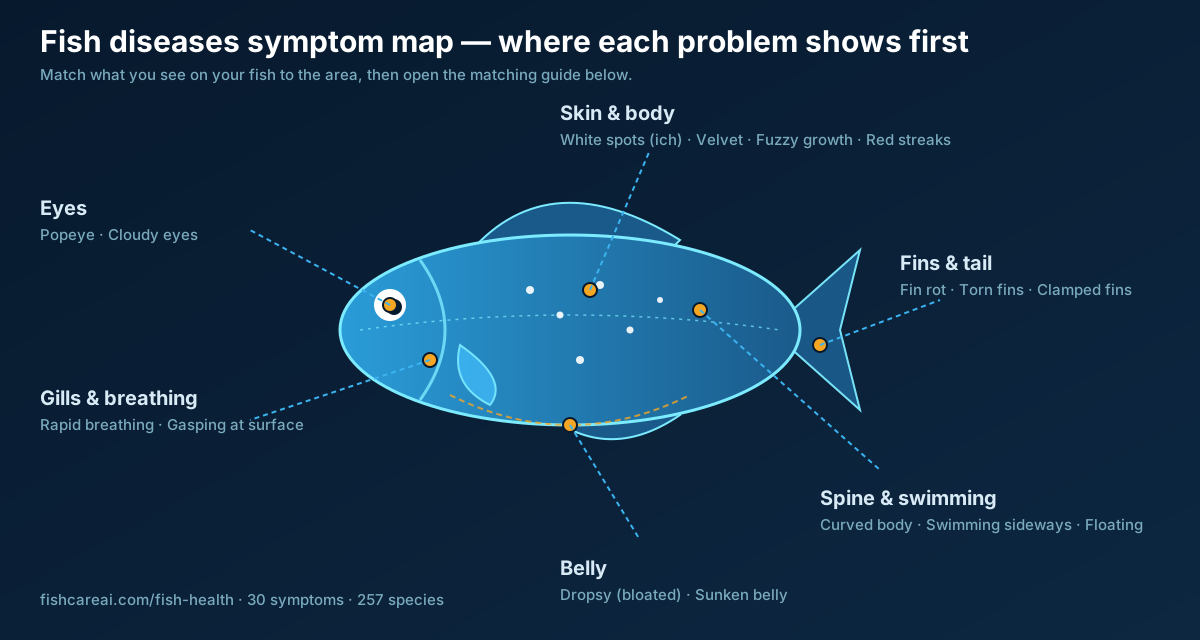
Fish Diseases by Symptom
The badge on each card is how fast to act. Monitor means watch for 24–48 hours while you correct the water; Urgent means isolate and start treatment today; Emergency means the fish can die within hours without an immediate water change or extra oxygen. The guide links open the page for three of the most-kept species — use the species search further down for any other fish.
Behavioral Signs of Fish Disease
A change in how a fish acts — hiding, hovering at the surface, darting, refusing food or picking fights — is usually the first warning, and it often shows up a day or two before any physical symptom. Most behavior changes trace back to water quality, temperature or tank mates rather than a pathogen, so test the water before you reach for medication.
Fish repeatedly spits out food or makes gulping motions without eating.
Guides: Betta Fish · Goldfish · Guppy
Fish darts erratically or rubs its body against surfaces (flashing), suggesting external irritants.
Guides: Betta Fish · Goldfish · Guppy
Fish repeatedly gulps at the water surface, indicating oxygen deprivation or gill damage.
Guides: Betta Fish · Goldfish · Guppy
Fish spends unusually long periods concealed behind decor, plants, or substrate.
Guides: Betta Fish · Goldfish · Guppy
Fish repeatedly leaps toward the surface or out of an open tank.
Guides: Betta Fish · Goldfish · Guppy
Fish moves little or not at all, resting on the substrate or floating listlessly.
Guides: Betta Fish · Goldfish · Guppy
Fish refuses food for one or more days, ignoring offerings it normally accepts.
Guides: Betta Fish · Goldfish · Guppy
Gills moving much faster than normal; visible labored respiration.
Guides: Betta Fish · Goldfish · Guppy
Fish scratches itself on rocks, gravel, or decor repeatedly.
Guides: Betta Fish · Goldfish · Guppy
Fish attacks tank mates or owner's hand when previously calm, chasing or nipping.
Guides: Betta Fish · Goldfish · Guppy
Physical Signs of Fish Disease
Visible changes to the body or fins — fading colour, swelling, clamped or torn fins, a curved spine, trouble staying upright — narrow the diagnosis fast because each one has a short list of likely causes. These symptoms can be early signs of fish diseases or the result of injury, diet or poor water; the guides work through that list from most to least likely.
Fish abdomen appears abnormally distended; scales may protrude outward (pinecone effect).
Guides: Betta Fish · Goldfish · Guppy
Fins are held tightly against the body instead of fanned out normally.
Guides: Betta Fish · Goldfish · Guppy
Fish spine appears bent, curved, or the body curls unnaturally.
Guides: Betta Fish · Goldfish · Guppy
Fish floats involuntarily at the surface, unable to descend normally.
Guides: Betta Fish · Goldfish · Guppy
Fish appears noticeably paler or less vibrant than usual.
Guides: Betta Fish · Goldfish · Guppy
Patches of scales are absent, exposing bare skin.
Guides: Betta Fish · Goldfish · Guppy
Fish color is washed out or significantly lighter than when healthy.
Guides: Betta Fish · Goldfish · Guppy
Fish sinks involuntarily and rests on the substrate, unable to rise.
Guides: Betta Fish · Goldfish · Guppy
Fish appears severely thin with a concave abdomen despite regular feeding.
Guides: Betta Fish · Goldfish · Guppy
Fish tilts or rolls on its side while swimming, cannot maintain upright orientation.
Guides: Betta Fish · Goldfish · Guppy
Fin edges appear shredded, torn, or uneven without obvious injury.
Guides: Betta Fish · Goldfish · Guppy
Infectious Fish Diseases
Parasites, bacteria, fungi and viruses each leave a recognisable signature: white salt-grain spots, red streaks, cotton-like growth, rot at the fin edges, bulging or cloudy eyes. These are the classic fish diseases hobbyists ask about most, and every one of them spreads through a tank if it is not treated, so isolate the fish while you read the guide.
Dark or black patches appearing on the body, fins, or skin.
Guides: Betta Fish · Goldfish · Guppy
One or both eyes protrude dramatically from their sockets.
Guides: Betta Fish · Goldfish · Guppy
Eyes appear opaque, milky, or covered in a white film.
Guides: Betta Fish · Goldfish · Guppy
Fish body coated in thick, slimy, or whitish mucus layer beyond normal slime coat.
Guides: Betta Fish · Goldfish · Guppy
Fin edges deteriorate progressively, often with a discolored or ragged border.
Guides: Betta Fish · Goldfish · Guppy
Cotton-like white or grey fungal growth on body, mouth, or fins.
Guides: Betta Fish · Goldfish · Guppy
Hemorrhagic red streaks or blotches visible under skin or on fins.
Guides: Betta Fish · Goldfish · Guppy
Pin-point or larger spots, velvet dust, or discoloration appearing on fin tissue.
Guides: Betta Fish · Goldfish · Guppy
Small white salt-grain-like spots covering the body and fins — classic sign of Ichthyophthirius multifiliis.
Guides: Betta Fish · Goldfish · Guppy
Common Fish Diseases Explained
These eight conditions cover the large majority of sick-fish cases in home aquariums. Each entry gives the signs to look for, what actually causes it, and the treatment that works — then points you to the symptom card so you can open a guide for your own species.
White Spot Disease (Ich)
Signs: Tiny white dots like grains of salt on the body and fins, flashing against objects, clamped fins and rapid breathing as the parasite reaches the gills.
Cause: The ciliate parasite Ichthyophthirius multifiliis, almost always brought in on a new fish or plant and triggered by a temperature drop or stress.
Treatment: Raise the temperature gradually to 28–30 °C (82–86 °F) to speed up the parasite's life cycle, add aquarium salt or a malachite-green/formalin medication, and keep treating for at least a week after the last spot disappears — the free-swimming stage is the only one medication can reach. Species guides for white spots (ich) →
Fin Rot in Fish
Signs: Fin edges turn milky, ragged or black and recede toward the body; in advanced cases the base of the fin reddens and the rot reaches the body.
Cause: Opportunistic bacteria (Aeromonas, Pseudomonas, Flavobacterium) that take hold when ammonia, nitrite or nitrate is high, or after fin-nipping from tank mates.
Treatment: Test the water and do a 30–50 % water change first — mild fin rot heals on clean water alone. Persistent cases need a broad-spectrum antibacterial in a hospital tank, and the nipping tank mate has to go. Species guides for fin rot →
Fungal Fish Diseases (Saprolegnia)
Signs: Cotton-wool tufts, white or grey, on the body, mouth or fins, usually growing over an existing wound or patch of missing scales.
Cause: Water moulds that are always present in the tank and only colonise damaged tissue — so a fungal outbreak means something injured or weakened the fish first.
Treatment: Move the fish to a hospital tank, treat with an antifungal (methylene blue or a malachite-green product) and fix the original injury or water problem. Cotton-mouth that does not respond is usually columnaris, a bacterium, and needs an antibacterial instead. Species guides for fuzzy white growth →
Dropsy in Fish
Signs: A swollen abdomen with scales standing out like a pinecone, often with bulging eyes, pale gills and lethargy.
Cause: Not one disease but a symptom of internal organ failure, most often a bacterial infection of the kidneys after long-term poor water quality or an internal parasite load.
Treatment: Isolate immediately, add Epsom salt (1 tsp per 5 gallons) to draw off fluid, keep the water pristine and try a medicated food or antibacterial. Once the pinecone effect is obvious the prognosis is poor, so this is a disease to prevent rather than cure. Species guides for bloated or swollen →
Velvet Disease (Oodinium)
Signs: A gold or rust-coloured dust over the body and fins that is easiest to see with a torch in a dark room; fish flash, clamp their fins and breathe hard.
Cause: The dinoflagellate parasite Oodinium (Piscinoodinium in freshwater, Amyloodinium in marine tanks). It spreads faster than ich and kills small fish quickly.
Treatment: Dim the tank — the parasite photosynthesises — raise the temperature, and treat with copper or a malachite-green/acriflavine medication for the full course. Remove carbon from the filter while medicating. Species guides for spots on fins →
Popeye in Fish
Signs: One or both eyes swell outward from the socket; the eye may cloud over and the fish stops eating.
Cause: One bulging eye is usually an injury; both eyes point to a systemic bacterial infection or poor water quality, and it is a common companion of dropsy.
Treatment: Clean water and Epsom salt resolve most injury cases in a week or two. Bilateral popeye needs an antibacterial in a hospital tank and a hard look at nitrate levels. Species guides for bulging eyes (popeye) →
Swim Bladder Disease
Signs: The fish floats at the surface, sinks to the bottom or swims sideways and cannot hold a normal position, but otherwise looks alert.
Cause: Usually constipation or gulped air from overfeeding dry food, especially in round-bodied goldfish and bettas; less often an infection, injury or a birth defect.
Treatment: Fast the fish for two or three days, then feed a shelled, blanched pea or daphnia to clear the gut, and soak dry food before feeding from then on. If a fast does not help within a week, treat as a bacterial infection. Species guides for swimming sideways →
Columnaris Disease in Fish
Signs: A white or grey saddle-shaped patch across the back, fuzzy lips, excess slime coat, frayed fins and rapid gill movement — it looks like fungus but moves much faster.
Cause: The bacterium Flavobacterium columnare, which thrives in warm, hard water with a high organic load and attacks stressed or overcrowded fish.
Treatment: Lower the temperature a few degrees if the species allows, do large water changes and treat with an antibacterial that targets gram-negative bacteria (nitrofurazone, kanamycin) in a hospital tank. Fast-moving cases can kill within 48 hours, so start the same day. Species guides for excess mucus coating →
How to Diagnose Fish Diseases
Nine out of ten fish diseases are either caused or made worse by the water, so the diagnosis always starts there. Work through these steps in order before you medicate — treating a water problem with antibiotics wastes the medication and stresses the fish further.
- Test the water. Ammonia and nitrite should be 0 ppm, nitrate under 20–40 ppm, and pH and temperature inside the range for your species. Run your readings through the water parameter checker to see which value is out of range.
- Look at the whole tank. One sick fish points to injury, bullying or an individual weakness; several fish with the same sign points to water quality or a contagious disease. Check whether anything was added in the last two weeks — a new fish, plant or decoration is the usual route in for parasites.
- Match the symptom. Find the card above that best describes what you see. If the fish shows several signs, start with the most specific one — white spots beat “lethargic”, red streaks beat “hiding” — because the specific sign has fewer possible causes.
- Open the guide for your species. Causes are ranked differently for different fish: swim bladder trouble is almost always diet in a fancy goldfish but usually water in a tetra. The species guide lists the causes in the right order for that fish and gives the diagnosis checks for each.
- Isolate before you treat. A bare hospital tank with a heater, a sponge filter and daily water changes lets you dose accurately, protects the main tank's biofilter and plants from the medication, and stops an infectious disease reaching the other fish.
What Causes Fish Diseases
Almost every pathogen behind the common fish diseases is already in the tank, on the fish or in the tap water. Healthy fish with an intact slime coat and a working immune system shrug them off; disease breaks out when something weakens the fish. In practice that something is nearly always one of five things:
- Poor water quality. Ammonia and nitrite burn gills and skin, chronic nitrate suppresses the immune system, and both invite bacterial fish diseases such as fin rot, columnaris and dropsy. Weekly water changes and a cycled filter prevent more disease than any medication.
- New arrivals without quarantine. Ich, velvet, flukes and internal worms arrive on new fish and plants. Two to four weeks in a quarantine tank catches almost all of them before they reach the display tank.
- Stress from stocking and tank mates. An overstocked tank, an aggressive tank mate or a shoaling species kept alone keeps stress hormones high and the immune system low. The fish compatibility checker and tank size calculator flag both problems before they cause disease.
- Temperature swings. A heater failure or a cold water change is the classic trigger for an ich outbreak, and a tank that runs too warm for the species breeds columnaris. Keep a thermometer where you can see it every day.
- Diet. Overfeeding fouls the water and causes bloat and swim bladder trouble; a diet of one dry food for months causes deficiencies that show as faded colour and a sunken belly. The fish feeding calculator gives a portion size for your stocking.
Treating Fish Diseases
Fish diseases fall into four treatment groups, and using the right group matters more than the brand on the bottle. External parasites (ich, velvet, flukes) respond to heat, salt and malachite green, formalin or copper. Bacterial infections (fin rot, columnaris, red streaks, popeye, dropsy) need an antibacterial — nitrofurazone, kanamycin or erythromycin depending on whether the bacterium is gram-negative or gram-positive. Fungus responds to methylene blue or malachite green. Internal parasites (worms, hexamita) need medicated food containing praziquantel, levamisole or metronidazole.
Whatever you use: remove activated carbon from the filter so it does not strip the medication, dose for the actual water volume rather than the tank's nominal size, run the full course even after the fish looks better, and add an airstone because most medications lower dissolved oxygen. If two courses of the correct medication do not help, or the fish is a valuable specimen, an aquatic veterinarian can take a skin scrape or gill biopsy and identify the pathogen under a microscope — the Merck Veterinary Manual's aquarium fish chapter and the University of Florida's Introduction to Fish Health Management are the references most fish vets work from.
Preventing Fish Diseases
Prevention is cheaper and far more reliable than treatment, and it comes down to a short routine: a 25–30 % water change every week with dechlorinated water at tank temperature; a filter that is rinsed in old tank water rather than replaced; feeding only what the fish finish in two minutes, with one fasting day a week; quarantine for every new fish and plant; and a compatible, correctly sized community planned with the aquarium planner before the fish are bought. Watch the fish for a minute at every feeding — the behavioral signs at the top of this page are the earliest warning you will get, and fish diseases caught at that stage almost always recover.
Fish Diseases by Species
Every species page lists all 30 symptom guides for that fish — the same fish diseases, with the causes, medication tolerances and water ranges adjusted for that species. Search by common or scientific name.
Fish Diseases FAQ
What are the most common fish diseases in aquariums?
White spot disease (ich), fin rot, fungal infections, velvet, dropsy, popeye, columnaris and swim bladder disorder account for the large majority of cases hobbyists see. Ich and fin rot alone are behind most of the questions submitted to the FishCare AI symptom checker.
Is my fish sick or just stressed?
Stress shows as behaviour — hiding, clamped fins, faded colour, refusing food — with nothing visibly growing on the fish, and it improves within a day or two of fixing the cause. Fish diseases add physical signs that get worse over time: spots, fuzz, rot, swelling or red streaks. Test the water first; if it is fine and the sign is spreading, treat it as disease.
Can fish diseases spread to other fish in the tank?
Most infectious fish diseases — ich, velvet, columnaris, fin rot bacteria, fungus — spread through the water and will reach every fish in the tank. Move the sick fish to a hospital tank as soon as you spot a symptom, and treat the main tank too if the disease is parasitic.
Can aquarium fish diseases infect humans?
Very few. Fish tuberculosis (Mycobacterium marinum) can cause a skin infection through a cut on your hand, and Aeromonas can infect open wounds. Wear gloves if you have a cut, wash your hands after tank work, and never start a siphon with your mouth.
How long do fish diseases take to cure?
Mild fin rot and stress-related symptoms clear within a week of clean water. Ich needs 10–14 days of treatment to cover the parasite's full life cycle. Bacterial infections typically need a 5–10 day course of medication. Dropsy and advanced columnaris are often fatal even when treated, which is why prevention matters more than any medicine.
Which fish diseases does aquarium salt treat?
Salt at 1–3 teaspoons per gallon helps with ich, mild fungus, fin rot and external parasites, and Epsom salt helps with dropsy, popeye and constipation. Salt does not treat internal bacterial infections, and scaleless fish such as corydoras, loaches and plecos tolerate it poorly — use half strength or a medication instead.
🤖 Use the AI Fish Disease Symptom Checker
Not sure which fish disease you are looking at? Describe your fish's symptoms to FishCare AI and get an instant, species-specific diagnosis with treatment steps.
Open Symptom Checker →