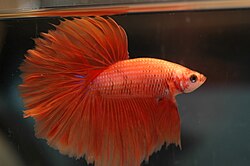
Of all the common aquarium fish, the betta is the one most often found on the floor, and its biology explains why. Wild Betta splendens live in small, shallow bodies of water — paddy fields, ponds, marshes and lagoons in central Thailand[1] — typically slow-flowing and densely vegetated.[3] Like all anabantoids, bettas have a labyrinth organ above the gills that lets them breathe air from the surface,[2] so they spend much of their time in the top few centimetres of water. A fish that lives, breathes and hunts at the surface is always one tail flick from leaving it.
Being a natural surface dweller explains why bettas get out; it does not mean nothing is wrong. A betta that jumps again and again is usually reacting to something in its tank — the current, the temperature, the water, or simply a small, bare container. The causes below are ordered by how often they lie behind a jumping betta, followed by checks, fixes, and what to do if you find your betta outside the tank.
Why Is My Betta Jumping? The Common Causes
An Uncovered Tank and a Surface-Living Fish
Most LikelyBettas breathe air as well as using their gills: the labyrinth organ is a folded, blood-rich chamber above the gills that extracts oxygen from gulps of air, and it shapes almost everything bettas do, from territorial displays to bubble-nest building.[2] In practice this means a betta patrols the surface constantly, rising to breathe, to inspect anything that moves above the water, and to take food. Keepers widely describe bettas as jumpers, and many online accounts of betta deaths begin with an open bowl or a gap left for a filter or feeding. You may also read that bettas evolved to jump between puddles; we could not find a study that shows this, so treat it as folklore rather than fact.
What is well established is that a surface-dwelling fish, an open top and water filled close to the rim add up to a real risk. Even a healthy, content betta can leap at a shadow, a hand over the tank or a floating piece of food. That is why a lid comes first on this page, before any diagnosis.
Too Much Current for a Long-Finned Fish
Most LikelyWild bettas come from slow-flowing, shallow, heavily planted water.[3] Most aquarium bettas have been bred for long, heavy fins that make swimming against a current hard work. A filter rated for a much bigger tank, or one whose outlet churns the surface, pushes the betta around the tank and makes it difficult for it to hold a position at the surface to breathe. Bettas in strong flow often wedge themselves in corners, hide behind the heater, or hang at the surface in the one calm spot — and jump from there.
This cause is likely if the betta is new to a filtered tank, if its fins are blown sideways by the flow, or if it spends its time in one corner near the top. Slowing the flow usually changes its behaviour within a day.
Water Quality and Temperature in a Small Tank
Most LikelyBettas are often sold for small, unfiltered, unheated bowls and vases. In those, waste accumulates quickly. UF/IFAS advises that ammonia should always read zero in a healthy tank, and that even low levels damage the gills and make fish more vulnerable to infection.[5] Bettas turn out to be remarkably tolerant of acute ammonia and nitrite poisoning: in one laboratory study, the 96-hour lethal concentrations were far above the range generally reported for freshwater fish, in line with other air-breathing species.[4] That tolerance is why bettas survive in dirty water for weeks — not evidence that dirty water is harmless. Chronic exposure still stresses and damages tissue.[5]
Temperature matters too. Bettas are tropical fish, comfortable at about 24–28 °C, and an unheated bowl in a cool room can sit well below that. The Merck Veterinary Manual stresses that in fish, all physiological processes are greatly influenced by water temperature, and describes "old tank syndrome" in containers where water is rarely changed.[6] A betta that is sluggish, pale, clamped and occasionally leaps from a small bowl is usually telling you about its water.
A Small, Bare Container
PossibleA 2024 study compared bettas kept in a 1.5-litre jar, a mid-sized tank and a 19.3-litre tank, bare or furnished. In the large tank the fish were significantly more active and spent less time resting and performing abnormal behaviours — hovering and stereotyped pacing — than in the smaller containers; barren tanks also produced more pacing and wall interactions than furnished ones.[3] Fish in the study spent almost half their resting time on or against plants and hideouts.[3]
The study did not measure jumping, so it cannot say that small jars cause it. But it shows clearly that a betta in a small, bare container is under stress, and stressed fish in cramped containers are the ones owners most often find on the floor. More space, live or silk plants and a leaf to rest on near the surface all help.
Feeding, Hunting and Excitement
PossibleBettas feed readily at the surface and quickly learn that food arrives from above. A fish veterinarian lists feeding excitement as one of the normal reasons fish jump,[8] and many bettas will leap at a finger, a feeding tongs or a shadow. This is healthy behaviour, but it is also how bettas escape through open feeding holes.
Parasites and Skin Irritation
Less CommonParasites on the skin and gills make fish itchy; affected fish rub against objects ("flashing"), lose their appetite and may gasp at the surface.[7] A fish vet notes that fish sometimes use the water surface to scratch, and that repeated jumping with flashing can indicate parasites.[8] Look for fine gold or white dusting, white spots, clamped fins or rubbing.
How to Tell Why Your Betta Is Jumping
Go through these in order today. The answer is usually visible within ten minutes.
-
Check the top of the tank
Is there a lid? Are there gaps for the filter, heater cable or feeding? How close to the rim is the water? An open top or a gap of a few centimetres is enough for a betta, because it spends so much time at the surface breathing air.[2]
-
Watch how the betta swims against the flow
With the filter running, watch the fins. If they are pushed sideways, if the betta struggles to hold its place at the surface, or if it hides in the one calm corner, the current is too strong for a fish from slow-flowing water.[3]
-
Measure the temperature
Bettas are tropical fish and do best at about 24–28 °C. An unheated bowl in a cool room is a common finding. Temperature changes how every system in a fish works,[6] so a cold betta is a stressed betta.
Recommended: Aquarium thermometer -
Test ammonia, nitrite and nitrate
Ammonia and nitrite should both read zero.[5] In a small unfiltered bowl they rarely do unless the water is changed very often. Remember that a betta's high tolerance for ammonia[4] means it can look fairly normal while the water is poor.
Recommended: Liquid water test kit -
Look at the body and fins
Flashing, a fine gold or white dust on the body, white spots or clamped fins point to parasites or irritation.[7] Torn fins or missing scales may be from a previous jump or from sharp decorations.
How to Stop a Betta From Jumping
-
Fit a lid — with an air gap
Use a fitted lid, a sheet of glass or acrylic, or fine mesh, and close the gaps around cables and feeding holes. Leave a few centimetres of air between the water and the lid, and lower the water level slightly if needed: bettas breathe from the surface,[2] and a lid sitting on the water would block it. A fish vet recommends a lid for any tank where fish jump.[8]
-
Tame the current
Choose a filter with adjustable flow, turn it down, or baffle the outlet with a sponge so the surface is barely rippling. Add tall plants to break up the flow. The aim is to mimic the slow, vegetated water bettas come from.[3]
-
Heat and clean the water
Add an adjustable heater to hold 24–28 °C. If ammonia or nitrite shows, reduce feeding and change 25–50% of the water with dechlorinated water at the same temperature, as UF/IFAS recommends, until both read zero.[5] Small containers need frequent changes; a filtered, heated tank is far easier to keep stable.[6]
-
Give the betta space and somewhere to rest
Move the betta from a jar or vase into a larger tank with plants and hiding places. In a controlled study, bettas in the larger, furnished tank were more active and showed fewer abnormal behaviours than those in small or bare containers.[3] A broad leaf or a floating "betta hammock" near the surface gives it a place to rest where it can breathe.
Preventing a Betta From Jumping
When a Jumping Betta Needs Urgent Help
🔬 AI Symptom Checker
Not sure what's wrong? Describe your fish's symptoms to the FishCare AI symptom checker for a second opinion before you treat.
Check Symptoms →Frequently Asked Questions
Why did my betta jump out of its tank?
How long can a betta survive out of water?
My betta jumped out and is lying at the bottom — will it live?
Should a betta tank have a lid?
Is my betta jumping because the filter is too strong?
Do bettas jump because they are happy?
This guide was researched against the veterinary and scientific sources listed below and reviewed for biological accuracy. Test water parameters before treating a sick fish, and consult an aquatic veterinarian if symptoms persist after 48 hours of correct treatment.
References
- Monvises, A., Nuangsaeng, B., Sriwattanarothai, N. & Panijpan, B. (2009). The Siamese fighting fish: Well-known generally but little-known scientifically. ScienceAsia 35(1): 8–16. doi:10.2306/scienceasia1513-1874.2009.35.008
- Tate, M., McGoran, R.E., White, C.R. & Portugal, S.J. (2017). Life in a bubble: the role of the labyrinth organ in determining territory, mating and aggressive behaviours in anabantoids. Journal of Fish Biology 91(3): 723–749. doi:10.1111/jfb.13357
- Clark-Shen, N., Tariel-Adam, J., Gajanur, A. & Brown, C. (2024). Life beyond a jar: Effects of tank size and furnishings on the behaviour and welfare of Siamese fighting fish (Betta splendens). Animal Welfare 33: e62. doi:10.1017/awf.2024.67
- Kajimura, M., Takimoto, K. & Takimoto, A. (2023). Acute toxicity of ammonia and nitrite to Siamese fighting fish (Betta splendens). BMC Zoology 8: 25. doi:10.1186/s40850-023-00188-3
- Francis-Floyd, R., Watson, C., Petty, D. & Pouder, D.B. Ammonia in Aquatic Systems. UF/IFAS Extension, FA16 (FA031). ask.ifas.ufl.edu
- Merck Veterinary Manual. Management of Aquarium Fish. Merck & Co., Inc. merckvetmanual.com
- Merck Veterinary Manual. Disorders and Diseases of Fish. Merck & Co., Inc. merckvetmanual.com
- Sanders, J. (2020). Why Do Fish Jump? Aquatic Veterinary Services, October 6, 2020. cafishvet.com
- Cook, K.V., Lennox, R.J., Hinch, S.G. & Cooke, S.J. (2015). Fish Out of Water: How Much Air Is Too Much? Fisheries 40(9): 452–461. doi:10.1080/03632415.2015.1074570
- Merck Veterinary Manual. Bacterial Diseases of Fish. Merck & Co., Inc. merckvetmanual.com