Is Your Aquarium Water Safe? Check All 6 Parameters at Once.
Enter your test kit readings, get an instant weighted health score from 0–100, and receive parameter-specific advice for safer, healthier fish keeping.
Check My Water NowEnter Your Water Test Results
Move each slider to your measured value, then click Analyze. Readings at their default starting positions represent typical safe values.
💧 Water Parameters
📊 Results
Set your values and click
Analyze Water Quality
How the Water Parameter Checker Works
Test Your Water
Use a liquid test kit, test strips, or a digital meter to measure pH, ammonia, nitrite, nitrate, temperature, and hardness in your aquarium.
Enter the Readings
Move each slider to match your reading. The number input next to each slider lets you type a precise value. All six parameters update in real time.
Read Your Score
Click Analyze Water Quality to see your 0–100 weighted health score, a color-coded badge for each parameter, and targeted tips for anything that needs attention.
Understanding Your Water Quality Score
All parameters are within ideal ranges. Your water is in great condition for healthy, thriving fish.
Conditions are safe and stable. Minor parameters are slightly off but pose no immediate risk with routine maintenance.
One or more parameters need attention. Take corrective action soon to prevent fish stress or illness.
Critical parameter(s) detected. Act now — perform a partial water change and follow the tips shown for each danger reading.
Everything About Aquarium Water Parameters
Learn what each measurement means, how to test accurately, and how to fix the most common water quality problems.
🔬 What Is an Aquarium Water Parameter Checker?
An aquarium water parameter checker is a tool that evaluates the key chemical and physical properties of your tank water to tell you whether conditions are safe for fish. Unlike a raw test kit reading, this checker combines all six measurements into a single weighted health score from 0 to 100, making it easy to see the overall picture at a glance.
The scoring system weights parameters by their danger potential. Ammonia and nitrite — the two most acutely toxic compounds — carry the highest weights. A single dangerous ammonia or nitrite reading caps the overall score to reflect the urgency, even if all other parameters are perfect. pH, nitrate, temperature, and hardness carry lower weights because fish can typically tolerate moderate deviations in those values longer than they can tolerate toxic nitrogen compounds.
The result is a practical, actionable snapshot: green badges confirm what is working, amber badges identify gradual issues, and red badges flag emergencies requiring immediate response.
📋 The 6 Key Aquarium Water Parameters
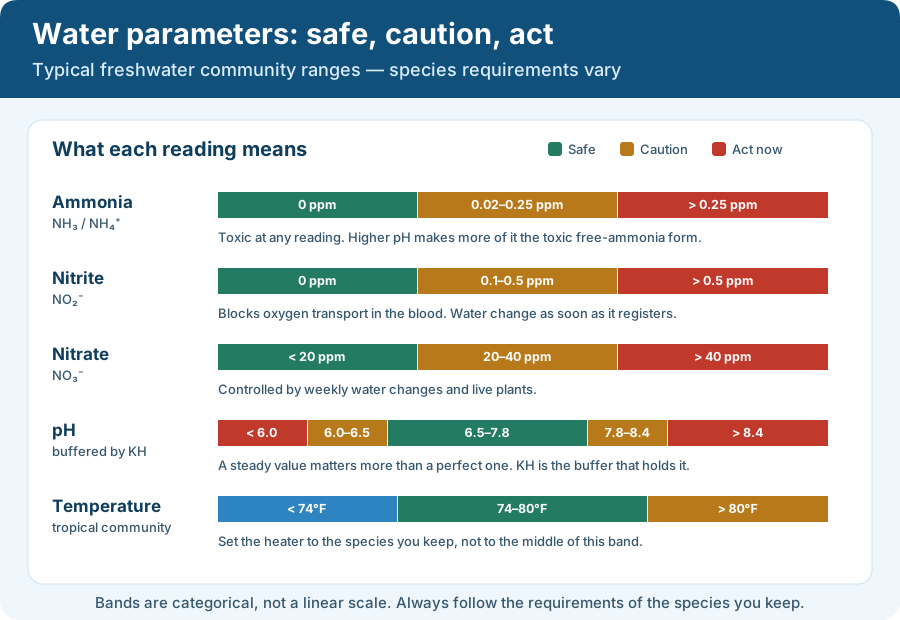
- pH — measures how acidic or alkaline your water is on a 0–14 scale. Most tropical community fish prefer 6.5–7.5. Sudden pH swings are more dangerous than a stable, slightly imperfect number.
- Ammonia (NH₃/NH₄) — the most critical parameter. Any ammonia above 0 ppm is harmful. It is produced by fish waste and uneaten food, and must be processed by beneficial bacteria in a cycled filter.
- Nitrite (NO₂) — the intermediate product of the nitrogen cycle. Like ammonia, the target is 0 ppm. Nitrite interferes with the ability of fish blood to carry oxygen.
- Nitrate (NO₃) — the end product of the nitrogen cycle, far less toxic but still harmful at high levels. Keep below 20 ppm for sensitive species, below 40 ppm for hardy community fish.
- Temperature — most tropical fish thrive between 72–82 °F. Rapid temperature swings stress the immune system and can trigger disease outbreaks even within a safe range.
- Hardness (GH) — total dissolved minerals, measured in dGH. Most community freshwater fish tolerate 4–12 dGH. Soft-water species like discus prefer lower values; livebearers prefer higher values.
🧪 How to Test Aquarium Water at Home
The three most common testing methods each have trade-offs:
- Liquid test kits (such as the API Master Test Kit) are the gold standard for accuracy. You add drops of reagent to a water sample, wait a few minutes, and compare the color against a reference chart. They are the most reliable way to measure ammonia and nitrite.
- Test strips are fast and convenient but less accurate, especially at low readings. They are useful for a quick check but should not replace liquid tests for critical parameters like ammonia.
- Digital meters and probes offer precise readings for pH and temperature and are easy to use, but require calibration and only cover one or two parameters per device. Good digital pH pens cost $20–$60 and are well worth the investment for planted tanks or fish that require stable pH.
For best results, test water from the middle of the tank, not near a filter outlet or heater. Rinse the test tube or cell with tank water before taking the sample.
📊 Understanding Your Water Quality Score
The aquarium water parameter checker uses a weighted scoring model to calculate your result. Each parameter contributes to a total out of 100 points, but not equally:
- A parameter in the safe range scores 100 points × its weight.
- A parameter in the warning range scores 45 points × its weight.
- A parameter in the danger range scores 15 points × its weight.
- A parameter in the critical range — pH below 5.5 or above 9.5, nitrate above 80 ppm, temperature below 64 °F or above 90 °F, GH below 1 or above 25 dGH, ammonia above 1.5 ppm, nitrite above 1 ppm — scores 0.
Danger readings also cap the overall grade, so a single lethal value can never hide behind five good ones. Any warning caps the score at 85, so a tank with a warning is never rated Excellent. Any danger reading caps it at 60, and any critical reading caps it at 40 — a red "Poor — Act Now" result. The badge beside the score tells you how many parameters are involved.
Ammonia and nitrite carry the highest weight (3×) and their own tighter caps: warning-level caps the score at 75, danger at 45, critical at 30. This ensures the score always reflects what matters most — toxic nitrogen compounds are a medical emergency for fish, not a minor inconvenience.
A score of 90+ means excellent conditions. 70–89 means good, stable water with minor room to improve. 50–69 means at least one parameter needs correction soon. Below 50 means act immediately.
📅 How Often Should You Check Water Parameters?
The right testing frequency depends on where your tank is in its lifecycle:
- New tank (cycling phase, 0–8 weeks) — test ammonia, nitrite, and nitrate every 2–3 days. You need to track the nitrogen cycle's progress and catch ammonia spikes before they harm fish.
- Established tank (first 6 months) — test all parameters weekly. Even stable tanks can drift as stocking, feeding, and plant growth change the biological load.
- Mature, stable tank — monthly testing is sufficient once you have several months of stable readings and a well-understood maintenance routine.
- Emergency testing — test immediately if fish are gasping at the surface, sitting at the bottom lethargically, showing clamped fins, or dying unexpectedly. Always test before and after treating a disease.
Keep a simple log of your readings with dates. Spotting a gradual nitrate climb or a slow pH drift is much easier when you have previous numbers to compare against.
🛠 Fixing Common Water Problems
- Ammonia spike — stop feeding for 24–48 hours, perform a 30–50% water change with dechlorinated water at the same temperature, dose a water conditioner that detoxifies ammonia (such as Prime), and add beneficial bacteria from a cycled filter if possible. Retest after 24 hours.
- pH swings — identify and fix the root cause before adjusting. Common causes include CO₂ fluctuations (planted tanks), low carbonate hardness (KH) as a pH buffer, or the use of peat or driftwood. Never dose pH chemicals without understanding why pH is drifting.
- Nitrate buildup — increase water change frequency and volume, reduce feeding, remove decaying plant matter, and consider adding fast-growing plants like hornwort or water lettuce. Overstocking is the most common root cause of chronic high nitrate.
- Temperature fluctuation — check your heater for malfunction and add a second heater as a backup. Keep the tank away from drafts, air conditioners, and windows with direct sunlight. A quality thermometer with a minimum/maximum reading function reveals overnight swings that are invisible to spot checks.
Frequently Asked Questions
Related Guides & Tools
Explore more resources to help you maintain a healthy, thriving aquarium.