Good angelfish care starts with the tank: freshwater angelfish need a tall, fully cycled 30-gallon tank for an adult pair, 76–84°F water, peaceful tank mates too large to swallow, and two small meals daily. Because Pterophyllum scalare are cichlids, their tank setup must also provide vertical plants or driftwood and enough room for territorial behavior when a pair forms.
Angel Fish Care: Quick Answers
- Tank: Use a tall freshwater angelfish tank of at least 30 gallons for an adult pair; a group needs 55 gallons or more.
- Water: Keep temperature at 76–84°F (24–29°C), pH around 6.5–7.5, ammonia and nitrite at 0 ppm, and nitrate below 20 ppm.
- Diet: Angelfish food should combine quality cichlid pellets or flakes with bloodworms, brine shrimp, daphnia, and occasional vegetable matter.
- Size: A full grown angelfish reaches about 6 inches in body length and 10–12 inches from the top fin to the bottom fin.
- Personality: These angel cichlids are intelligent and interactive, but can become territorial when a pair forms or begins spawning.
- Origin: Wild angelfish come from warm, slow-moving, plant-rich tributaries of the Amazon and Orinoco river systems.
- Key tip: Avoid very small fish and fin-nippers; adult angelfish may eat fish that fit in their mouth.
Freshwater Angelfish Tank Setup and Angelfish Tips
Angel fish, more commonly written as angelfish, are freshwater cichlids in the genus Pterophyllum. Good angel fish care starts with a cycled, tall aquarium rather than a small temporary tank. Leave open swimming space in the center, use broad-leaf plants or vertical driftwood for shelter, and choose gentle filtration that maintains oxygen without creating a powerful current. These angelfish tips are especially important for small angelfish, which grow faster than many new keepers expect.
Keep this page as a practical reference for angel fish diet, angelfish diet, angelfish food, angelfish personality, and angelfish water parameters. If you are learning how to take care of an angel fish or how to take care of an angelfish for the first time, make stability the priority: test the water regularly, feed lightly, and change water on a consistent schedule. Veil angelfish care needs the same chemistry, but extra attention to long fins, gentle flow, and peaceful tank mates.
Angelfish Care at a Glance
| Parameter | Recommended Range |
|---|---|
| Scientific Name | Pterophyllum scalare |
| Tank Size | 30 gallons minimum; 55+ for a group |
| Tank Height | At least 18 inches tall (taller is better) |
| Water Temperature | 76–84°F (24–29°C) |
| pH | 6.5–7.5 |
| Water Hardness | 3–8 dGH (soft to moderately soft) |
| Ammonia / Nitrite | 0 ppm |
| Nitrate | Under 20 ppm |
| Adult Size | 6 inches body length; 10–12 inches fin-to-fin |
| Lifespan | 10–15 years |
Angelfish Varieties
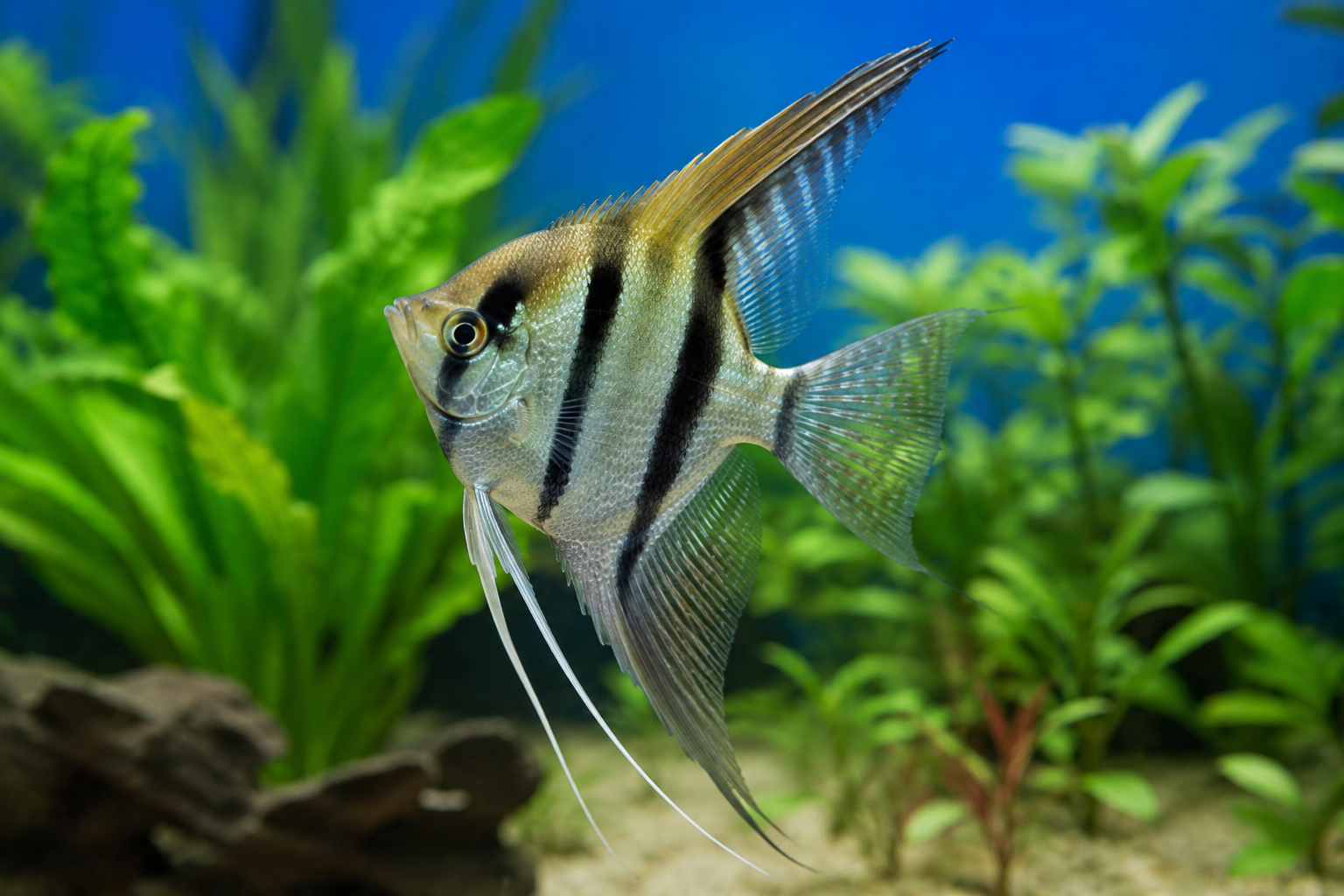
Wild angelfish (Pterophyllum scalare) are silver with black vertical stripes. Decades of captive breeding have produced dozens of color and fin variants.
Silver Angelfish: The classic variety. Silver body with three bold black vertical bars. Hardy and close to the wild type.
Marble Angelfish: Irregular black and white marbling pattern on a silver base. One of the most popular varieties in the hobby.
Gold Angelfish: Deep yellow to orange-gold body with minimal black patterning. Striking in a dark-substrate tank.
Black Angelfish: Deep black body. Full black varieties are less stable genetically than other morphs and require high-quality water to maintain coloration.
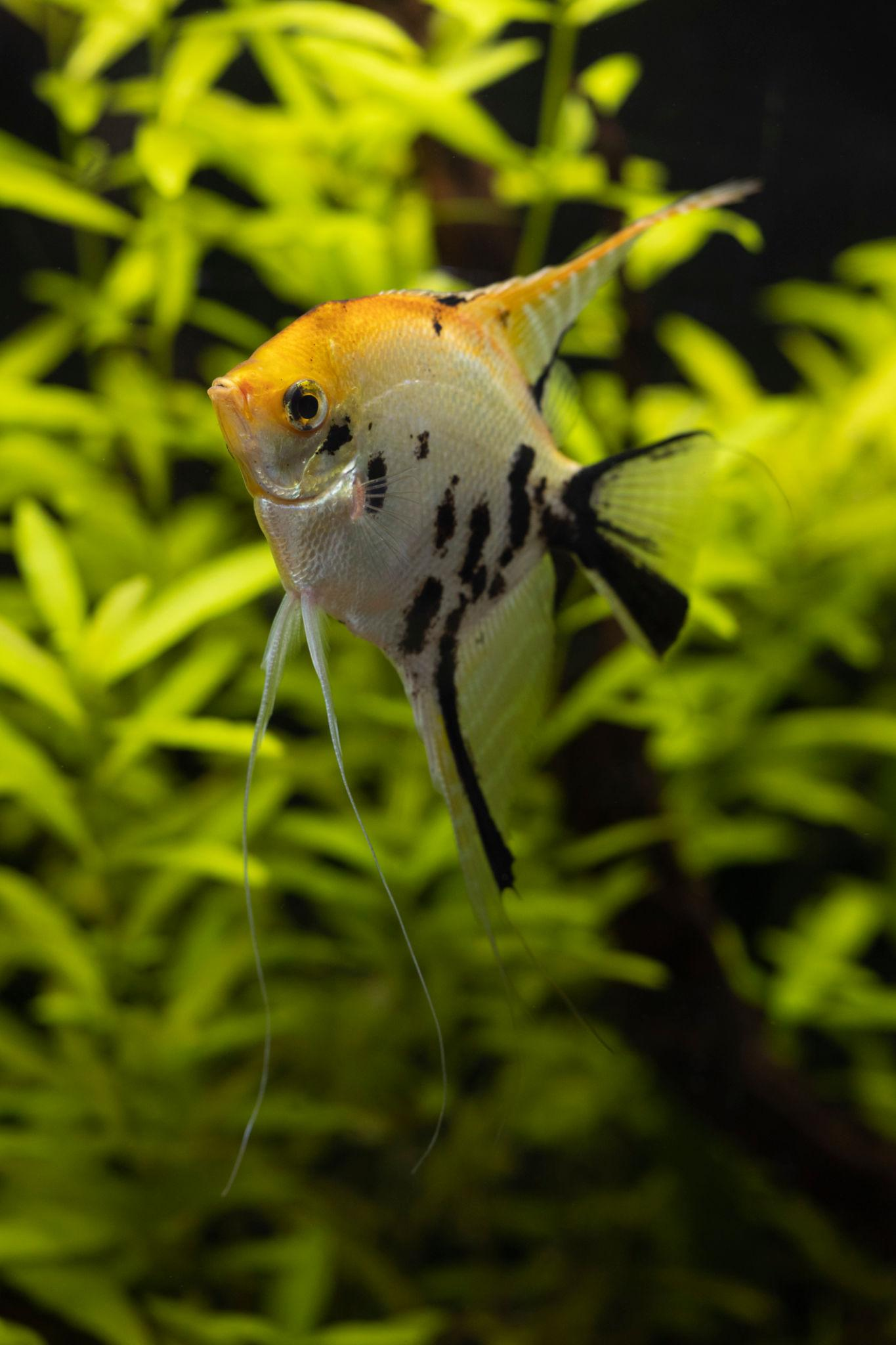
Koi Angelfish: Orange, black, and white patterning resembling a koi fish. Popular for their bold coloration.
Albino Angelfish: White body with red eyes. Sensitive to bright light — use lower intensity lighting or densely planted tanks for albinos.
Veil Angelfish: Any color morph with elongated, flowing fins. Beautiful but slower-swimming and more vulnerable to fin damage from tank mates.
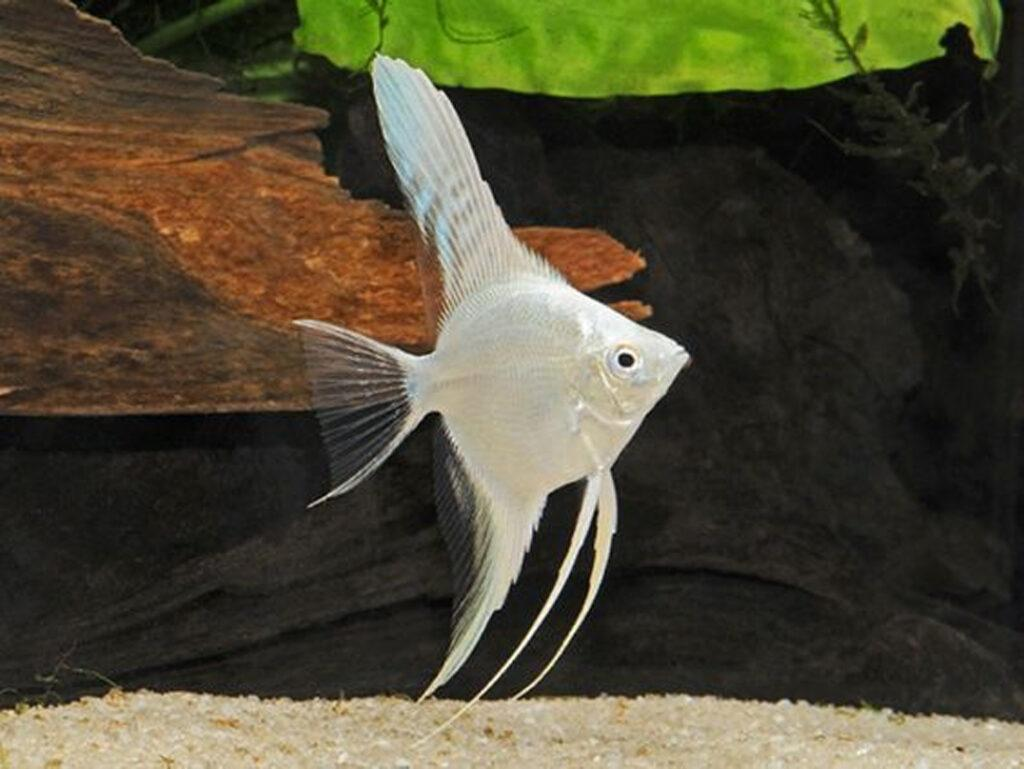
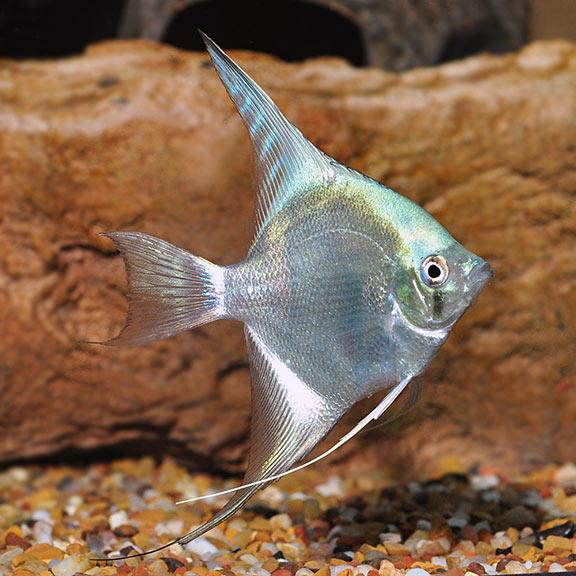
Platinum Angelfish: Solid pearly-white to silver body with no black patterning, giving a clean, metallic look. Distinct from albinos, which share the white body but have red eyes rather than dark ones.
Angelfish Tank Setup: Size, Height and Filtration
A 30-gallon tank can house a single pair of angelfish, but a group of four to six requires 55 gallons or more. More importantly, the tank must be tall. Angelfish can reach 10–12 inches from dorsal fin tip to ventral fin tip and need vertical swimming room. Standard 18-inch-tall tanks work; 24-inch-tall tanks are better.
A 55-gallon tank that is 48 inches long and 20 inches tall is a classic setup for a small group of angelfish. Longer tanks allow fish to establish territories and reduce conflict. Very wide, shallow tanks are poor choices regardless of volume.
If you're starting with young, dime-sized angelfish, it's tempting to house them in something smaller while they grow — a 20-gallon tank can technically work for a group of juveniles for a few months. But angelfish grow faster than many new owners expect, adding roughly a quarter to half an inch of body length per month through their first six to eight months and reaching full adult size somewhere between one and one-and-a-half years old. Plan for the 30- to 55-gallon adult setup from the start rather than budgeting for multiple upgrades — it's cheaper in the long run and avoids repeatedly stressing the fish with re-acclimation.
Use a canister filter or hang-on-back filter with gentle to moderate flow. Angelfish come from slow-moving South American rivers and prefer calm water. Avoid powerheads or wavemakers that create strong current — powerful flow stresses angelfish and can damage their flowing fins.
Water Conditions for Angelfish
Angelfish prefer slightly soft, slightly acidic water in the pH range of 6.5 to 7.5. Most captive-bred angels adapt well to neutral pH (7.0) and moderately soft water. Very hard or very alkaline tap water can be addressed by mixing with RO water.
Temperature should be maintained between 76°F and 84°F. Angelfish are warm-water fish — temperatures below 74°F slow their metabolism, suppress immune function, and make them more susceptible to disease. Use a reliable heater and verify temperature with a separate thermometer.
Ammonia and nitrite must remain at 0 ppm. Nitrate should stay below 20 ppm with weekly 25% water changes. Angelfish are moderately sensitive to nitrate accumulation — the long fins of angelfish are often first to show signs of degrading water quality through fin erosion.
If weekly 25% changes feel like too much for your schedule, a lighter but more frequent routine works just as well: many experienced keepers do a 10% water change every week combined with a deeper 25% change every other week, paired with a gravel vacuum to pull waste out of the substrate rather than just diluting the water column. Whichever schedule you pick, always treat replacement tap water with a dechlorinator first — untreated tap water contains chlorine or chloramine that will damage gill tissue and stress the fish, even at concentrations too low to smell.
Décor choices affect water conditions indirectly by shaping how waste accumulates. Large broadleaf plants and driftwood arranged vertically — mimicking submerged branches — give angelfish the sense of cover they evolved with, while a few floating plants provide shade and reduce the harsh, exposed feeling of a brightly lit tank. Vertically arranged décor also happens to be functional: it doesn't block the open swimming lanes angelfish need for their tall body shape the way horizontal driftwood or wide ornaments can.
Angelfish Feeding Guide: Diet, Food and Schedule
Angelfish are omnivores with a preference for protein-rich foods. In the wild they eat small fish, invertebrates, and insects. In captivity they readily accept a wide range of prepared and live foods.
Good staple foods include high-quality cichlid pellets, large tropical flakes, and freeze-dried or frozen foods such as bloodworms, brine shrimp, and daphnia. Feed twice daily in amounts that angelfish consume within three to four minutes. Remove uneaten food promptly.
Young angelfish need protein-rich food four to five times daily for healthy growth. Once mature, two feedings daily is sufficient. Supplement with vegetable matter occasionally — blanched spinach or spirulina flakes support overall health and coloration.
Although angelfish spend most of their time feeding at the surface or in mid-water, don't assume they ignore the bottom of the tank — in the wild they regularly forage along the riverbed for worms and small crustaceans, and captive fish retain that instinct. Occasionally offering a sinking pellet or letting some food drift down gives angelfish a chance to express this natural foraging behavior instead of only feeding at the top.
Rotating between two or three food types rather than feeding the same pellet every day helps ensure a complete nutrient profile and tends to produce more vibrant coloration over time. A simple rotation of a quality flake or pellet as the everyday staple, frozen bloodworms or brine shrimp two to three times a week, and an occasional vegetable-based food covers most of what an angelfish needs. Live or frozen foods are also useful beyond nutrition — many breeders use a few days of rich live feeding to help condition a pair and encourage spawning.
Growth & Development
Angelfish sold in stores are usually dime- to quarter-sized juveniles, which can make it easy to underestimate how much space they'll eventually need. Under good conditions, young angelfish grow at a fairly brisk pace during their first six to eight months — roughly a quarter to half an inch of added body length per month — before growth slows noticeably. Most angelfish reach their full adult size, around 6 inches of body length with fins that can span 10 to 12 inches top to bottom, somewhere between 12 and 18 months of age.
Growth rate is a useful early signal of husbandry quality. Angelfish that are stunted by an undersized tank, inconsistent feeding, or poor water quality rarely catch up fully later, even if conditions improve — another reason to set up the adult-sized tank from the beginning rather than treating a small starter tank as adequate for the first year.
Personality & Behavior
Angelfish are often described by longtime keepers as unusually interactive for a fish. It's common for angelfish to notice movement outside the tank and swim toward the glass, and many will follow a hand placed near or in the water, especially around feeding time. Individual fish tend to develop distinct personalities within a group — some bolder and more food-driven, others shier and more likely to hang back near cover — which is part of what makes keeping a small group more rewarding than keeping a single fish.
That said, angelfish are cichlids, and cichlid instincts sit just under the calm surface. A community that has been peaceful for months can shift once two fish pair off: the pair will often stake out and defend a territory, sometimes aggressively, pushing tank mates into other parts of the tank. This isn't a sign anything is wrong — it's normal reproductive behavior — but it's worth watching for, especially in tanks that are already near their stocking limit.
Best Tank Mates for Angelfish
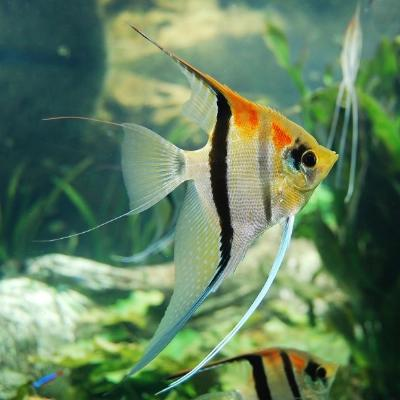
Choosing angelfish tank mates requires balancing three factors: size (nothing small enough to be eaten), water requirements (match angelfish temperature and pH), and temperament (nothing that nips long fins).
Good tank mates: Larger tetra species like black skirt tetras, bleeding heart tetras, and rummy-nose tetras (if angels are not large enough to eat them yet), peaceful rainbowfish, corydoras catfish, bristlenose plecos, dwarf cichlids like German blue rams, and larger peaceful gouramis.
Avoid: Neon tetras, cardinal tetras, ember tetras, and other small fish that adult angels may eat. Tiger barbs, serpae tetras, and other fin nippers that damage veil fins. Aggressive cichlids that compete for territory. Discus can coexist with angels but conflict sometimes develops — monitor closely.
When angels pair up and begin breeding, they become significantly more territorial and may attack former tank mates. Be prepared to rearrange décor to break line-of-sight or to move the pair to a dedicated breeding tank.
Angelfish Breeding Behavior
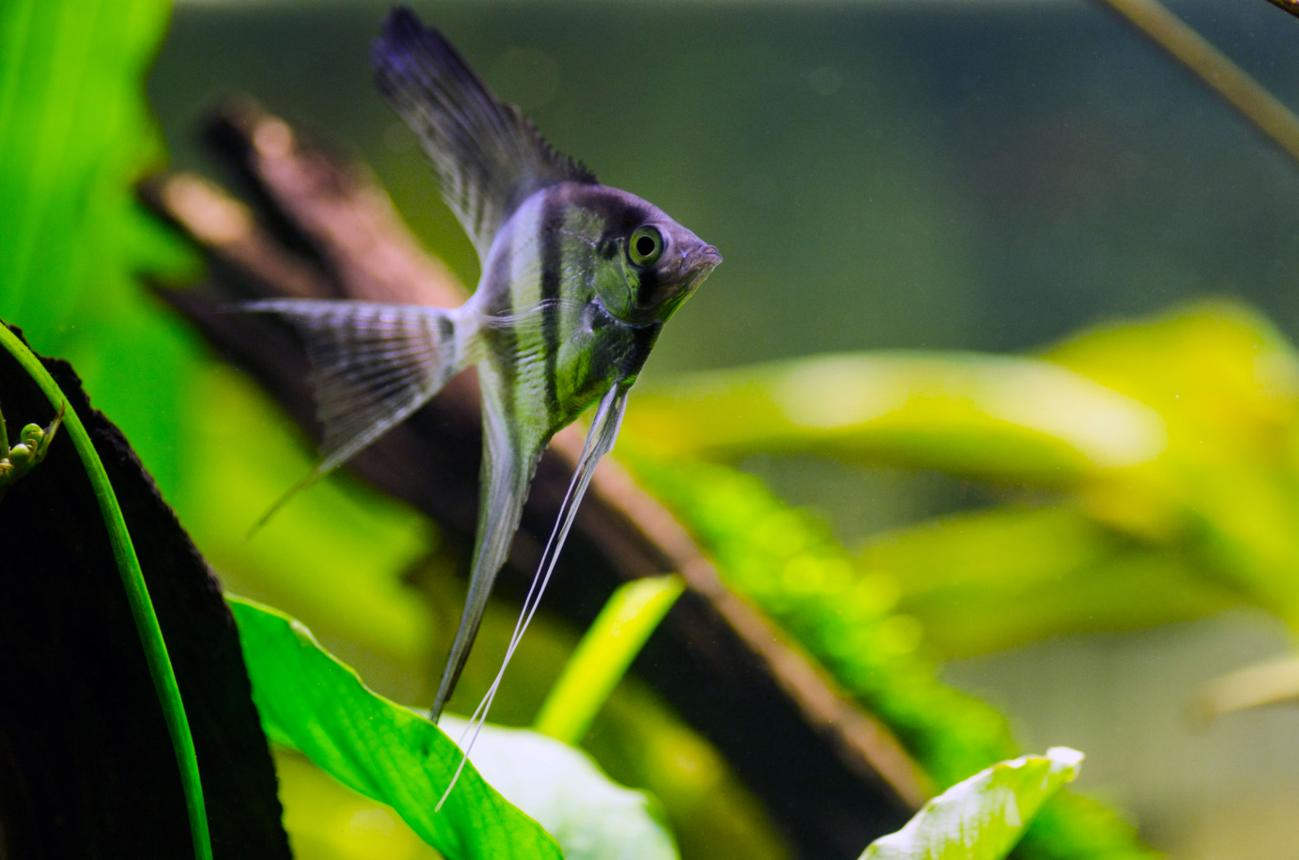
Angelfish form monogamous pairs and are dedicated egg-layers and parents. A bonded pair will claim a territory, clean a spawning site (typically a broad leaf or flat surface), and lay 100–1000 eggs. Both parents fan the eggs to oxygenate them and guard the clutch aggressively against tank mates.
Angelfish are notoriously easy to pair up — often easier than fishkeepers intend. Sexing them visually is unreliable: some mature males develop a small nuchal bump on the forehead, but plenty of males never show it, and it isn't present at all in young fish. The practical approach most breeders use is to buy a group of five or six juveniles, raise them together, and let them sort themselves into pairs naturally as they mature. Once two fish start guarding the same corner of the tank and chasing everyone else away, that's a pair, whether or not you can tell which one is male.
Spawning itself follows a fairly consistent pattern. The female lays her eggs in neat rows along the chosen surface, and the male follows behind to fertilize them. A vertical piece of slate, PVC pipe, or a broad-leafed plant works well as a spawning site — Amazon sword plants are a popular live-plant choice because their wide, sturdy leaves hold up to a pair's cleaning and guarding behavior.
Eggs typically begin hatching within 24 to 72 hours, with warmer water toward the top of the angelfish temperature range speeding things along. The newly hatched fry don't swim yet — they stay attached to the spawning surface by a sticky thread, living off their yolk sac for another five to six days without needing any external food. Parents that retain strong instincts will spend this period picking up any fry that fall loose and spitting them back onto the spawning site.
Around the one-week mark the fry become free-swimming, which is the best time to separate them from the adults if you want to raise a large batch — even attentive parents can accidentally lose fry to tank mates, or in some cases eat the brood themselves, particularly with young or inexperienced pairs, or pairs of purely captive-bred lineage that have had the parenting instinct bred out over many generations. Two common separation methods work well: gently siphoning the free-swimming fry into a grow-out tank with an air-line tube, or moving the entire spawning surface — slate, tile, or leaf, fry and all — into a separate tank, which is gentler on the fry but does interrupt the parents mid-brood.
In a community tank, expect most or all fry to be eaten by other tank mates despite the parents' best efforts. For successful breeding, move the pair to a dedicated breeding tank before spawning, or accept that a community setup is more about observing natural pairing and courtship behavior than raising large numbers of fry.
Feed fry newly hatched brine shrimp or commercially prepared fry food four to five times daily. Fry grow quickly and will be large enough to be recognizable miniature angels within four to six weeks.
Choosing Healthy Angelfish at the Store
Because angelfish are cichlids with some size and territorial requirements ahead of them, it's worth spending a little extra time picking healthy stock rather than grabbing the first fish in the tank. Look for fish with a full, rounded belly rather than a pinched or sunken abdomen, clear eyes, fins held upright and spread rather than clamped against the body, and steady, level swimming rather than listing to one side or gasping at the surface.
Avoid buying a fish that has only just arrived at the store. Shipping is stressful for any fish, and a temporarily weakened immune system makes newly arrived stock more likely to develop disease in the days that follow — both from the stress itself and from exposure to whatever else has recently passed through the store's holding tanks. Giving a new shipment several days to settle in before purchase, and asking staff how long a given fish has been in stock, meaningfully improves the odds of bringing home a healthy angelfish.
If you're planning to eventually breed your angelfish or simply want a compatible group, buying five or six juveniles from the same tank at once — rather than one or two fish now and more later — makes it far easier for natural pairs to form and reduces the territorial disruption that comes with introducing new adult angelfish to an already-established group.
Common Health Problems
Fin Rot: Eroding fin edges caused by bacterial infection, usually secondary to poor water quality or physical damage from fin nippers. Improve water conditions; treat with antibiotics if no improvement.
Ich: White granular spots on fins and body. Raise temperature gradually to 84°F, increase aeration, and treat with ich medication.
Hole in the Head (HITH): Small pitting or erosions on the head, associated with poor water quality, excessive activated carbon, and nutritional deficiency. Improve diet and water quality.
Parasitic worms / wasting: Thin appearance despite eating, visible stringy feces. Treat with praziquantel or metronidazole.
For a symptom-by-symptom index of angelfish health problems — 30 guides covering everything from clamped fins to swimming sideways — see the angelfish health problems hub.
Daily Angelfish Care Routine
Watch angelfish posture, fins, appetite, and social dynamics daily. Healthy angelfish move calmly through the water column and come forward eagerly for food. Stressed fish may hide, clamp fins, or guard a corner excessively. Because angelfish are cichlids, behavior can change as they mature and pair bonds form — what was a peaceful community can shift when breeding behavior begins.
Perform 25% water changes weekly. Clean the substrate with a gravel vacuum each water change. Trim plants and clean any algae growth that blocks swimming space. Check the filter monthly and rinse media in used tank water (never tap water) when flow reduces.
Taxonomy: The Pterophyllum Genus
The genus Pterophyllum contains three recognized species: Pterophyllum scalare (the common aquarium angelfish), Pterophyllum altum (the majestic altum, larger and more demanding), and Pterophyllum leopoldi (the smallest and rarest). Nearly all fish sold as "angelfish" are Pterophyllum scalare or hybrids thereof — this is the species this guide focuses on. Pterophyllum belongs to the cichlid family (Cichlidae), placing angelfish in the same broad family as discus, oscars, and rams, despite their very different body shape.
| Rank | Classification |
|---|---|
| Order | Cichliformes |
| Family | Cichlidae |
| Genus | Pterophyllum |
| Species | P. scalare |
Natural Habitat
Wild angelfish inhabit slow-moving, heavily vegetated tributaries and floodplain lakes across the Amazon and Orinoco river systems. Water is typically warm (76–84°F), soft, and slightly acidic, stained by tannins from submerged wood and leaf litter. Their tall, laterally compressed body shape evolved for slipping through vertical reed stems — the same posture that makes their vertical stripe pattern such effective camouflage.
History in the Aquarium Hobby
Angelfish have one of the longer documented histories of any tropical aquarium fish. They were first brought to Europe from South America in the early 1800s and quickly became a prized addition to serious fishkeepers' collections, admired then as now for their unusual body shape and calm, deliberate way of swimming. Reliable captive breeding took decades longer to achieve; angelfish were not consistently bred in captivity until fish exporters in the United States succeeded around 1930. That breakthrough is what eventually made angelfish affordable and widely available rather than a rare import, and it kicked off nearly a century of selective breeding for the color and fin varieties sold today.
Almost every angelfish in the hobby today is several generations removed from any wild-caught ancestor. Wild-caught angelfish still exist in the trade, mostly wild-type silver fish imported for breeding programs seeking to reinforce genetic diversity, but they are a small niche compared to the captive-bred stock sold at nearly every fish store. This matters for care: captive-bred lines have been selected for generations to tolerate a wider range of water chemistry than their wild ancestors, which is part of why angelfish have a reputation as a relatively forgiving cichlid for intermediate fishkeepers.
Fish Care FAQ
How to care for angelfish in a freshwater tank?
Provide a tall 30-gallon minimum tank, stable water at 76–84°F and pH 6.5–7.5, quality protein-rich food twice daily, and tank mates too large to be eaten. Perform 25% weekly water changes and keep ammonia and nitrite at zero.
Are angelfish aggressive?
They are semi-aggressive cichlids. Juveniles are relatively peaceful, but adults can become territorial — especially when forming pairs or spawning. The bigger the tank and the more space each fish has, the better behavior is managed.
Can angelfish live with neon tetras?
Not safely with adult angelfish. Adult angels are large enough to eat neon tetras. Small angels can coexist briefly but the risk increases as angels grow. Use larger tetra species with adults.
Do angelfish need a heater?
Yes. Angelfish require water between 76–84°F and cannot be kept at room temperature in most climates. Use a reliable heater and verify temperature with a thermometer.
What do angelfish eat?
Angelfish eat high-quality cichlid pellets, tropical flakes, and frozen or live protein foods like bloodworms, brine shrimp, and daphnia. Feed twice daily and remove uneaten food within four minutes.
What does an angelfish eat, and what should angelfish food contain?
An angelfish eats a varied omnivorous diet. Choose angelfish food with a reputable protein source as the staple, then rotate frozen bloodworms, brine shrimp, daphnia, and occasional spirulina or blanched vegetables. Young fish need smaller meals more often, while adults should receive measured portions to prevent obesity and water-quality problems.
What does angel fish eat compared with other aquarium cichlids?
What does angel fish eat in a community aquarium? The same balanced cichlid foods work well, but angelfish often prefer slow-sinking pellets and medium-sized flakes that remain in the mid-water column. Avoid relying on feeder fish or only one food type; variety supports growth, coloration, and long-term health.
What is the scientific name for angelfish?
The freshwater angelfish commonly kept in home aquariums belongs to the genus Pterophyllum, most often the species Pterophyllum scalare. Two closer relatives, Pterophyllum altum and Pterophyllum leopoldi, are occasionally available but are more demanding and less common in the hobby. All three species are South American cichlids native to the Amazon and Orinoco river basins.
How long do angelfish live?
Angelfish live 10–15 years with proper care. Poor water quality, stress, or poor diet can shorten this significantly — many angels kept in suboptimal conditions live only five to seven years.
How fast do angelfish grow, and when are they full-grown?
Young angelfish typically add a quarter to half an inch of body length per month for their first six to eight months, then slow down. Most reach full adult size — about 6 inches of body length with fins spanning up to a foot — between 12 and 18 months old.
How big do angel fish get?
Most freshwater angelfish grow to about 6 inches in body length. Because their dorsal and ventral fins are tall, a full grown angelfish can measure 10–12 inches from top to bottom. That is why a tall angelfish in a tank setup is safer than a shallow aquarium with the same gallon volume.
How can I tell if my angelfish are male or female?
Reliably sexing angelfish by eye is difficult. Some mature males develop a small bump on the forehead, but many never do, and juveniles show no visible difference at all. Most keepers buy a group of five or six young fish and let natural pairs form as they mature, rather than trying to select a male and female upfront.
Why did my previously peaceful angelfish suddenly become aggressive?
This is almost always a sign that two fish have paired off and are guarding a territory ahead of spawning. It's normal cichlid behavior, not illness or a personality change — expect it once a bonded pair forms in a group, and be ready to rearrange décor or relocate the pair if the aggression becomes a problem for tank mates.
What is the minimum tank size for angelfish?
30 gallons is the practical minimum for a single pair as adults, and 55 gallons or more is recommended for a small group. A 20-gallon tank can work temporarily for young juveniles, but angelfish grow quickly and will need the larger, taller setup well within their first year.
How do I take care of an angel fish as a beginner?
To take care of an angel fish, start with a fully cycled tall tank, a reliable heater and filter, stable angelfish water parameters, and a varied diet. Observe breathing, appetite, fin position, and aggression each day. Quarantine new fish and make gradual water changes instead of chasing a perfect number.
This guide was reviewed for practical fish care safety, water quality accuracy, and beginner clarity. For severe illness, poisoning, or pond emergencies, contact an aquatic veterinarian or experienced local aquatics professional.