Fish Tank Stocking Calculator
Find out how heavily your aquarium is stocked before you add another fish. Enter your tank volume, add the fish you keep or plan to keep, and this fish tank stocking calculator scores the tank on adult size and waste output — not the one inch per gallon rule.
🐠 Aquarium Stocking Calculator
Results update as you add fish. Every species is scored at its adult size, because that is the size your filter will be dealing with in a year. The same method works as a fish tank stocking calculator for a 5 gallon betta tank or a 125 gallon cichlid tank.
Common tank sizes
Jump straight to a standard aquarium size. These are US gallon figures for the tank as sold — switch the unit above if you work in litres.
How to Use the Fish Tank Stocking Calculator
Four inputs, one honest answer about whether the tank can carry the fish you want.
Enter tank volume
Use the real water volume if you can. A "20 gallon" tank with gravel, rock and a filter intake holds around 17 gallons of water.
Describe the filter
Be honest. A cycled canister rated for the tank is "good". A sponge filter on a 40 gallon is "basic" no matter what the shop said.
Add your fish
Pick each species and how many. Include the fish already in the tank as well as the ones you are thinking of buying.
Read the percentage
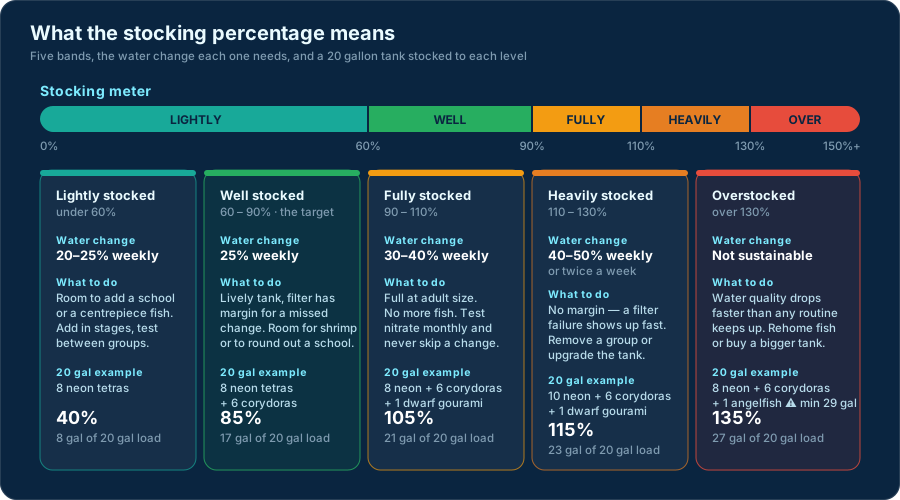
Under 90 percent leaves room. Over 100 means the tank is full at adult size, whatever the fish look like today.
How Many Fish Per Gallon?
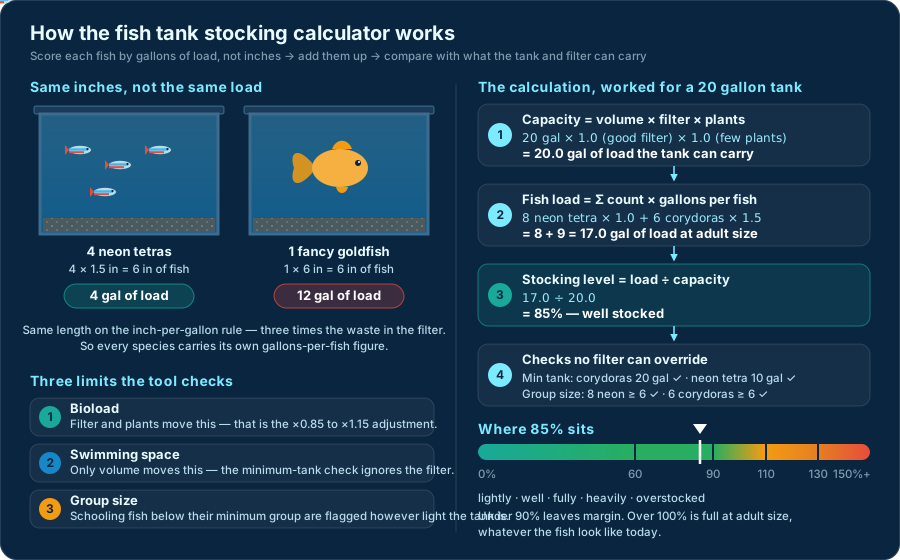
The rule everyone learns first is one inch of fish per gallon of water. It is easy to remember and it is roughly right for the fish it was written about — small, slim community fish like tetras, rasboras and guppies in a tank with an ordinary filter. Ten neon tetras in a 10 gallon tank is about where that rule lands, and it is a reasonable stocking level.
The rule breaks the moment the fish get bigger or heavier. A fancy goldfish at 6 inches has perhaps ten times the body mass of four 1.5 inch tetras, eats far more, and produces waste in proportion. The inch rule counts them the same. Worse, it says nothing about swimming room: one 10 inch oscar "fits" a 10 gallon tank by the arithmetic, and no oscar keeper would put one in anything under 75.
Stocking is really three separate limits:
- Biological load. Ammonia and nitrite have to be processed as fast as the fish produce them. This is the limit that filtration and plants can move.
- Nitrate and water changes. The end product of the nitrogen cycle builds up between water changes in proportion to the bioload. More fish means bigger or more frequent changes.
- Physical space. Schooling fish need a length of tank to swim, bottom dwellers need floor area, and territorial fish need space to avoid each other. Nothing but a bigger tank moves this limit.
This calculator handles the first two by giving every species a gallons-per-fish figure that reflects its adult size and how much waste it produces, then adjusts that for your filter and plants. It handles the third by checking each species against a minimum tank size that no amount of filtration overrides.
Working figures by fish size
If you want a quick planning number without the calculator, these are the gallons per fish the tool works from, for a tank with a correctly rated filter.
| Type of fish | Adult size | Gallons per fish | Examples |
|---|---|---|---|
| Nano schooling fish | Under 1 in | 0.6 – 0.8 | Chili rasbora, ember tetra, pygmy cory |
| Small schooling fish | 1 – 2 in | 1 – 1.5 | Neon tetra, harlequin rasbora, guppy, zebra danio |
| Small centrepiece or bottom fish | 2 – 3 in | 2 – 3 | Betta, platy, corydoras, German blue ram |
| Medium community fish | 3 – 5 in | 3 – 6 | Molly, dwarf gourami, kribensis, rainbowfish |
| Large or heavy-bodied fish | 5 – 7 in | 8 – 12 | Angelfish, discus, bristlenose pleco, fancy goldfish |
| Very large fish | 10 in and over | 40 – 60 | Oscar, common goldfish, common pleco |
| Invertebrates | Any | 0.15 – 1.5 | Cherry shrimp, nerite snail, mystery snail |
How Many Fish in a 10 Gallon Tank?
A 10 gallon tank comfortably holds one small school of eight nano or small fish, or a single centrepiece fish with a small school around it. It does not hold goldfish, angelfish, any gourami bigger than a honey gourami, or anything that reaches 4 inches, regardless of how small the fish are when you buy them.
| Stocking | Stocking level | Notes |
|---|---|---|
| 8 neon tetras | 80% | The classic 10 gallon school. Room for a few shrimp or a nerite snail. |
| 1 betta + 6 chili rasboras | 66% | Works if the betta is placid. Add the rasboras first, the betta last. |
| 6 male guppies | 90% | Males only, or the fry will overstock the tank within months. |
| 6 pygmy corydoras + 8 ember tetras | 96% | Full. Both species stay under an inch, so it looks emptier than it is. |
| 1 honey gourami + 8 ember tetras | 73% | Calm centrepiece with a nano school. Heavy planting suits both. |
| 1 fancy goldfish | 120% — not suitable | Needs 20 gallons minimum. Goldfish are the most common 10 gallon mistake. |
Whatever you choose, stock a 10 gallon in two stages a few weeks apart. Small volumes swing fast, and a newly cycled filter needs time to grow into a full load. If a fish on your list comes out as "needs a larger tank" here, the answer is a larger tank — the tank size calculator will tell you how large.
Fish Tank Stocking Chart by Tank Size
A well stocked example for each standard aquarium size, assuming a filter rated for the tank and a light to moderate amount of plants. Each of these lands between 80 and 96 percent on the calculator — full, with a little margin.
| Tank size | Litres | Example stocking | Level |
|---|---|---|---|
| 5 US gal | 19 | 1 betta + a cherry shrimp colony | 90% |
| 10 US gal | 38 | 8 neon tetras + 2 nerite snails | 86% |
| 20 US gal long | 76 | 8 neon tetras + 6 bronze corydoras | 85% |
| 29 US gal | 110 | 1 dwarf gourami + 10 harlequin rasboras + 6 corydoras | 86% |
| 40 US gal breeder | 151 | 1 pearl gourami + 12 rummy nose tetras + 8 corydoras | 90% |
| 55 US gal | 208 | 2 angelfish + 10 cardinal tetras + 8 corydoras + 1 bristlenose | 96% |
| 75 US gal | 284 | 6 Boesemani rainbowfish + 12 cardinals + 8 corydoras + 1 bristlenose | 88% |
| 125 US gal | 473 | 1 oscar + 1 common pleco | 92% |
Tank shape matters as much as volume, and a fish tank stocking calculator cannot see shape. A 20 gallon long has twice the floor space of a 20 gallon high and suits schooling fish and corydoras far better; a 40 gallon breeder is the best-shaped tank on this list for the money. These are ceilings for the layout shown, not shopping lists — every combination still needs checking for temperament and water chemistry in the fish compatibility checker.
Signs Your Fish Tank Is Overstocked
An overstocked aquarium rarely fails all at once. It shows up as a tank that is harder to keep stable than it should be.
- Nitrate climbing fast between water changes. If a 25 percent weekly change no longer keeps nitrate under 20 to 40 ppm, the bioload has outgrown the routine.
- Ammonia or nitrite that will not stay at zero. A mature filter on a correctly stocked tank reads zero for both. Persistent traces mean the filter cannot keep up.
- Fish at the surface in the morning. Dissolved oxygen is lowest just before the lights come on. Gasping at dawn is the classic low-oxygen signature of a crowded tank.
- Algae you cannot get on top of. More fish means more dissolved nutrients, whatever the lighting schedule.
- Constant chasing and torn fins. Crowding removes the space fish use to avoid each other, so aggression that would be harmless in a bigger tank becomes constant.
- Recurring ich, fin rot and unexplained losses. Chronic stress suppresses the immune response and keeps parasites circulating.
If you are seeing these, test first. The water parameter checker will tell you whether ammonia, nitrite, nitrate or pH is the immediate problem, but if the readings keep drifting back after every water change, the fix is fewer fish or more water rather than more chemistry.
Stock in stages
Even a tank that scores well here should not be filled in one afternoon. A cycled filter carries the bacteria for the load it was cycled with, and it takes a week or two to grow into a bigger one. Add a third to a half of the planned fish, wait two to three weeks, test, then add the next group. Schooling fish should be added as a complete group, so plan the stages around whole schools rather than splitting one.
Frequently Asked Questions
Stocking questions, answered with the numbers behind them.
Related Aquarium Tools
Stocking is one part of the plan. These cover the rest of the tank.
Fish Tank Size Calculator
Work out the real water volume from your tank dimensions, after substrate and decor.
Fish Compatibility Checker
Check that the fish on your list get along — temperament, temperature and pH.
Fish Feeding Calculator
How much and how often to feed the stocking level you have settled on.
Water Parameter Checker
Check whether the readings say your stocking level has outgrown the filter.
Planning a pond rather than a tank? The koi pond stocking calculator uses pond-specific figures. For a full setup checklist from cycling to first fish, start with the aquarium planner, and the tank setup guide covers the order to do it in.
Methodology and accuracy
Each species carries a gallons-per-fish figure that reflects its adult length and body mass, and therefore its waste output, in a community tank with a filter rated for the volume. The figures range from 0.15 gallons for a cherry shrimp through 1 gallon for a neon tetra, 3 for a betta, 10 for an angelfish and 12 for a fancy goldfish, to 55 to 60 for an oscar or common pleco. They are planning conventions drawn from widely used hobby guidelines rather than measured carrying capacities, and sources vary either side of them.
Stocking level is the sum of gallons-per-fish across all fish, divided by the tank volume after the filtration and plant adjustments, expressed as a percentage. Filtration multiplies capacity by 0.85 for a basic filter, 1.0 for a correctly rated cycled filter, and 1.15 for an oversized canister or sump. Live plants multiply it by 1.05 for a moderately planted tank and 1.15 for a heavily planted one. The adjustments are deliberately small: filtration and plants change the biological limit, not the amount of swimming space.
Minimum tank sizes and minimum group sizes are checked separately and are not affected by filtration. A species that needs 20 gallons is flagged in any tank under 20 gallons however lightly stocked it is. The one inch per gallon cross-check sums adult lengths and compares them to the raw volume; it is shown because it is the figure most people know, not because it is the better guide.
Volume conversions are exact: 1 US gallon = 3.785411784 litres, 1 imperial gallon = 4.54609 litres. The calculator does not check temperament, temperature or water chemistry compatibility — use the fish compatibility checker for that. It estimates capacity; it is not a substitute for testing your own water.