Aquarium & Fish Tank Size Calculator
This free aquarium size calculator (fish tank size calculator) turns your tank's inside dimensions into total capacity, filled volume and usable water in US gallons, UK gallons and litres — a complete fish tank size calculation in one click, with a species planner underneath.
💧 Fish tank size calculator: enter your inside dimensions
Measure inside the glass and the aquarium size calculator returns total capacity, filled volume and usable water in gallons (US & UK) and litres.
Enter inside dimensions
Results will show US gallons, UK gallons, litres and water weight.
Volume formulas & conversions used by this tank size calculator
Rectangular / cube: length × width × depth | Vertical cylinder: π × radius² × depth | Horizontal cylinder: circular segment area × length
Conversions (per NIST SP 811): 1 US gallon = 3.785411784 L | 1 UK gallon = 4.54609 L | Measure inside the glass, not the outer frame.
Water weight excludes the tank, stand, substrate, rocks and equipment. Consult a qualified professional if floor or stand loading is a concern.
🐠 Fish tank size planner by species
Compare physical volume with a conservative species-based space estimate. Planning aid only — not a stocking guarantee.
Choose a species
Results show minimum and recommended tank size with care notes.
How to calculate the size of a fish tank in four steps
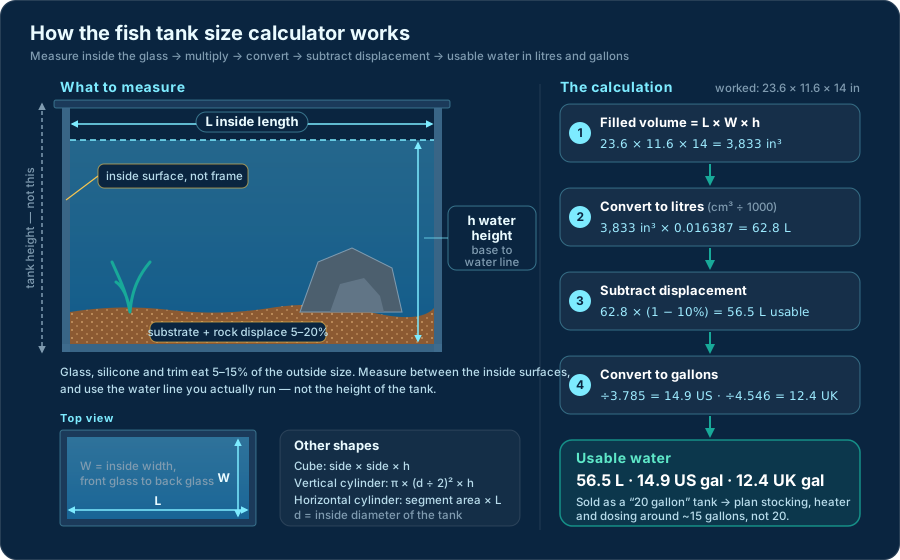
The calculator does the arithmetic; the accuracy comes from what you measure. Follow these four steps and the fish tank size calculation will match the water your fish actually live in.
-
1. Measure inside the glass
Run the tape from inside surface to inside surface for length and width. Glass panels, silicone seams and trim take up 5–15% of the outside footprint, which is why a tank sold as "20 gallons" never holds 20 gallons of water. For a cube tank enter only one side; for a cylinder enter the inside diameter.
-
2. Use the water height, not the tank height
Measure from the inside base to the line you actually fill to — usually 1–2 inches (2–5 cm) below the rim to leave room for a lid, filter outflow and surface agitation. The "Actual water depth" field takes this number; leave it blank and the calculator assumes a brim-full tank.
-
3. Deduct substrate and decor displacement
Gravel, sand, rock, driftwood and internal equipment all push water out. Choose 0% for a bare quarantine tank, 10% for a typical community aquarium, or 15–20% for a heavily planted or hardscape layout. If you are still choosing a substrate depth, the aquarium substrate calculator sizes that layer from the same footprint.
-
4. Read the result in the unit your region uses
The calculator prints US gallons, UK gallons and litres side by side. Use US gallons for American tank labels and most online stocking rules, UK gallons for tanks sold in the United Kingdom, and litres for Europe, Australia and most of Asia — and for dosing medication or conditioner, which is almost always labelled per litre.
Fish tank size calculation formulas and a worked example
Prefer to calculate size of fish tank volume yourself? These are the exact formulas and conversion factors the calculator uses.
Rectangular and cube fish tanks
Volume = inside length × inside width × water height. In inches, multiply the cubic inches by 0.004329 for US gallons or 0.016387 for litres. In centimetres, divide cubic centimetres by 1000 for litres, then divide litres by 3.785 for US gallons or 4.546 for UK gallons.
Cylinder fish tanks
Vertical cylinder: π × (inside diameter ÷ 2)² × water height. Horizontal cylinder: the area of the circular segment below the water line × length — the calculator handles the segment formula for you, since it is the one part of a fish tank size calculation that is genuinely awkward by hand.
Worked example: the size of a standard "20 gallon high" fish tank
A 20 High is sold as 24 × 12 × 16 inches, measured outside. Inside the glass it is closer to 23.6 × 11.6 × 16 in, and most people fill it to about 14 in of water.
| Step | Calculation | Result |
|---|---|---|
| Brim-full capacity | 23.6 × 11.6 × 16 in = 4,380 cu in × 0.016387 | 71.8 L · 19.0 US gal |
| At the water line | 23.6 × 11.6 × 14 in = 3,833 cu in × 0.016387 | 62.8 L · 16.6 US gal |
| After 10% displacement | 62.8 L × 0.90 | 56.5 L · 14.9 US gal · 12.4 UK gal |
| Water weight | 56.5 L × 0.998 kg/L | 56.4 kg · 124 lb (water only) |
So the tank on the label as "20 gallons" gives your fish about 15 US gallons of water. That 25% gap is normal, and it is the number you should use for stocking, heater sizing and medication doses.
Fish tank size in US gallons, UK gallons and litres
Three units, one volume. Which figure you quote depends on where you shop and what you are dosing.
US gallons vs UK gallons
The tool shows both US gallons (3.785 L each) and UK Imperial gallons (4.546 L each). UK tank labels and many UK fish-keeping guides quote Imperial gallons, so a "40 gallon" tank in the United States is only about 33 UK gallons — a difference big enough to change a stocking plan.
Litres — the international standard
Litres are the working unit in Europe, Australia and most of Asia, and almost every water conditioner, fertiliser and medication is dosed per litre. The litre figure shown is usable water after your chosen displacement, so it is the one to use for dosing.
Usable water, not box size
Labels print gross volume from outside dimensions. Actual usable water is always less. Because this tool works from inside measurements, the real water depth and a displacement allowance, it returns a conservative estimate of what your fish actually swim in — the figure filtration and stocking rules assume.
Common fish tank size benchmarks
Standard sizes: 10 US gal (37.9 L / 8.3 UK gal) · 20 US gal (75.7 L) · 29 US gal (109.8 L) · 55 US gal (208.2 L) · 75 US gal (283.9 L). Run your own tank through the calculator to see how far a lower fill line and hardscape pull the usable figure below the nominal size. For typical dimensions, filled weight and stocking at specific sizes, see our guides to the 50 gallon fish tank, 55 gallon fish tank and 100 gallon fish tank.
Fish tank size calculators by species
Once you know the usable volume, the next question is whether it suits the fish. Each species calculator gives a minimum and a recommended tank size for the number you plan to keep — not a generic inch-per-gallon rule.
Betta tank size
5–30 gal
🐟Goldfish tank size
20–40 gal first fish
🐠Guppy tank size
10 gal minimum
🐠Angelfish tank size
29 gal per pair
🐠Molly tank size
20 gal minimum
🐡Swordtail tank size
20 gal minimum
🐟Oscar tank size
75 gal per fish
🐠Discus tank size
55 gal group of 4
🐠Koi tank size
250 gal per koi
🐡Zebra danio tank size
10 gal for 6
Fish tank size calculator vs aquarium tank size calculator: is there a difference?
No. A fish tank size calculator, an aquarium tank size calculator and an aquarium volume calculator all answer the same question: how much water does this glass box actually hold? People reach for different words — some search "fish tank gallon calculator", others "calculate size of fish tank" or "fish tank size calculation in litres" — but the arithmetic is identical, and this page handles all of them.
What does change the answer is how you measure. Manufacturers name tanks by nominal outside size, while the number you need for stocking, dosing and heater sizing is the usable water volume — measured inside the glass, minus what substrate, rock and equipment displace. That is the figure this calculator returns, and it is the reason the result is usually 15–25% below the label.
So whichever phrase brought you here, the method is the same three moves: measure inside the glass, enter length, width and water height, then apply a displacement allowance. The result is the volume your fish, filter and test kit actually live with.
Fish tank size calculator — frequently asked questions
Answers about US gallons, UK gallons, litres, displacement and how to interpret your result.
More aquarium tools
Use these alongside the size calculator to plan a complete, healthier setup.
Add your fish and see how heavily the tank is stocked at adult size, with minimum tank and school-size checks.
Open Tool → 🔬 Compatibility CheckerCheck whether selected fish can share a tank — temperament, temperature, pH and size rules.
Open Tool → 💧 Water Parameter CheckerEnter pH, ammonia, nitrite, nitrate and temperature for an instant water-quality score.
Open Tool → 🍽 Feeding CalculatorEstimate daily feeding frequency and portion rules to avoid overfeeding and water-quality problems.
Open Tool → 🧭 Aquarium PlannerBuild a complete equipment, cycling and stocking checklist before buying animals.
Open Tool → 🪨 Aquarium Substrate CalculatorWork out how much gravel, sand or aquarium soil your tank footprint needs, in litres and pounds.
Open Tool → 📚 Water Parameters GuideExpert guide to pH, ammonia, nitrite, nitrate, temperature and hardness for freshwater tanks.
Read Guide →