55 Gallon Fish Tank at a Glance
55 Gallon Fish Tank Dimensions
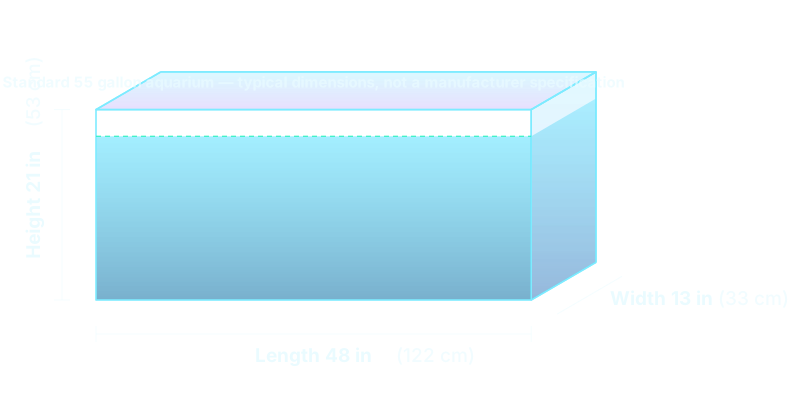
Unlike the 50 gallon fish tank, which is sold in several shapes, the 55 is remarkably consistent: almost every one is a 48-inch-long, 12¾–13-inch-deep tank between 20 and 21 inches tall. Some brands round the height to 20 inches, others list 21; the front-to-back measurement is where the 55 gets its reputation for being narrow.
| Tank type | Length | Width (front to back) | Height | Best for |
|---|---|---|---|---|
| Standard 55 gallon | ≈ 48 in (122 cm) | ≈ 13 in (33 cm) | ≈ 20–21 in (51–53 cm) | Community tanks, angelfish groups, schooling tetras and rasboras, rainbowfish, planted layouts |
| For comparison: 50 gallon standard | ≈ 36 in (91 cm) | ≈ 18 in (46 cm) | ≈ 19 in (48 cm) | Deeper footprint for dwarf cichlids and aquascaping — see the 50 gallon guide |
| For comparison: 75 gallon standard | ≈ 48 in (122 cm) | ≈ 18 in (46 cm) | ≈ 21 in (53 cm) | Same length as a 55 with 5 in more depth; suits bulkier fish |
| For comparison: 100 gallon standard | ≈ 72 in (183 cm) | ≈ 18 in (46 cm) | ≈ 20 in (51 cm) | 6-ft length for large schools and bigger centerpiece species |
Why the footprint matters more than the gallons
Fish live on the floor area and along the length of a tank far more than in its gallon count. A 55 gives you a 48 × 13 inch floor (about 4.3 square feet) and a 4-foot swimming run. That run is excellent for rainbowfish, larger tetras and barbs that cruise back and forth, and the 21-inch height leaves room for tall-bodied angelfish. What it does not give you is depth: a 13-inch-wide tank leaves very little room for a 7- or 8-inch cichlid to turn around, for rockwork with caves behind it, or for a planted layout with real foreground-midground-background depth.
That is why a 75 gallon (same length, 18 inches deep) is so often recommended as the next step for cichlid keepers, while the 55 remains the better-value choice for schooling and community fish. If you are choosing between the two for a slim-bodied community, the 55 is fine; for anything bulky, the extra 5 inches of the 75 matter more than the extra 20 gallons.
How Much Does a 55 Gallon Fish Tank Weigh?
Water is the heavy part, but it is not the whole story. One US gallon of freshwater weighs about 8.34 lb (3.78 kg), so 55 gallons of water alone would be about 459 lb — except a running 55 never contains 55 gallons of water. Substrate, hardscape and the gap below the rim displace several gallons, while the glass, gravel and rock add weight of their own. The realistic operating weight is what your stand and floor carry.
| Component | Estimated weight | Basis |
|---|---|---|
| Empty glass tank | ≈ 75–85 lb (34–39 kg) | Typical for a rimmed 48-inch 55; acrylic tanks weigh roughly half |
| Water | ≈ 400 lb (182 kg) | ≈ 48 gal actual × 8.34 lb after displacement and fill line |
| Substrate (2 in gravel) | ≈ 60–75 lb (27–34 kg) | 48 × 13 in floor × 2 in ≈ 0.7 cu ft; gravel ≈ 90–100 lb per cu ft |
| Rock, wood and décor | ≈ 20–40 lb (9–18 kg) | A few pieces of driftwood and stone; heavy rockscapes weigh more |
| Hood, light, filter, heaters | ≈ 10–15 lb (5–7 kg) | A hang-on-back filter full of water counts too |
| Estimated operating weight | ≈ 570–650 lb (260–295 kg) | Before the stand, which adds another 50–120 lb |
Example calculation
Round that to about 600 lb for planning. A 55 gallon aquarium with an aquarium stand therefore puts roughly 650–700 lb onto a 48 × 13 inch patch of floor. Deep sand beds, large rock piles or a sump underneath push the total higher; a sparse, bare-bottom quarantine tank comes in lighter.
How Many Fish Can Live in a 55 Gallon Tank?
The honest answer is that a 55 gallon tank comfortably houses somewhere between a handful of medium fish and about thirty-five small ones, and which end of that range applies depends far more on the species than on the gallon figure. The old "one inch of fish per gallon" rule falls apart at this size: it would allow four 13-inch oscars or fifty-five neon tetras, and only one of those is a healthy 55.
What actually sets the limit
- Adult size and body mass. A fish's mass grows roughly with the cube of its length, so one 6-inch fish carries the bioload of dozens of 1-inch fish, not six.
- Activity level and swimming zone. Rainbowfish and danios use the whole 4-foot run; angelfish hover mid-water; corydoras stay on the floor. Fish that occupy different zones stack far better than fish that all compete for the same one.
- Territorial behaviour. One pair of dwarf cichlids claims a patch of the 48 × 13 inch floor; a second pair may not fit even though the "gallons" are there.
- Schooling requirements. Tetras, rasboras, barbs and corys need groups of six or more to behave normally, so they are counted as a school, not as individuals.
- Waste production and filtration. Messy eaters (goldfish, plecos, large cichlids) need far more filtration and water change per body than tetras do.
- Oxygenation and surface area. A 48 × 13 inch surface exchanges gas well for its volume; a tall, narrow tank with the same gallons would not.
- Maintenance frequency. Weekly 25–30% water changes support denser stocking than fortnightly ones — but only if you will actually keep them up.
Practical examples for a 55
- Works well: 4 angelfish, 12 lemon tetras, 8 sterbai corys and 1 bristlenose pleco — about 25 fish spread across three zones with a moderate bioload.
- Works well: 15 rummy-nose tetras, 12 harlequin rasboras and 10 kuhli loaches — nearly 40 small bodies, but low individual mass and heavy plant cover.
- Does not work: a single oscar. It fits the gallon count on paper but reaches 12–14 inches in a 13-inch-wide tank and produces the waste of a small pond.
- Does not work long term: five clown loaches bought as 2-inch juveniles. They are wonderful for a year or two and then outgrow the footprint.
Treat every figure on this page as a planning estimate, then verify the specific combination — adult sizes, group minimums and bioload — with the Aquarium Planner before you buy.
Best Fish for a 55 Gallon Tank
These species genuinely suit a 55 gallon aquarium as adults: they either use the 4-foot length, sit comfortably in the 21-inch water column, or stay small enough that the 13-inch depth never becomes a problem. Group sizes are minimums for normal behaviour, not stocking targets.
Angelfish
- Adult size
- 6 in long, up to 8–10 in tall
- Group
- 1 pair or 4–5 raised together
- Temperament
- Semi-aggressive, territorial when breeding
- Zone
- Mid-water
The classic 55 gallon centerpiece. The 21-inch height gives their tall fins room, and the 4-foot length lets a small group establish space. See how many angelfish fit a 55.
Pearl gourami
- Adult size
- 4–5 in
- Group
- 1 male with 2–3 females, or a trio
- Temperament
- Peaceful
- Zone
- Upper and mid-water
A calm, hardy centerpiece for planted 55s that never bothers tetras or corys. Needs floating plants and gentle surface flow to feel secure.
Bolivian ram
- Adult size
- 3–3.5 in
- Group
- Pair, or 1 pair per 55
- Temperament
- Peaceful dwarf cichlid
- Zone
- Lower mid-water and floor
Tolerates a wider temperature and hardness range than the German blue ram and claims only a small territory on the 48-inch floor.
Kribensis
- Adult size
- 3–4 in
- Group
- 1 pair
- Temperament
- Peaceful except when guarding fry
- Zone
- Floor and caves
A hardy West African dwarf cichlid that spawns readily in a cave and coexists with mid-water schools. Keep one pair per 55 to avoid floor disputes.
Boeseman's rainbowfish
- Adult size
- 4–4.5 in
- Group
- 6 or more, mixed sexes
- Temperament
- Peaceful, very active
- Zone
- Mid to upper water
One of the best reasons to own a 4-foot tank. These fast cruisers use the whole 48-inch run and colour up spectacularly in groups.
Congo tetra
- Adult size
- 3–3.5 in
- Group
- 8 or more
- Temperament
- Peaceful, slightly shy
- Zone
- Mid-water
A large, flowing-finned tetra that looks cramped in a 20 and superb in a 55. Males develop long fins only when they have swimming room.
Lemon tetra
- Adult size
- 1.75–2 in
- Group
- 10 or more
- Temperament
- Peaceful
- Zone
- Mid-water
Deep-bodied enough not to be angelfish food, hardy, and shows its best colour in a big school — a better angelfish companion than neons.
Harlequin rasbora
- Adult size
- 1.75 in
- Group
- 10–15
- Temperament
- Peaceful
- Zone
- Mid-water
Tight-schooling, undemanding and gorgeous in numbers. A 55 lets you keep a school large enough to see real shoaling behaviour.
Sterbai cory
- Adult size
- 2.5 in
- Group
- 6–8
- Temperament
- Peaceful
- Zone
- Floor
Tolerates the warmer water angelfish and gouramis prefer, unlike many corydoras. A 48-inch floor supports a large, busy group. See our corydoras care guide.
Kuhli loach
- Adult size
- 3–4 in
- Group
- 6 or more
- Temperament
- Peaceful, nocturnal
- Zone
- Floor
Eel-like scavengers that thread through plants and driftwood. Their slim bodies add almost no bioload, and a group makes them bolder.
Bristlenose pleco
- Adult size
- 4–5 in
- Group
- 1 (or a pair)
- Temperament
- Peaceful
- Zone
- Glass, wood and floor
The right pleco for a 55: stays under 5 inches, grazes algae and needs driftwood to rasp. The common pleco sold beside it does not belong here. See the bristlenose care guide.
Platy
- Adult size
- 2–2.5 in
- Group
- 6 or more (more females than males)
- Temperament
- Peaceful
- Zone
- Mid to upper water
The ideal beginner fish for a hard-water 55: colourful, active and forgiving. Plan for fry — a 55 absorbs them better than a 10 ever could.
Every fish listed has a full profile in the species encyclopedia with temperature, pH and tank-mate details, and most pairs have a dedicated page in our fish compatibility guides.
55 Gallon Fish Tank Stocking Ideas
Eight ways to stock a 55 gallon fish tank, built around its two defining traits: a 4-foot swimming run and a narrow 13-inch floor. Each combination fills the upper, middle and bottom zones without asking two territorial species to share the same patch of gravel.
Classic Angelfish Community
Why it works: Angelfish hover mid-water, lemon tetras school in the same layer but are too deep-bodied to be eaten, and the corys and pleco work the floor. All four species are happy at 78–82°F in soft-to-moderate water. Angelfish and lemon tetra compatibility is covered in detail.
Watch for: Angelfish pair off and defend spawning sites as adults; a group of five sometimes becomes two plus three unhappy extras. Skip neon tetras — adult angels eat them.
Rainbowfish Schooling Tank
Why it works: Rainbowfish are constant cruisers that need length more than volume; two species with different colours school loosely together and fill the middle and upper water. Zebra loaches keep the floor busy and handle the same slightly hard, 75–79°F water.
Watch for: Twelve 4-inch rainbows are a real bioload — plan on 300+ GPH of filtration and weekly water changes. Keep more females than males to limit chasing.
Southeast Asian Planted Community
Why it works: Everything here comes from slow, soft, warm water and none of it is a fin-nipper. Gouramis own the surface, rasboras the middle, loaches and otos the floor and glass — with a bioload low enough that a planted 55 barely registers it.
Watch for: Otocinclus need an established, algae-bearing tank; add them months in, not on day one. Pearl gourami males can spar, so one male only.
Amazon Blackwater Biotope
Why it works: This is a textbook zone split: hatchetfish never leave the surface, phantoms hold the middle, rams and corys share the floor peacefully. Soft, slightly acidic water at 76–79°F suits all four, and tannins from wood and leaves calm every species in the list. See Bolivian ram and black phantom tetra compatibility.
Watch for: Hatchetfish jump — a tight lid is non-negotiable. Panda corys prefer the cooler end of the range, so hold the tank near 76°F.
West African Riverine Tank
Why it works: Kribs stay low and in caves, Congos school through the open middle, and the upside-down catfish shelter under wood by day. Moderate water (pH 6.5–7.5, 75–79°F) suits all three, and the 4-foot length gives the Congos room to grow their long fins.
Watch for: A kribensis pair with fry will chase anything near their cave — give them a rock pile at one end so the tetras can keep their distance.
Beginner Livebearer Community
Why it works: Platies and swordtails share the same moderately hard, alkaline water and never bother each other; bronze corys are the toughest cory for a new tank; the bristlenose handles algae. Platy and swordtail compatibility is straightforward.
Watch for: Livebearers breed constantly. Either stock a single sex or accept that the tank's population will grow — and keep male swordtails to one, since they harass each other.
Mbuna Rock Tank (Advanced)
Why it works: Mbuna are kept deliberately crowded so no single fish can hold a territory, and a 48-inch tank is the length most keepers treat as the working minimum. Hard, alkaline water (pH 7.8–8.5) and a bristlenose that tolerates it round out the tank. Electric yellow and bristlenose are a proven pairing.
Watch for: The 13-inch depth limits how much rock you can stack safely, and heavy stocking means oversized filtration and larger weekly water changes. A 75 gallon is the more comfortable choice for the same fish.
Low-Bioload Nano-School Showcase
Why it works: Rummy-nose tetras school more tightly than almost any other aquarium fish, and a group of thirty in a 4-foot tank moves as a single body. Total fish mass stays low, so filtration and water changes are easy, and the shrimp and otos handle algae.
Watch for: Rummy-noses are sensitive to nitrate and new-tank instability; add them to a mature, fully cycled aquarium and drip-acclimate.
Fish That Are Not Suitable for a 55 Gallon Tank
“What fish are too big for a 55 gallon tank?” usually comes up after a fish has been bought. These are the species most often placed in a 55 and most often regretted, with the reason each one fails here and the size range where it belongs. Minimum tank sizes are contested in the hobby, so treat the alternatives as general ranges rather than hard rules.
Oscar
Adults reach 12–14 inches and are broad-bodied; in a 13-inch-wide tank an oscar can barely turn, and its bioload overwhelms standard 55-gallon filtration.
One oscar: 75 gallons and a 48 × 18 inch floor as a working minimum; see the oscar tank size guide.
Common pleco
Sold at 2 inches, grows to 18–24 inches and produces more waste than the rest of a community combined. The most common outgrown fish in the hobby.
Choose a bristlenose or clown pleco for a 55; a common pleco needs 150+ gallons.
Bala shark
A 12–14 inch schooling fish that needs a group and a very long swimming run; a lone bala in a 55 is stressed and a group does not fit.
A group in a 6-ft tank of 125 gallons or more; see the bala shark care guide.
Clown loach
Slow-growing but eventually 10–12 inches, long-lived and strongly social. A 55 works for juveniles only, which is exactly why they end up rehomed.
A group of five or more in a 6-ft tank of 100–125+ gallons.
Iridescent shark and pacu
Both are pond-sized: iridescent sharks pass 3 feet and pacu approach it. Neither ever belongs in a home aquarium of this size.
Public aquaria and very large ponds; there is no practical home-tank alternative.
Green terror and Jack Dempsey
8–10 inch, deep-bodied cichlids that need turning room and defend large territories. The 13-inch depth is the problem here more than the volume.
A single adult in a 75; a pair in 100+ gallons with an 18-inch or deeper footprint.
Silver arowana
A surface predator that grows past 3 feet within a few years and needs a tank several times its body length.
250+ gallons at minimum, and realistically a custom tank.
Common and comet goldfish, koi
Single-tailed goldfish reach 10–12 inches and koi far more; both are heavy waste producers suited to ponds. Fancy goldfish are a different story — a small group is workable in a 55.
Ponds or 100+ gallon tanks for single-tails; see the goldfish care guide for fancy varieties.
Borderline cases worth researching before you buy: a single severum or blue acara can live in a 55 but is happier in an 18-inch-deep 75; a group of discus is possible for experienced keepers who can manage warm, very clean water; and Denison barbs use the length well but grow to 6 inches and are usually recommended a 75. Our angelfish tank mates guide and discus tank size guide go deeper.
How to Set Up a 55 Gallon Fish Tank
Setting up a 55 gallon fish tank follows the same sequence as any freshwater aquarium, but a few steps change because of the size: you cannot move it once it is full, it needs two people to lift, and a 4-foot tank must be level end to end. For the fundamentals, see how to set up a fish tank.
- Choose the location and standPick a spot away from windows and heating vents, near an outlet, with room to reach behind the tank. Use a 48-inch aquarium-rated stand and check the floor can carry roughly 650–700 lb (see the weight section).
- Position and level the empty tankSet the empty tank on the stand and check level along the 48-inch length and front to back. A tank that is off by even a quarter inch over 4 feet stresses the seams once full. Shim under the stand, never under the tank.
- Add substrateRinse gravel or sand until the water runs clear, then spread 1.5–2 inches (about 60–75 lb for a 55). Slope it slightly toward the front so debris collects where you can see and siphon it.
- Install filter and heaterHang or plumb the filter, and place heaters near the flow so warm water circulates. On a 4-foot tank two smaller heaters at opposite ends give more even temperature than one large heater in a corner.
- Add hardscape and plantsSet driftwood and stone directly on the glass or deep in the substrate before planting, and keep an open swimming lane along the length for schooling fish. Our aquarium plant care guide covers low-light choices for a 21-inch-tall tank.
- Fill and condition the waterFill slowly over a plate to avoid disturbing the substrate — about 48 gallons will fit. Dose dechlorinator for the actual volume; the water preparation guide explains the details.
- Start the nitrogen cycleRun the filter and heater, add an ammonia source (or bottled bacteria plus a small ammonia dose) and wait. A 55 typically takes 4–6 weeks to convert ammonia and nitrite to nitrate reliably.
- Confirm water parametersTest ammonia, nitrite, nitrate, pH and temperature. You are ready when ammonia and nitrite read zero within 24 hours of a dose and nitrate is climbing. Compare results with our water parameters guide.
- Introduce livestock graduallyAdd one group at a time — bottom dwellers or the hardiest school first — and wait one to two weeks between additions so the bacteria can grow into the extra load.
- Monitor the aquariumTest weekly for the first two months, watch feeding behaviour, and log temperature. Most problems in a new 55 show up as a nitrite spike in week six or seven, after the second round of fish.
Equipment for a 55 Gallon Aquarium
Equipment for a 55 gallon aquarium is easy to source because the size is so common; the mistake is buying to the gallon figure on the box rather than to the fish you plan to keep. Here is how to size each part.
🌀Filter
Size filtration to the livestock, not the label. A planted tank of tetras and corys does well on a hang-on-back filter rated for 50–75 gallons or a canister moving about 220–330 GPH, which is four to six times the tank volume per hour. A tank of rainbowfish, mbuna or livebearer colonies wants the upper end or two filters. On a 4-foot tank a single outlet at one end leaves a dead corner; a spray bar or two smaller filters spreads flow evenly and keeps debris moving toward the intake.
🌡️Heater
Required wattage depends on the tank volume, the room temperature and the water temperature you want, not on the gallon figure alone. A 55 in a 70°F room heated to 78°F needs roughly 150–200 W; the same tank in a 62°F basement heated to 82°F for discus or angelfish may need 300 W. Two 150 W heaters at opposite ends heat more evenly and give you a backup if one fails. Use a separate thermometer to verify the dial.
💡Lighting
A fish-only 55 needs nothing more than a basic full-spectrum LED to show colour. For a low-light planted tank (anubias, java fern, crypts, mosses) a mid-range 48-inch LED is enough, but the 21-inch height means light drops off before it reaches the substrate. Demanding carpeting or red stem plants need a high-output fixture, CO₂ injection and regular fertiliser — a serious step up in cost and maintenance.
🪨Substrate
Two inches of gravel or sand across a 48 × 13 inch floor is roughly 60–75 lb; planted tanks using aquasoil usually run 2–3 inches. Sand suits corys and loaches, whose barbels wear down on sharp gravel.
🪵Stand
A running 55 weighs around 600 lb, so the stand must be built for a 55 gallon aquarium and must sit level on the floor. Commercial 48-inch stands, either metal frame or cabinet, are inexpensive because the size is so common; a cabinet stand also hides a canister filter. Furniture not designed for aquariums should not be used, regardless of how sturdy it looks.
Water Parameters for a 55 Gallon Aquarium
Tank size does not determine water chemistry. A 55 gallon aquarium has no ideal temperature, pH, GH or KH of its own — the fish do. An angelfish and tetra 55 might run at 80°F, pH 6.5–7.0 and soft water; a livebearer 55 in the same room might run at 76°F, pH 7.5–8.0 and moderately hard; an mbuna 55 at 78°F and pH 8.0+. All three are correct for their livestock and wrong for each other's.
What the volume does give you is stability. Fifty-odd gallons of water warms and cools more slowly than ten, dilutes a missed feeding more, and buffers pH swings better — which is why a 55 is more forgiving of beginner mistakes than a small tank, not because its "parameters" are different. The rules that do apply universally are ammonia 0 ppm, nitrite 0 ppm and nitrate kept low through water changes.
Choose your fish first, look up their overlapping ranges in the species encyclopedia, test your tap water with a liquid test kit, and pick species that match it rather than fighting your water with chemicals. Our fish tank water guide explains how to read the results.
55 Gallon Fish Tank Maintenance
A 55 gallon fish tank is not harder to maintain than a smaller one — the water is more stable and the tasks are the same — but each task involves more water and more glass. Budget about an hour a week once the routine settles.
- Partial water changes. Let nitrate, not the calendar, set the volume. Many community 55s settle at 25–30% (12–15 gallons) weekly; a lightly stocked planted tank may hold nitrate under 20 ppm with less, while a rainbowfish or mbuna tank may need more. A gravel vacuum that drains to a sink and refills from the tap saves carrying fifteen buckets.
- Substrate cleaning. Vacuum a different third of the 48-inch floor each week rather than all of it, so beneficial bacteria in the gravel are never disturbed all at once.
- Filter maintenance. Rinse mechanical media in old tank water every 2–4 weeks and replace it only when it falls apart. Never rinse under tap water, and never change all media in the same week as a big water change.
- Algae management. Scrape the front glass weekly; on a 4-foot tank a long-handled magnet cleaner is worth the money. Persistent algae usually means too much light or too much nitrate, not too few algae eaters.
- Testing. Test ammonia, nitrite and nitrate weekly for the first three months, then nitrate weekly and the rest whenever something looks wrong. Use the water parameter checker to interpret the numbers for your species.
- Temperature. Glance at the thermometer daily. On a 55 a stuck heater takes hours to cause harm rather than minutes, but it is still the most common way to lose a whole tank.
Stocking density, feeding, live plants and how quickly nitrate climbs between changes all shift this schedule; the fish feeding calculator helps keep the input side under control.
Is a 55 Gallon Fish Tank Right for You?
For many keepers a 55 is the first “real” aquarium — big enough to keep the fish they actually want, small enough to fit an ordinary living room. Here is how it trades off against smaller and larger tanks.
✅ Advantages
- Stocking flexibility. Room for a centerpiece group, two schools and a bottom crew — a full community rather than a compromise.
- Water stability. Around 48 gallons of water buffers temperature, pH and nitrate swings far better than the 10–29 gallon starter sizes.
- The 4-foot length. Suits rainbowfish, larger tetras, barbs and angelfish groups that look cramped in 3-foot tanks.
- Cheap and available. Because the 55 is the most common large tank sold, stands, lids, lights and used tanks are everywhere and inexpensive.
- Community-tank options. Eight genuinely different stocking plans above, from beginner livebearers to an Amazon biotope.
⚠️ Considerations
- Narrow footprint. Thirteen inches front to back rules out bulky cichlids and limits aquascaping depth — a 75 fixes this at the same length.
- Space. You need a 4-foot wall, plus room to reach behind it and above a 21-inch-tall tank on a 30-inch stand.
- Weight. Roughly 600 lb running plus the stand; an aquarium-rated stand is mandatory and upper floors deserve thought.
- Water-change volume. A 25% change is 12–15 gallons every week — a hose system is close to essential.
- Equipment cost. A filter, two heaters, a 48-inch light and a stand cost more than the tank itself.
Choose a 55 if you want a community of small-to-medium fish, angelfish or an active school, and you have a 4-foot space. Consider a 50 gallon instead if your space is 3 feet wide or you want depth for aquascaping and dwarf cichlids. Step up to a 75 or a 100 gallon if the fish on your list are 6 inches or larger, or you want big schools and real territory.
Plan Your 55 Gallon Aquarium
Not sure which fish can live together in your 55-gallon tank? Build your aquarium and check stocking, compatibility and care requirements before adding fish.
55 Gallon Fish Tank FAQ
What are the dimensions of a 55 gallon fish tank?
A standard 55 gallon fish tank is about 48 inches long, 13 inches wide (front to back) and 20–21 inches tall — roughly 122 × 33 × 51–53 cm. Nearly all 55s share this 4-foot footprint, though exact measurements vary by an inch or so between manufacturers, so measure the actual tank before ordering a stand or lid.
How many fish can I put in a 55 gallon tank?
There is no fixed number. A 55 comfortably holds around 20–35 small-to-medium community fish spread across zones — for example 4 angelfish, 12 lemon tetras, 8 corys and a bristlenose — or roughly 40 very small schooling fish in a planted tank, but only a handful of 5–6 inch fish and no fish that reaches a foot long. Adult size, bioload, behaviour and filtration set the limit, not gallons per inch.
What fish are best for a 55 gallon aquarium?
Angelfish, pearl gouramis, Bolivian rams, kribensis, Boeseman's and turquoise rainbowfish, Congo tetras, lemon tetras, harlequin rasboras, sterbai corys, kuhli loaches, bristlenose plecos and platies all suit a 55 gallon tank as adults. The 4-foot length favours active schooling fish; the 13-inch depth favours slim or tall-bodied species over bulky cichlids.
How much does a 55 gallon fish tank weigh when full?
A running 55 gallon aquarium weighs roughly 570–650 lb (260–295 kg): about 80 lb of glass, around 400 lb of water (48 actual gallons at 8.34 lb each), 60–75 lb of gravel and 20–40 lb of rock and wood. Add another 50–120 lb for the stand. Plan floor and stand support around the full operating weight, not the water alone.
How often should I change the water in a 55 gallon tank?
Most community 55s do well on a 25–30% change (about 12–15 gallons) each week, but the right schedule is the one that keeps nitrate low for your stocking. Heavily stocked rainbowfish or cichlid tanks may need more; lightly stocked planted tanks may need less. Test nitrate weekly and adjust.
What size filter do I need for a 55 gallon tank?
Aim for four to six times the tank volume per hour — about 220–330 GPH of rated flow — from a hang-on-back filter rated for 50–75 gallons or a mid-size canister. Messy or heavily stocked tanks should sit at the top of that range or use two filters. On a 4-foot tank, spread the flow along the length with a spray bar or a second filter.
What size heater do I need for a 55 gallon tank?
Typically 150–300 W in total. A 55 in a 70°F room heated to 78°F needs around 150–200 W; a cold room or a warm discus or angelfish tank needs 250–300 W. Two 150 W heaters at opposite ends of the tank heat more evenly and give you a spare if one fails.
Is a 55 gallon tank good for beginners?
Yes — often better than a 10 or 20 gallon. The larger water volume is more stable and more forgiving of feeding or dosing mistakes. The trade-offs are cost, weight (about 600 lb running), and needing a hose system for 12–15 gallon water changes. Beginners do best with hardy, small fish such as platies, corys and rasboras rather than large cichlids.
Can an oscar live in a 55 gallon tank?
Not comfortably. An adult oscar reaches 12–14 inches and is deep-bodied, so in a 13-inch-wide tank it can barely turn, and its heavy bioload overwhelms typical 55 gallon filtration. A 75 gallon with a 48 × 18 inch footprint is the usual working minimum for one oscar; see our oscar tank size guide.
How many angelfish can I keep in a 55 gallon tank?
One bonded pair, or a group of four to five angelfish raised together, with schooling companions that are too large to eat, such as lemon tetras. Groups often reduce to a dominant pair as they mature. Our dedicated guide on angelfish in a 55 gallon tank covers group sizes and tank mates in detail.
Compare Other Aquarium Sizes
Gallons alone hide the real differences between aquarium sizes — length, depth and weight decide what you can keep. Here is how the 55 compares with the sizes people most often weigh it against.
A foot shorter but 5 inches deeper than a 55, at nearly the same operating weight. Better for dwarf cichlids and aquascaping depth; worse for rainbowfish and other cruisers that want a 4-foot run.
The same 48-inch length with an 18-inch depth. Costs and weighs noticeably more (around 850 lb running) but opens the door to severums, blue acaras, a single oscar and deeper hardscape.
A 6-foot tank that roughly doubles the water and the weight of a 55. Suits large schools, discus groups, Malawi communities and bigger centerpiece fish — with filtration, heating and floor demands to match.
Fewer gallons than a 55 but a wider floor. A favourite for dwarf cichlids, shrimp and planted tanks where footprint matters more than height or length.
Browse every size in the fish tank size guide, or enter your own dimensions in the aquarium size calculator.
How FishCare AI Makes Tank Recommendations
The species, group sizes and stocking combinations on this page are based on the same factors the Aquarium Planner and Fish Compatibility Checker weigh for every species in our database:
- Adult size — we plan around the fish an animal becomes, not the juvenile sold in stores.
- Swimming behaviour — cruising, hovering and darting species need different lengths and depths.
- Territorial requirements — cichlids and some catfish claim floor space that has to exist in the footprint.
- Schooling needs — shoaling species are counted as groups, never as individuals.
- Bioload — body mass, diet and messiness drive the filtration and water-change budget.
- Aquarium footprint — length, width and surface area, not just gallons.
- Compatibility — temperament, size difference and fin-nipping risk between species.
- Water requirements — temperature, pH and hardness overlap across every fish in a combination.
For the 55 gallon fish tank specifically, the 48 × 13 inch footprint drove most decisions: species that cruise the length or hover in the water column scored well, while deep-bodied fish over about 6 inches were excluded or flagged as borderline even where their gallon minimum is often quoted as 55.
Dimensions and empty weights are typical figures for the size class, not specifications for any particular product; filled weights are estimates built from the assumptions shown. Husbandry ranges are general guidance drawn from mainstream aquarium practice and our editorial policy, not veterinary or scientific advice. Individual fish, tank layouts and local water vary — check any plan against your own parameters before buying fish.