What Equipment Does Your Tank Need? Get the Right Size Instantly.
Enter your tank volume and type to instantly calculate the right heater wattage, filter GPH, air pump LPH, and lighting for your setup.
⚙️ Aquarium Equipment Calculator
Enter your tank details below to get instant heater, filter, air pump, and lighting recommendations.
Fill in your tank details and click Calculate Equipment Sizes to see your heater, filter, pump, and lighting recommendations.
Note: These recommendations follow widely used aquarium care guidelines. Always verify against your specific fish species requirements. For tanks over 40 gallons, consider using two smaller heaters for redundancy and even heat distribution.
Three steps to the right aquarium equipment
Our aquarium equipment calculator uses established fishkeeping formulas to give you practical, immediately actionable sizing guidance.
Enter tank volume and type
Input your tank's volume in US gallons and select the tank type — community freshwater, saltwater, planted, goldfish, or shrimp. Each type has different equipment demands.
Set your room temperature
Room temperature is the single biggest factor in heater sizing. A tank in a 60°F basement needs roughly twice the wattage of the same tank in a 75°F living room.
Read your equipment recommendations
The calculator returns the next standard heater size, minimum and recommended filter GPH with turnover rates, air pump LPH, and a photoperiod guide for lighting.
What each equipment result means
Here is how to interpret the four cards the aquarium equipment calculator produces and how to apply them when shopping.
Heater (Watts)
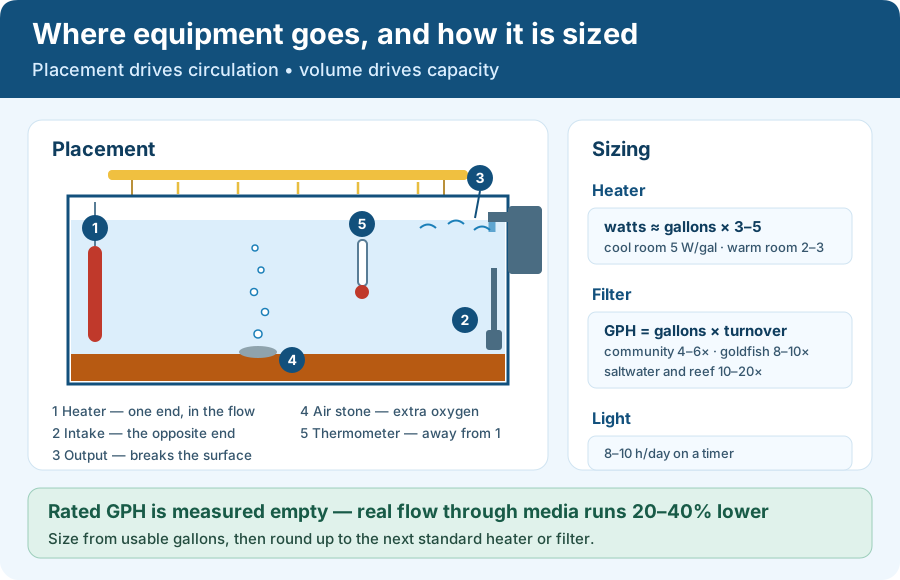
The wattage shown is the next standard commercial size at or above the calculated target. Choose a heater with a built-in thermostat and set it to your target temperature. For tanks over 50 gallons, two half-wattage heaters placed at opposite ends give more even heating and a safety backup if one fails.
Filter (GPH)
GPH — gallons per hour — tells you how much water the filter moves. The minimum figure is the floor; the recommended figure gives a safe buffer. When comparing filter specs, use the flow rate with media installed, not the manufacturer's peak rating in empty water.
Air Pump (LPH)
LPH — liters per hour — is the standard rating for air pumps. The figure shown is a baseline for surface aeration. If you are running multiple sponge filters, air stones, or a protein skimmer off the same pump, step up one size on the chart. Saltwater tanks need roughly double the air volume of freshwater setups.
Lighting (Hours & Intensity)
The lighting card shows daily photoperiod and intensity guidance, not a specific fixture recommendation. Planted tanks need more intense, longer-duration light. Reef tanks require specialized spectrum LED fixtures. Always use a timer — a consistent photoperiod prevents algae spikes and reduces fish stress.
Complete aquarium equipment sizing guide
In-depth reference for heater wattage, filter GPH, air pump sizing, lighting, and when to upgrade your equipment.
What Is an Aquarium Equipment Calculator?
An aquarium equipment calculator is a sizing tool that takes your tank's volume and environment as inputs and returns specific equipment recommendations — heater wattage, filter flow rate, air pump output, and lighting duration. Proper equipment sizing is one of the most overlooked aspects of fish keeping. Undersized heaters cannot maintain stable temperature; undersized filters allow ammonia and nitrate to build up; and inconsistent lighting causes algae blooms and stresses both fish and plants.
The calculator on this page covers four categories: heater wattage in watts, filter flow rate in gallons per hour (GPH), air pump output in liters per hour (LPH), and a lighting photoperiod and intensity guide. It adjusts recommendations by tank type — freshwater community, saltwater, planted, goldfish, and shrimp — because each has meaningfully different equipment demands.
Heater Size Guide for Aquariums
The most widely used heater sizing formula is watts per gallon. In a moderate room (65–72°F), plan for 3–4W per gallon. In a cool room (60–65°F), increase to 5W per gallon. In a warm room above 72°F, 2–2.5W per gallon is often sufficient.
Always round up to the next standard commercial size: 25W, 50W, 75W, 100W, 150W, 200W, 300W, or 500W. A heater that runs continuously at full power is working too hard; you want a heater rated slightly above your calculated need so it cycles on and off. For tanks over 40 gallons, two smaller heaters provide redundancy — if one fails in winter, the second prevents a temperature crash that could kill your fish overnight. Saltwater tanks lose heat faster through evaporation, so add 15–20% to your calculated wattage.
Goldfish are the exception: they are cold-water fish that do not need a heater in most homes. Keeping goldfish above 75°F shortens their lifespan, lowers dissolved oxygen, and increases disease susceptibility.
Aquarium Filter Size: GPH and Turnover Rate
GPH — gallons per hour — measures how much water your filter processes. Turnover rate divides GPH by tank volume to tell you how many times per hour the full tank volume passes through the filter media. Most community freshwater tanks need 4–6× turnover per hour. A 30-gallon tank therefore needs a filter rated at 120–180 GPH minimum.
Goldfish are exceptionally messy and need 8–10× turnover — double most community fish. Planted tanks do best at 4× turnover with gentle flow that does not uproot plants or disturb CO2 levels. Saltwater and reef tanks need 10–20× turnover because marine biological filtration demands are much higher and saltwater holds less dissolved oxygen than fresh.
Shrimp tanks should use sponge filters with a pre-filter sponge over the intake. Fine shrimp and fry can be sucked into standard hang-on-back or canister filters if the intake is unprotected.
When comparing filter specifications, always look for the rated GPH with media installed — not the peak flow in an empty test tank. Real-world flow through activated carbon, ceramic rings, or sponge media is typically 20–40% lower than the peak rating.
Choosing the Right Air Pump Size
Air pumps are rated in liters per hour (LPH) and drive bubbles through air stones, sponge filters, or protein skimmers. The baseline formula is approximately 0.5 liters of air per liter of tank water per hour for freshwater setups. Saltwater tanks need double this rate because saltwater holds less dissolved oxygen and marine inhabitants are more sensitive to oxygen fluctuation.
Standard commercial air pump sizes are 40, 60, 100, 150, 200, and 400 LPH. Always choose the next size above your calculated need — running an air pump at its upper limit creates back-pressure, reduces pump lifespan, and produces more heat and noise.
If you already have a hang-on-back or canister filter that creates vigorous surface agitation, a separate air pump may not be necessary for a standard freshwater community tank. Air pumps become more critical in heavily stocked tanks, summertime when oxygen solubility drops with temperature, and in tanks housing high-oxygen-demand species like rainbowfish or danios.
Aquarium Lighting Guide
Lighting serves three functions in an aquarium: supporting live plants, providing natural day/night signals for fish behavior, and creating a visually appealing display. Light requirements vary significantly by tank type.
Standard freshwater community tanks do best with 8–10 hours of moderate light per day at 1–2W per gallon equivalent. Planted tanks need 8–12 hours and 2–4W per gallon to support photosynthesis, though this must be balanced with CO2 and fertilizer to prevent algae explosions. Saltwater reef tanks require specialized full-spectrum LED fixtures that deliver the right wavelengths for coral photosynthesis — consult species-specific requirements before choosing a reef light.
The most important lighting habit you can build is using a timer. Inconsistent photoperiods confuse fish, trigger algae blooms, and stress plants. A simple 24-hour mechanical or digital timer set to the same on/off time daily makes a visible difference in tank health within weeks.
Signs You Need to Upgrade Your Equipment
Equipment that worked well for your tank six months ago may now be inadequate if you have added livestock, plants, or upgraded to a larger tank. Watch for these warning signs that your heater, filter, or pump needs replacement or a size upgrade.
Heater: Temperature swings of more than 2°F between morning and evening, a heater that runs continuously without reaching the set temperature, or a thermostat that reads correctly but actual water temperature differs by more than 1–2°F.
Filter: Nitrate levels above 20 ppm between weekly water changes, persistent cloudiness despite regular maintenance, fish hovering at the surface for oxygen, or visible uneaten food remaining on the substrate 30 minutes after feeding.
Air pump: Reduced bubble output, increased operating noise, fish showing signs of low oxygen (gasping, lethargy), or a pump that runs hot to the touch. Air pump diaphragms typically last 1–2 years in continuous operation and are often inexpensive to replace rather than the whole unit.
Aquarium equipment calculator — frequently asked questions
Answers to the most common questions about heater wattage, filter GPH, air pump sizing, turnover rate, and lighting.
Guides and tools to pair with this calculator
Use these guides and tools alongside the aquarium equipment calculator to build a complete, well-equipped setup.
How to Set Up a Fish Tank
Step-by-step guide covering equipment placement, cycling, and stocking your first tank safely.
Aquarium Encyclopedia
Species profiles with temperature ranges, tank size minimums, and equipment compatibility notes.
Aquarium Size Calculator
Calculate your tank's actual volume in US gallons, UK gallons, and litres before sizing equipment.
Aquarium Planner
Build a complete equipment, cycling, and stocking checklist before purchasing your setup.
Water Parameter Checker
Test pH, ammonia, nitrite, nitrate, and temperature readings for instant water quality assessment.
Goldfish Care Guide
Why goldfish need different equipment — high filtration, no heater, and cool water — explained in full.