The zebra loach (Botia striata) is a peaceful, mid-sized loach from the Krishna River system of southern India, recognisable by its gold body, fine dark bars and usually red mouth.
It was described from the Tunga River in Karnataka, a Western Ghats tributary of the Tungabhadra and ultimately the Krishna. It has also been recorded in the Koyna and Panchganga rivers in Maharashtra.[2] FishBase describes its habitat as clear mountain streams.[1] One field survey on the neighbouring Bhadra River found it at only one of six sites, below a dam, over a bed of bedrock, boulders and cobbles in soft, neutral, 21 °C water.[3][2]
In the wild the species is listed as Endangered on the IUCN Red List.[1] Aquarium stock is produced commercially, so buying farm-bred fish does not add to pressure on wild populations.[2] The sections below explain how to keep a group healthy: tank size, setup and diet, starting with the question owners ask most often: which tank mates work.

Zebra Loach Tank Mates
This species is peaceful, but it is busy and boisterous, and Seriously Fish warns that much smaller fish can be intimidated by its size and constant activity.[2] Choose tank mates by speed and fin shape as well as by temperament.
| Tank mate | Verdict | Notes |
|---|---|---|
| Danios, rasboras, peaceful barbs | Good | Open-water cyprinids are the recommended core community[2] |
| Barilius (hill trout) | Good in large tanks | Seriously Fish lists Barilius as an option once the tank is big enough for these fast swimmers[2] |
| Bala shark (Balantiocheilos) | Large tanks only | Grows far bigger than the loaches and needs a very long tank[2] |
| Other Botia; clown loach | Good / very large tanks | Most Botia mix well; clown loaches only in very large aquaria[2] |
| Siamese algae eater, rainbow shark, Garra | Possible | Crossocheilus, Epalzeorhynchos and Garra are listed as possibilities[2] |
| Bettas, guppies, many cichlids | Avoid | Slow, long fins get nipped[2] |
Can zebra loaches live with Barilius? Yes, provided the tank gives the Barilius enough length to swim. Both come from clear, flowing hill streams in South Asia, both need plenty of oxygen, and they use different levels of the tank, so they suit each other better than most mixes do. Run the full stocking list through the compatibility checker first, since Barilius species vary a lot in adult size.
How Many Zebra Loaches to Keep Together
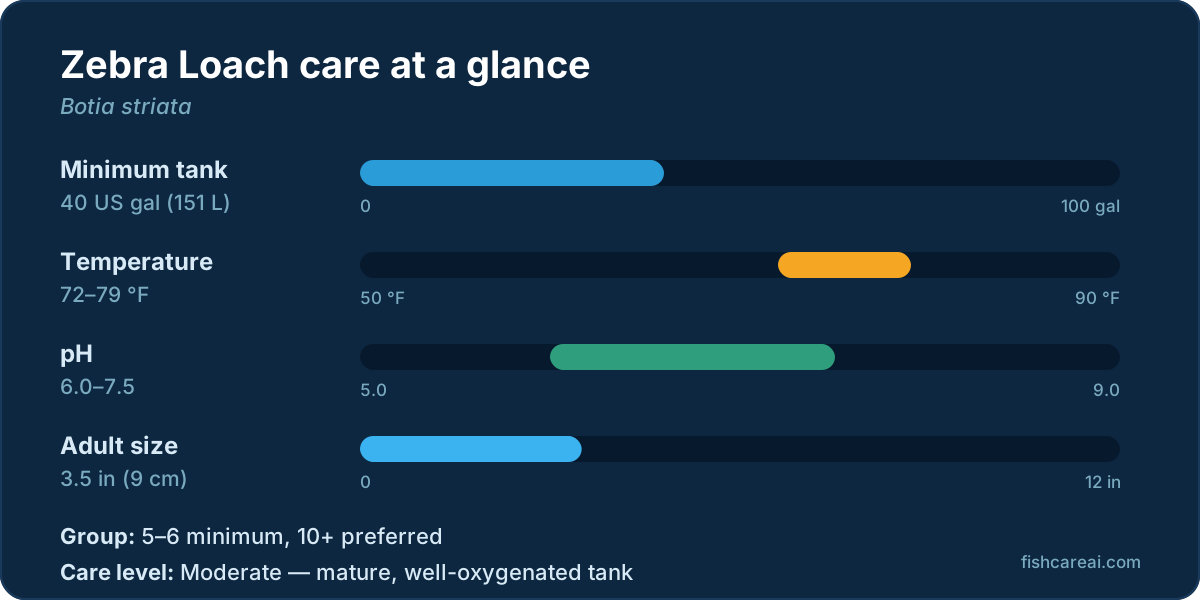
Botia are gregarious fish with complex social hierarchies. Seriously Fish recommends at least five or six, and preferably ten or more.[2] Fewer causes trouble. A single fish may become withdrawn or turn on similarly shaped tank mates, and in a pair or trio the dominant loach can harass the others until they stop eating.[2] In a larger group the aggression is spread across many fish, and you see more of the species' social rituals and play-like chasing.
Zebra Loach Tank Size and Setup
The minimum is a base of 120 × 30 cm (48 × 12 in), roughly a 40-gallon long tank.[2] Zebra loaches cover the whole floor of the tank, and the length is what gives a group room to establish its pecking order.
- Substrate: sand or fine gravel with smooth, water-worn pebbles and rocks.[2]
- Cover: driftwood, rock caves or flower pots. Loaches squeeze into gaps, so remove sharp edges and seal any hole small enough to trap a fish.[2]
- Plants: Java fern, Java moss and Anubias tied to the hardscape. Soft-leaved plants may be eaten.[2]
- Flow: moderate current and plenty of oxygen. Turbulence is not necessary.[2]
- Lid: tight-fitting, because these loaches do jump.[2]
Water Parameters and Maintenance
Seriously Fish gives 21–26 °C (70–79 °F), pH 6.0–7.5 and 1–10 dGH. FishBase gives 23–26 °C, pH 6.0–8.0 and 5–12 dGH.[1][2] Water quality matters more than precise chemistry. Botiids do not tolerate a build-up of organic waste, should never go into a tank that is still cycling, and do best with routine weekly water changes of 30–50%.[2] University of Florida extension guidance lists low dissolved oxygen among the water-quality stressors that come before many disease outbreaks, and recommends keeping it at 5 mg/L or more.[4] For a hill-stream fish like this, surface movement from the filter outlet is worth having.
What Zebra Loaches Eat
In the wild, Botia eat aquatic snails, insects, worms and other invertebrates, and they also take plant matter when available.[2] A good captive diet combines sinking pellets with frozen or live bloodworm and brine shrimp, plus vegetables such as cucumber, courgette or blanched spinach.[2] Once settled, zebra loaches feed boldly and often rise into midwater at mealtimes.
Sexing and Breeding
Mature females are usually plumper than males, especially when carrying eggs.[2] The species has not been bred in home aquaria. Commercial farms produce it using hormone injections.[2] The same farms have started producing hybrids, including an apparent cross between a Botia and the clown loach, so buy from a seller who can confirm what the fish are.
Zebra Loach FAQ
Are zebra loaches compatible with Barilius?
How many zebra loaches should be kept together?
How big do zebra loaches get?
Will zebra loaches eat my plants or shrimp?
Related Species
References
- Froese, R. & Pauly, D. (eds.). Botia striata Narayan Rao, 1920. FishBase, version 2025. fishbase.se
- Seriously Fish. Botia striata (Zebra Loach). Species profile. seriouslyfish.com
- Shahnawaz, A., Venkateshwarlu, M., Somashekar, D. S. & Santosh, K. (2010). Fish diversity with relation to water quality of Bhadra River of Western Ghats (India). Environmental Monitoring and Assessment 161: 83–91. doi.org/10.1007/s10661-008-0729-0
- Francis-Floyd, R. Stress — Its Role in Fish Disease (Circular 919). University of Florida IFAS Extension. edis.ifas.ufl.edu