The upside down catfish (Synodontis nigriventris) is a small, peaceful Congo River catfish that swims belly-up for most of its life.
It comes from the middle Congo basin, including Pool Malebo and the Kasai and Ubangi drainages, with further records from the Kouilou-Niari basin in the Republic of the Congo.[1] There it lives along densely vegetated riverbanks. It feeds mainly at night on insects, small crustaceans and plant matter, often picking food from the underside of leaves and the water surface while upside down.[1][2]
Seriously Fish rates it one of the gentlest members of its genus and a good first "oddball" for a community tank.[2] This guide covers what makes it easy, what can still go wrong, and the research showing why swimming upside down is efficient rather than a defect.

Upside Down Catfish Difficulty Level
| Factor | Rating | Why |
|---|---|---|
| Water chemistry | Easy | Accepts pH 6.0–8.0 and soft to moderately hard water[1][2] |
| Diet | Easy | Omnivore that takes flakes, pellets, frozen food and vegetables[2] |
| Temperament | Easy | Peaceful; one of the mildest Synodontis[2] |
| Social needs | Moderate | Stays hidden and nervous unless kept in a group[1][2] |
| Activity pattern | Moderate | Nocturnal, so feeding must reach it after dark[1] |
| Breeding | Hard | Rare in aquaria and poorly documented[2] |
Overall, this is a beginner-friendly fish whose main demand is company. A lone fish usually spends the whole day wedged in a cave, and owners often assume it has died. A group of four or five gives each fish the confidence to come out and roost under leaves in view.[2]
Upside Down Catfish Tank Size and Setup
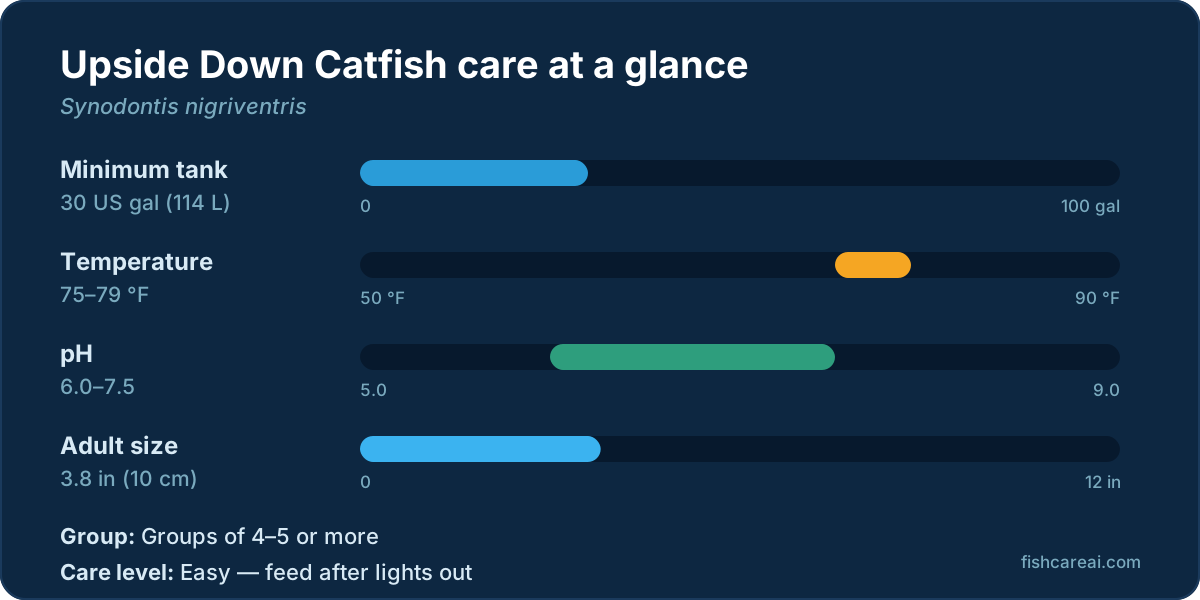
FishBase gives 80 cm (about 32 in) as the minimum tank length for a group of five or more.[1] Seriously Fish notes that a single fish could manage in a 75 × 30 × 30 cm (30 × 12 × 12 in) tank of about 70 litres, but stresses that a group needs more room.[2] A 30-gallon tank suits a group of four or five, and a 4-foot tank lets you add a few more.
- Lighting: dim, or shaded by floating plants.[2]
- Hiding places: caves made from rocks, driftwood and twisted roots, with one cave per fish.[2]
- Plants: broad-leaved species such as Anubias or Amazon swords, whose undersides the catfish rest against.[2]
- Substrate: sand or smooth fine gravel to protect the barbels.
Water Parameters
Seriously Fish lists 24–28 °C, pH 6.0–7.5 and 5–20 dGH, and FishBase lists 22–26 °C, pH 6.0–8.0 and 5–12 dGH.[1][2] The overlap, about 24–26 °C (75–79 °F) at near-neutral pH, works well in most community tanks. Keep the temperature steady, since Seriously Fish flags temperature as the parameter this species is least tolerant of changing.[2]
What Upside Down Catfish Eat
Like other Synodontis, this catfish will eat almost anything: dried, frozen and live foods are all accepted. It also rasps at vegetables such as shelled peas and cucumber with the teeth in its lower jaw.[2] Unlike most of its relatives it often feeds at the surface, upside down, taking floating flakes from below.[2]
The key detail is timing. Wild fish feed mainly at night.[1] In a busy community, daytime food is gone before the catfish leave their caves. Drop a few sinking pellets or a pinch of frozen bloodworm in after the lights go off, at least every other day.
Why Does the Upside Down Catfish Swim Inverted?
This fish spends most of its time inverted, and the habit has a clear purpose. In a 2007 study in the Journal of Experimental Biology, Blake and Chan measured drag on fish swimming just below the surface. Swimming belly-up created about 15% less drag than swimming upright. While gulping air at the surface, upright fish faced 1.5 times the drag of inverted fish.[3] Swimming deeper, they found no difference between the two postures.
Their conclusion was that the posture pays off where this catfish feeds and breathes: at the air–water boundary, picking food from the undersides of leaves and taking occasional gulps of air.[3] The dark belly makes sense from the same angle. Seen from above it blends with the dark water, which is the reverse of the usual pattern in fish, and the authors suggest this reverse countershading evolved together with the inverted habit and night-time activity.[3]
The fry do not start out this way. Young fish swim upright and switch to the inverted position at around seven to eight weeks old.[2]
Peaceful Tank Mates
Almost any peaceful community fish is suitable. Seriously Fish suggests African biotope companions in particular: African tetras such as the Congo tetra, West African dwarf cichlids like Pelvicachromis (the kribensis) or Anomalochromis, and small mormyrids.[2] Avoid aggressive cichlids and large predators, and do not mix it with big, boisterous Synodontis that will take over every cave.
Sexing and Breeding
Males are slimmer and darker than females. The fish are too small to sex by checking the genital papilla.[2] Spawning in aquaria has been reported but is poorly documented. Because the species breeds in the rainy season, when it moves into flooded areas, a large, cooler water change is the usual suggested trigger.[2]
Reports disagree on where the eggs go: some describe a pit in the substrate, others a cave or length of pipe, so offer both. Up to about 450 eggs have been recorded. The fry swim freely after roughly four days and can be started on brine shrimp nauplii or microworms.[2] FishBase notes that the parents tend the clutch rather than guarding it aggressively.[1]
Upside Down Catfish FAQ
Are upside down catfish good for beginners?
How big do upside down catfish get?
Why is my upside down catfish swimming the right way up?
Do these catfish need to live in a group?
Related Species
References
- Froese, R. & Pauly, D. (eds.). Synodontis nigriventris David, 1936. FishBase, version 2025. fishbase.se
- Seriously Fish. Synodontis nigriventris (Upside-down Catfish). Species profile. seriouslyfish.com
- Blake, R. W. & Chan, K. H. S. (2007). Swimming in the upside down catfish Synodontis nigriventris: it matters which way is up. Journal of Experimental Biology 210: 2979–2989. doi.org/10.1242/jeb.006437