The iridescent shark (Pangasianodon hypophthalmus) is a large migratory catfish from the rivers of mainland Southeast Asia, sold in pet shops as a small, shimmering "shark" for community tanks.
In the wild it lives in the main channels and large tributaries of the lower Mekong and the Chao Phraya, moving upstream to spawn when the rivers flood.[1][2] It is also one of the most important farmed fish in the region: FishBase calls it one of the most important aquaculture species in Thailand, and it is the farmed catfish sold abroad as swai or pangasius.[2] Nearly every specimen in the aquarium trade comes from the same fish farms.[1]
The trade names are the problem. Seriously Fish notes that names like "shark" are chosen to sell fish, and that many buyers are given no information about the adult size or lifespan, so fish are later rehomed or dumped.[1] This profile sets out what an adult really needs, how to recognise one in the shop, and what to do if you already own one.
How Big Does an Iridescent Shark Get?
FishBase records a maximum standard length of 130 cm and a weight of up to 44 kg, though the weight comes from an unverified photograph.[2] Seriously Fish says captive fish rarely reach the full 130 cm but easily exceed 90 cm, and that they live for more than 20 years.[1] Growth is fastest in the first two years, so a fish bought at a few centimetres outgrows a typical home tank far sooner than most owners expect.
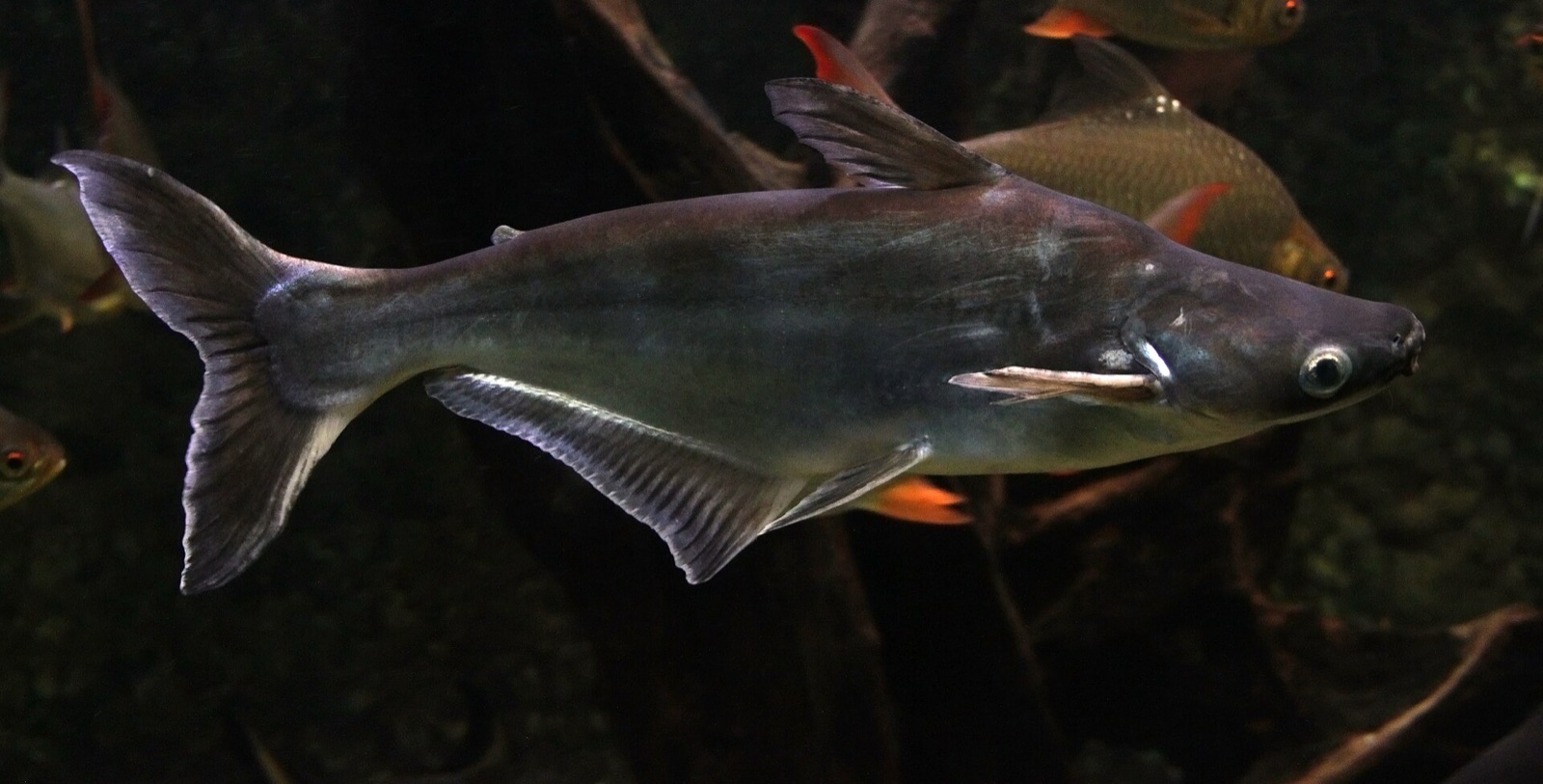
The "shark" look also fades with age. Juveniles are silvery with two dark lateral stripes and that sheen. Adults lose the stripes and the shine and turn a plain dark grey, with a tall dorsal fin and a long anal fin (see the photo above). The fish is a catfish in the family Pangasiidae, not a shark or any kind of cartilaginous fish.[2]
What Tank Size an Adult Actually Needs
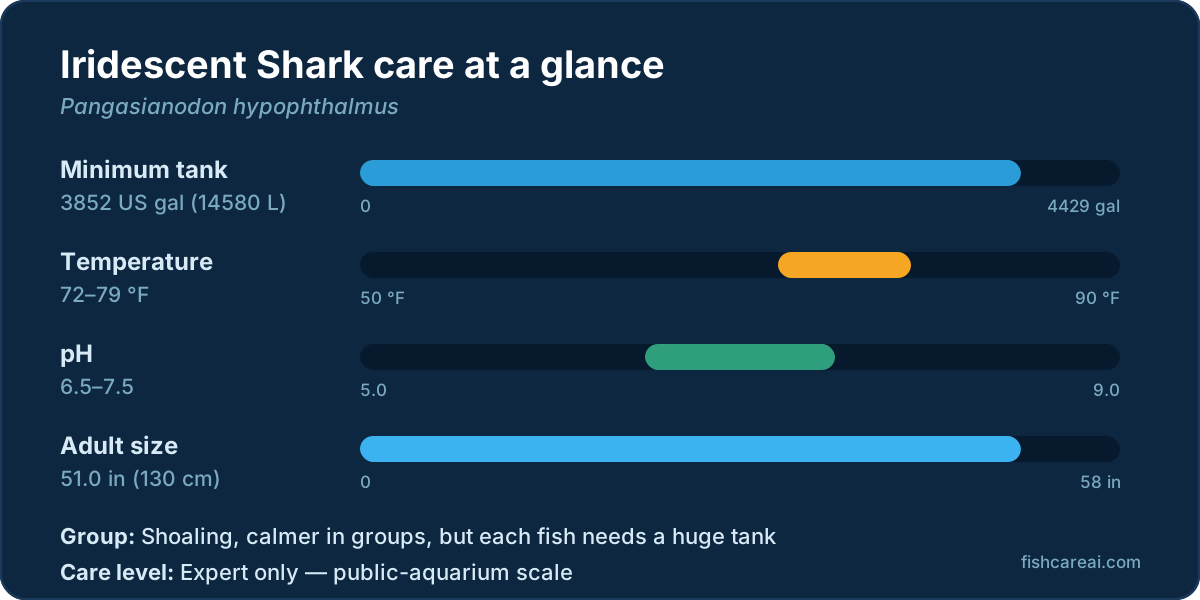
Seriously Fish gives a minimum of 450 × 180 × 180 cm (15 × 6 × 6 ft), about 14,580 litres or 3,850 US gallons, for a single specimen kept long term, and calls the species unsuitable for all but the very largest aquaria.[1] FishBase lists a minimum aquarium of more than 150 cm and recommends groups of five or more, which is only possible in public-aquarium systems.[2]
Juveniles can be grown on in smaller tanks, but only if the large system is already planned.[1] A 55- or 75-gallon tank is a temporary home for a few months at most, not a compromise size. Cramped fish swim in panicky bursts, crash into the glass and décor, and injure their snouts and fins.[1]
Setting up the tank
- Open water: adults need long, uninterrupted swimming space. Décor is optional; anything you add, such as large bogwood or smooth rocks, must be too heavy to move or be fixed in place.[1]
- Dim lighting: bright, bare tanks make the fish more nervous.[1]
- Heavy lid: frightened fish breach the surface and can jump out.[1]
- Protected equipment: a large fish can break heaters and thermometers, so keep them in a sump or behind guards.[1]
Water Parameters and Filtration
Seriously Fish recommends 22–26 °C (72–79 °F), pH 6.5–7.5 and a general hardness of anywhere from 2 to 30 dGH, so water chemistry is less of a challenge than volume.[1] FishBase gives the same temperature and pH ranges.[2] The water should be well oxygenated and moving, as in the river channels the species comes from.[1]
A fish this size produces a lot of waste. Seriously Fish advises a large, efficient biological filter, preferably a sump.[1] Ammonia and nitrite must stay at zero, because both damage the gills even at low levels, and toxicity rises with pH and temperature.[5] Large, frequent water changes are part of the routine, not an occasional job.
Why it gulps air at the surface
This catfish can breathe air through a modified swim bladder. In well-oxygenated water its gills alone cover its resting needs, but when oxygen falls it switches to gulping air at the surface, and in one study it began air-breathing below about 8 kPa of oxygen.[3] A second study found that it relies more on air breathing as water temperature rises.[4] Frequent dashes to the surface are therefore a sign to check oxygen, temperature and filtration, not a quirk to ignore.
Feeding an Iridescent Shark
It is an omnivore whose diet changes with age. In the wild it eats fish, crustaceans and plant debris.[2] Seriously Fish recommends plenty of protein for juveniles, such as chopped earthworm, bloodworm and dry pellets, and more vegetable matter for adults, including spinach, frozen peas, Spirulina-based foods and occasional fruit.[1]
Feed young fish small meals several times a day and adults once or twice. Uneaten food breaks down quickly in a large tank and feeds ammonia spikes, so remove leftovers. Because it eats any fish that fits in its mouth, it should never be given live feeder fish as a treat.
Iridescent Shark Tank Mates
It is not aggressive, but it will eat anything small enough to swallow, which in a few months includes neon tetras, guppies and most community fish.[1] Suitable companions are large, peaceful fish that hold their own: big doradid catfish such as Oxydoras niger, Megalodoras uranoscopus and Pterodoras granulosus, pacu, and larger cyprinids.[1]
On this site, the pacu, tinfoil barb and silver arowana are the kinds of fish that share a tank of that scale. Keep in mind that each of them also needs a very large aquarium of its own.
Sexing and Breeding
Females are reported to be stockier and more lightly patterned, but these differences cannot be seen at the size the fish are sold.[1] The species migrates upstream to spawn in late spring and summer, and aquarium spawning is considered unlikely.[1] Farms breed it in large ponds in Southeast Asia, which is where nearly all aquarium stock comes from.[1]
Already Own One That Is Outgrowing Its Tank?
Do not release it. It is not native outside Southeast Asia, and FishBase notes it has been introduced into other river basins for aquaculture.[2] Release is illegal in many places and almost always fatal for the fish.
- Measure the fish now and compare it with the 90 cm or more it will likely reach.[1]
- Contact local fish clubs, specialist monster-fish keepers and public aquariums. Many public aquariums cannot accept more iridescent sharks, so start early.
- Until it is rehomed, cut stocking, upgrade filtration and keep water changes frequent to limit stress and injuries.
If you are choosing a fish with a similar look for a home tank, the bala shark and the rainbow shark are often suggested. Bala sharks still need a large tank, so check their profiles before buying.
Iridescent Shark FAQ
Is an iridescent shark a real shark?
How big do iridescent sharks get in an aquarium?
What size tank does an iridescent shark need?
Can iridescent sharks live with small fish?
Why does my iridescent shark keep swimming to the surface?
Related Species
References
- Seriously Fish. Pangasianodon hypophthalmus (Iridescent Shark Catfish). Species profile. seriouslyfish.com
- Froese, R. & Pauly, D. (eds.). Pangasianodon hypophthalmus (Sauvage, 1878). FishBase, version 2025. fishbase.se
- Lefevre, S., Huong, D. T. T., Wang, T., Phuong, N. T. & Bayley, M. (2011). Hypoxia tolerance and partitioning of bimodal respiration in the striped catfish (Pangasianodon hypophthalmus). Comparative Biochemistry and Physiology A 158: 207–214. doi.org/10.1016/j.cbpa.2010.10.029
- Damsgaard, C., Thomsen, M. T., Bayley, M. & Wang, T. (2018). Air-breathing changes the pattern for temperature-induced pH regulation in a bimodal breathing teleost. Journal of Comparative Physiology B 188: 451–459. doi.org/10.1007/s00360-017-1134-1
- Francis-Floyd, R., Watson, C., Petty, D. & Pouder, D. B. Ammonia in Aquatic Systems (FA16). University of Florida IFAS Extension. edis.ifas.ufl.edu