The motoro stingray (Potamotrygon motoro), also called the ocellate river stingray, is the most widespread freshwater ray in South America and the one most often seen in the aquarium trade.
It lives in the Amazon, Orinoco, Paraná-Paraguay and Uruguay river systems, on sandbanks, in river shallows and slow tributaries with mud or sand, and in flooded forest during the wet season.[1][2] Its brown disc is covered in large orange-yellow spots, each ringed in black, which is where the "ocellate" name comes from.
Rays are rewarding pets: they become tame enough to recognise their owners and to take food at the surface.[1] They are also among the most demanding fish you can buy, with a tank the size of a small room, high water-quality needs and a sting that can put a keeper in hospital. This profile covers each of these.
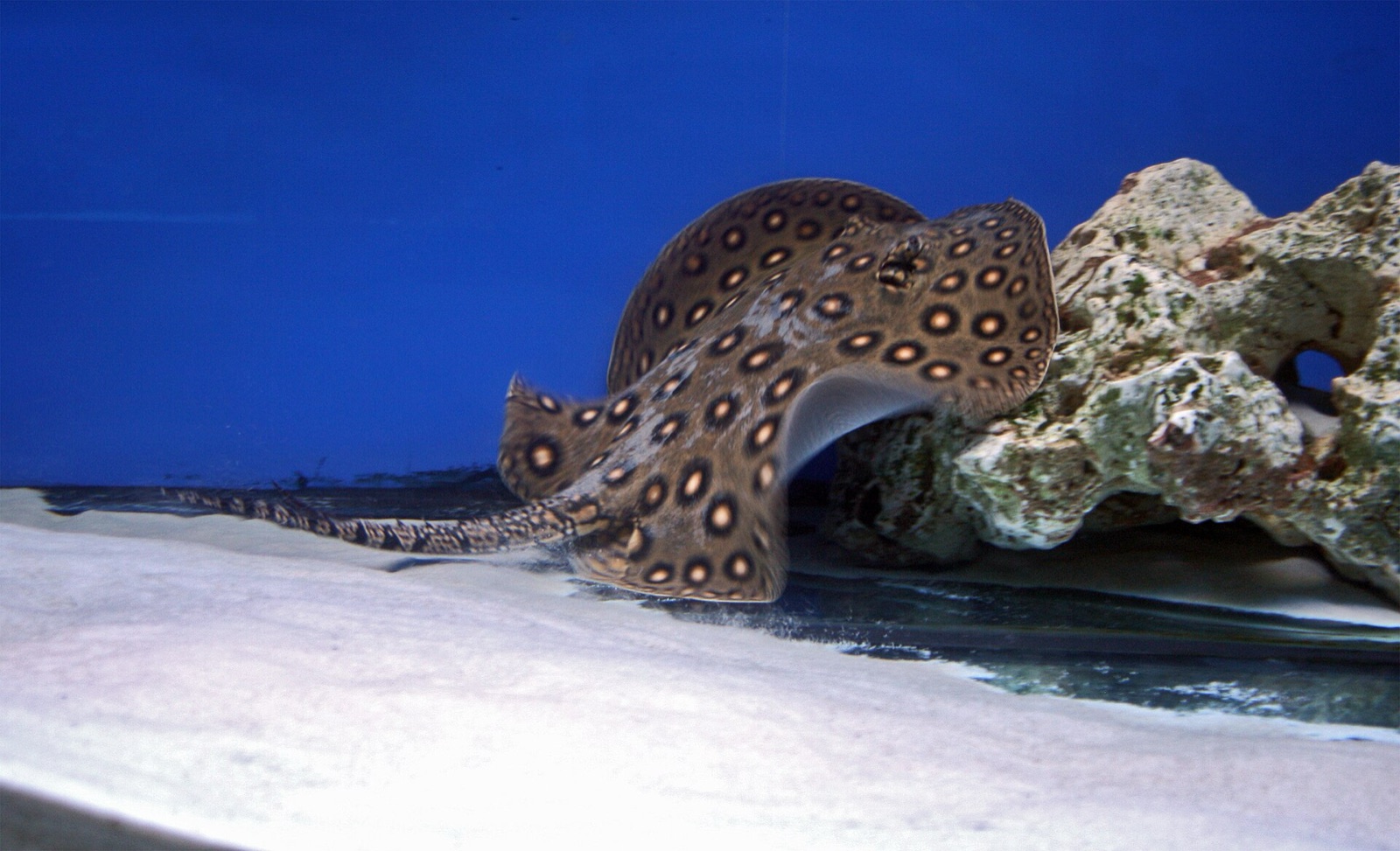
Motoro Stingray Tank Size and Setup
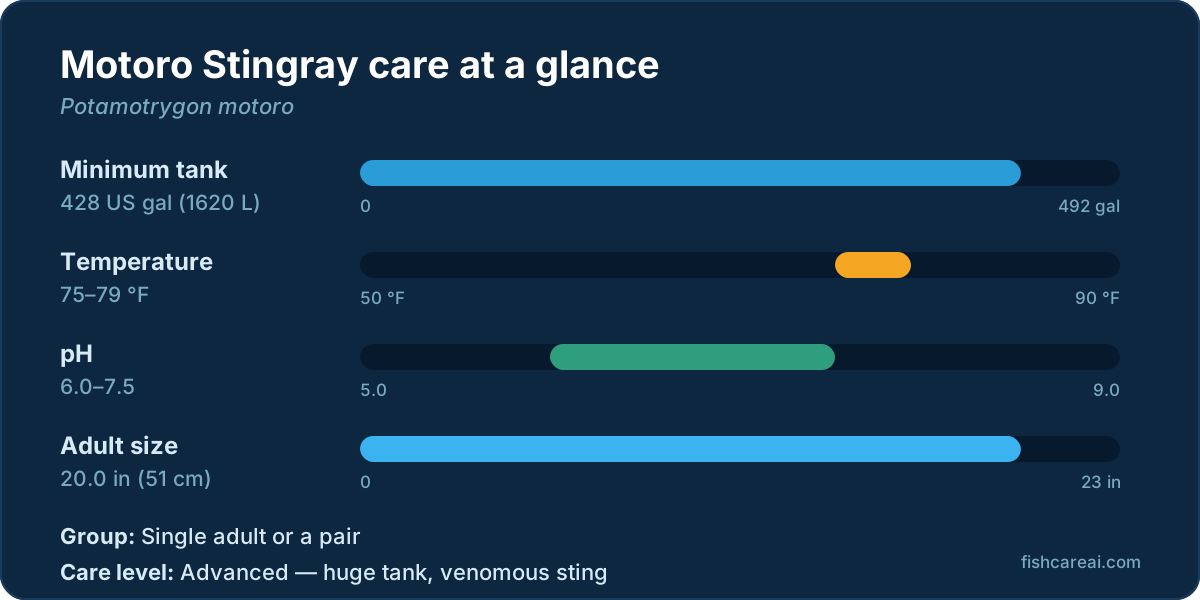
FishBase records a maximum disc width of 50 cm.[2] Seriously Fish recommends 240 × 90 × 75 cm (96 × 36 × 30 in), about 1,620 litres or 428 US gallons, for an adult or a pair, and says the tank should be at least 2 m long.[1] Width matters as much as length, because the ray needs room to turn its whole disc.
- Substrate: fine river sand, especially for juveniles. Rays bury themselves when stressed, and Seriously Fish considers denying them a sand bed unkind.[1]
- Décor: optional. Use large bogwood, branches or smooth rocks that are too heavy to move or are fixed in place, and leave as much open floor as possible.[1]
- Lighting: dim light is preferred.[1]
- Plants: rooted plants get dug up or eaten; Java fern and Anubias attached to wood may survive.[1]
- Heater guards: a ray resting against an unguarded heater can be burned, so keep equipment in a sump or behind guards.
Water Quality and Filtration
Seriously Fish gives 24–26 °C (75–79 °F), pH 6.0–7.5 and a hardness of 1–12 dGH, and stresses that the temperature should be kept very steady.[1] FishBase lists the same temperature but a lower pH of 5.0–6.0.[2] Both point to soft, slightly acidic water; stability matters more than hitting an exact pH.
Water quality is where most rays are lost. Seriously Fish recommends about 50% water changes every week, a large and efficient biological filter (ideally a sump) and a turnover of around four times the tank volume per hour, with the outflow directed to create a current along the tank.[1] Rays tolerate nitrate fairly well but not ammonia or nitrite.[1] Both are toxic to gills at low levels, and ammonia becomes more toxic as pH and temperature rise.[4]
Feeding a Motoro Stingray
Rays have a high metabolism and should be fed at least twice a day.[1] Seriously Fish suggests bloodworm, Tubifex, Artemia and krill for juveniles, and whole mussels, cockles, prawns, squid, whitebait or other fish, and earthworms for adults. Some accept dried foods.[1]
- New arrivals: imported rays are often thin and reluctant to feed. Start them on live bloodworm or earthworms, then wean them onto frozen food.[1]
- Avoid mammal meat: beef heart and chicken contain fats rays cannot metabolise properly.[1]
- Avoid feeder fish: livebearers and small goldfish carry disease and parasite risks.[1]
Is a Motoro Stingray Dangerous? Sting Safety
Yes, it can be. The sting sits on top of the tail with backward-facing barbs, and FishBase classifies the species as one that can cause injury.[1][2] A clinical study of 84 people stung by freshwater stingrays in Brazil found that intense pain was the most common symptom and that skin necrosis occurred in a high proportion of victims.[3] Hot-water immersion relieved the acute pain but did not prevent necrosis.[3]
- Wear thick gloves for feeding and tank maintenance, and keep your hands in view of the ray.[1]
- Never catch a ray with a net. Guide it into a solid container or a large fish bag.[1]
- Stings are shed about every six months and stay venomous, so check the sand before siphoning.[1]
- If you are stung, put the wound in water as hot as you can safely tolerate and get medical advice.[1][3]
Motoro Stingray Tank Mates
Rays are predators on the bottom and prefer a quiet tank. Good companions are large, peaceful fish that stay in the upper water, such as Heros and Geophagus cichlids, large characins and cyprinids, arowana, Cichla, Datnioides and bichirs.[1] On this site, the silver arowana, severum and ornate bichir fit that description.
Use care with discus, which some keepers have lost at night, and avoid most suckermouth catfish, which can latch onto a ray's disc and injure it; Hypostomus plecos are considered safe.[1] Do not mix different Potamotrygon species, because they hybridise freely.[1]
Choosing a Healthy Ray Before You Buy
Rays are expensive and slow to settle, so it pays to choose carefully. Seriously Fish describes motoros as hardy once established, but many imported fish arrive thin and stressed.[1]
- Watch it eat: ask the shop to feed the ray in front of you. A ray that will not eat in the shop is a risk.[1]
- Check the body: avoid rays with bones showing beside the tail base, a hollow between the eyes, or any lifting of the disc edges.[1]
- Avoid "bat" rays: these have a deformed disc caused by a genetic defect, and Seriously Fish advises against buying them.[1]
- Ask about origin: Seriously Fish notes that Brazil's environmental agency, IBAMA, controls ray exports and that no ray species can currently be exported legally from Brazil, so captive-bred stock is usually the better choice.[1]
- Have the tank ready: the full-size, fully cycled system should be running before the ray comes home, because juveniles grow quickly and do not tolerate unstable water.[1]
Acclimatise a new ray slowly, matching temperature and water chemistry carefully, and keep the lights low for the first days. Offer live bloodworm or earthworms to get it feeding, and do not add other new fish until it is eating well.[1]
Sexing and Breeding
Males are easy to tell apart: they have a pair of claspers, finger-like extensions of the pelvic fins that are visible even on juveniles.[1] Rays give birth to fully formed young. In aquaria, gestation is about 9–12 weeks and litters are 1–8 pups.[1] FishBase cites wild studies reporting anywhere from 3 to 21 embryos per pregnancy.[2]
Pick a pair with a larger female, since males chase and bite during courtship. Separate them if harassment is excessive, and give the female a break after every two or three litters.[1] Remove the pups, which live on a yolk sac for up to a week and then need live and frozen food several times a day, and do a large water change after the birth.[1]
Motoro Stingray FAQ
How big do motoro stingrays get?
What size tank does a motoro stingray need?
Are motoro stingrays venomous?
What do motoro stingrays eat?
Can motoro stingrays live with other fish?
Related Species
Housing, water, diet and breeding figures follow Seriously Fish, and size, range, litter data and conservation status follow FishBase.[1][2] Sting symptoms and first aid are cited to a clinical study of freshwater stingray injuries, and the ammonia guidance to the University of Florida extension service.[3][4]
References
- Seriously Fish. Potamotrygon motoro (Motoro Stingray). Species profile. seriouslyfish.com
- Froese, R. & Pauly, D. (eds.). Potamotrygon motoro (Müller & Henle, 1841). FishBase, version 2025. fishbase.se
- Haddad, V. Jr., Neto, D. G., de Paula Neto, J. B., de Luna Marques, F. P. & Barbaro, K. C. (2004). Freshwater stingrays: study of epidemiologic, clinic and therapeutic aspects based on 84 envenomings in humans and some enzymatic activities of the venom. Toxicon 43: 287–294. doi.org/10.1016/j.toxicon.2003.12.006
- Francis-Floyd, R., Watson, C., Petty, D. & Pouder, D. B. Ammonia in Aquatic Systems (FA16). University of Florida IFAS Extension. edis.ifas.ufl.edu