The Congo tetra (Phenacogrammus interruptus) is a peaceful, shoaling Congo tetra from the lower and middle Congo River basin in Central Africa.
FishBase records it from the Democratic Republic of the Congo and the Republic of Congo.[1] Almost all fish on sale are bred commercially in Asia and Eastern Europe.[2] Despite the name, it is not closely related to South American tetras such as neons. African tetras form their own family, the Alestidae, whose relationships Arroyave and Stiassny reconstructed in a 2011 molecular study.[4]
They are often overlooked in shops because juveniles are plain grey. Mature males are among the most striking freshwater fish, with iridescent bodies, a long dorsal fin and a feathery tail. This guide covers the tank size and water quality that bring out that colour, safe tank mates, and breeding.

Congo Tetra Tank Size and Setup
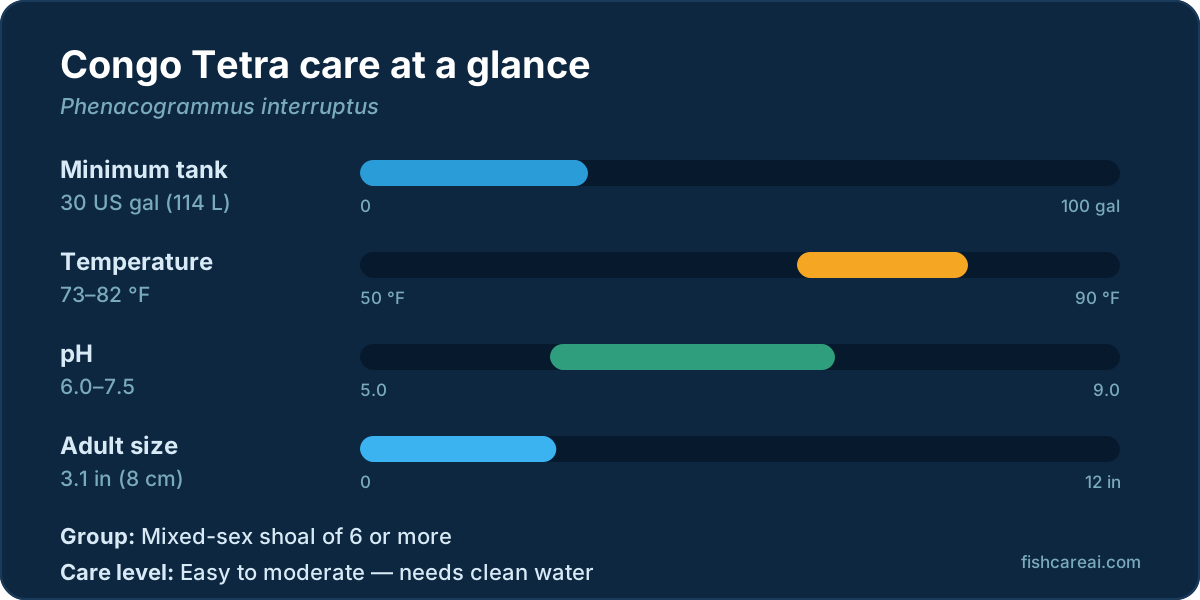
Seriously Fish recommends 120 × 30 × 30 cm (48 × 12 × 12 in) for adults, although juveniles can start in smaller tanks.[2] FishBase gives a 100 cm minimum length.[1] These active, fast swimmers need open space, and a short tank leaves them nervous and pale. A 4-foot tank of 30 gallons or more is the realistic target for a shoal.
An African biotope with driftwood branches, floating plants and Anubias suits them well. They also look good in any well-planted tank with open swimming space and good circulation.[2] Front and top lighting, especially natural light, shows off the males' iridescence.[2]
Congo Tetra Water Parameters
Seriously Fish gives 23–28 °C (73–82 °F), pH 6.0–7.5 and 3–18 dGH, and recommends soft water on the acidic side of neutral. FishBase lists 23–26 °C.[1][2] The species is sensitive to water quality. Seriously Fish notes that in poorly kept tanks males' fins may not develop properly and the fish lose colour.[2] Regular water changes and a mature filter with zero ammonia and nitrite are what bring out the fins people buy this fish for.[3]
Congo Tetra Tank Mates
This tetra is peaceful but can startle shy fish with its size and speed, and it is itself easily frightened if kept in small numbers.[2] Keep a mixed-sex shoal of at least five or six.[1][2] Good companions:[2]
- Other medium tetras and rainbowfish.
- Bottom dwellers such as Corydoras, plecos and Synodontis, including the upside down catfish from the same river basin.
- Peaceful cichlids such as kribensis (Pelvicachromis) or the keyhole cichlid.
- Avoid: fin-nippers such as tiger barbs or serpae tetras, which shred the males' fins, and boisterous fish that keep a shy shoal stressed.
Feeding
Wild fish eat worms, small insects, crustaceans, algae and plant matter.[1][2] In the aquarium they accept most foods. A good flake or small pellet works as the staple, but live and frozen foods such as bloodworm, brine shrimp and Daphnia should make up a good share of the diet for the best colour.[2] Include some plant-based food, such as a spirulina flake.
Male vs Female Congo Tetras
Males grow larger, up to about 8 cm against 6 cm for females, and are much more colourful.[1][2] They develop a long, flowing dorsal fin and extended filaments in the centre of the tail.[2] Females are smaller, deeper in the belly, and have short, rounded fins. These differences appear only as the fish mature, so buy six or more juveniles to be sure of getting both sexes.
Breeding Congo Tetras
Breeding is not easy, but it is possible. The species scatters its eggs and gives no parental care.[2]
- Condition the fish on live and frozen foods, then move the best-coloured male and the plumpest female into a small breeding tank with a mesh floor, subdued light and clumps of plants. Use soft water below pH 7.[2]
- After a chase, the pair spawn side by side with a quivering motion. A female can lay up to 300 large eggs over several days, though 100–200 is more typical.[2][1]
- Many eggs fungus within the first 24–48 hours. Remove those with a long pipette.[2]
- Eggs hatch in about six days. Once the yolk sac is used up, roughly a day later, feed infusoria, then brine shrimp nauplii or microworms two or three days after that.[2][1]
Congo Tetra FAQ
How big do Congo tetras get?
What size tank does a Congo tetra need?
Why is my tetra still grey?
How many Congo tetras should I keep?
Related Species
Husbandry and breeding follow Seriously Fish, and range, size and spawning figures follow FishBase.[1][2] The note on the African tetra family cites Arroyave and Stiassny's 2011 phylogeny.[4] An earlier version of this profile listed a 5-gallon minimum tank, which neither source supports.
References
- Froese, R. & Pauly, D. (eds.). Phenacogrammus interruptus (Boulenger, 1899). FishBase, version 2025. fishbase.se
- Seriously Fish. Phenacogrammus interruptus (Congo Tetra). Species profile. seriouslyfish.com
- Francis-Floyd, R., Watson, C., Petty, D. & Pouder, D. B. Ammonia in Aquatic Systems (FA16). University of Florida IFAS Extension. edis.ifas.ufl.edu
- Arroyave, J. & Stiassny, M. L. J. (2011). Phylogenetic relationships and the temporal context for the diversification of African characins of the family Alestidae (Ostariophysi: Characiformes): evidence from DNA sequence data. Molecular Phylogenetics and Evolution 60: 385–397. doi.org/10.1016/j.ympev.2011.04.016