100 Gallon Fish Tank at a Glance
100 Gallon Fish Tank Dimensions
In North America, “100 gallon fish tank” almost always means a 6-foot rimmed glass tank about 72 inches long, 18 inches front to back and 20 inches tall. That is the same depth as a 75 and the same height as a 55, stretched to twice the length of a standard 50 — which is why the 100 is defined by its swimming run rather than by height or depth. Metric rimless tanks in the 360–400 liter range are also sold as roughly 100 gallons and come in shorter, deeper proportions.
| Tank type | Length | Width (front to back) | Height | Best for |
|---|---|---|---|---|
| Standard 100 gallon (6-ft) | ≈ 72 in (183 cm) | ≈ 18 in (46 cm) | ≈ 20 in (51 cm) | Large schools, discus and angelfish groups, Malawi communities, an oscar or severum with companions, multi-zone aquascapes |
| Rimless 150 × 50 × 50 cm (metric) | 150 cm (≈ 59 in) | 50 cm (≈ 20 in) | 50 cm (≈ 20 in) | ≈ 375 L / 99 gal. Large nature aquascapes; a little shorter and deeper than the 6-ft standard |
| Rimless 120 × 60 × 55 cm (metric) | 120 cm (≈ 47 in) | 60 cm (≈ 24 in) | 55 cm (≈ 22 in) | ≈ 396 L / 105 gal. Deep 4-ft footprint for cichlid territories and heavy hardscape where a 6-ft wall is not available |
| For comparison: 55 gallon standard | ≈ 48 in (122 cm) | ≈ 13 in (33 cm) | ≈ 21 in (53 cm) | Half the water, 5 in less depth, 2 ft less length — see the 55 gallon guide |
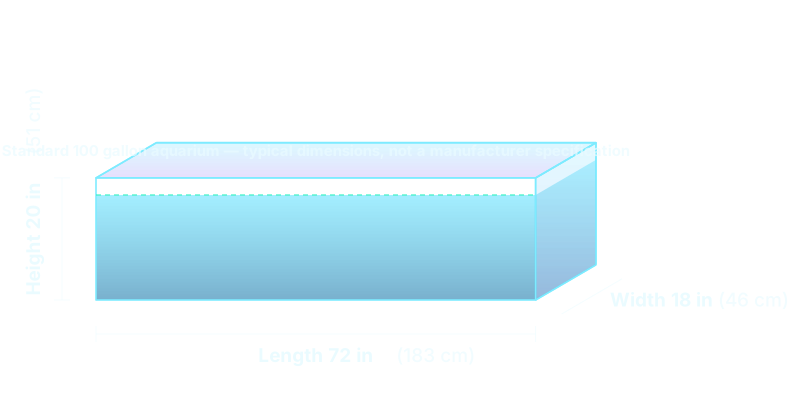
Why a 6-foot footprint changes what you can keep
Length is the resource large fish and large schools run out of first. A 72-inch tank gives a school of silver dollars or Denison barbs a run long enough to actually swim rather than turn, lets a group of discus spread out instead of stacking, and — critically for cichlids — allows two territories that do not overlap. A dominant fish holding one end of a 6-foot tank leaves 3 feet of neutral water; the same fish in a 4-foot tank leaves almost none.
The 18-inch depth matters too, because it is the same as a 75 gallon: bulky fish such as severums and oscars can turn, and rockwork can be stacked with caves behind the front line. What the 100 does not add is height. At 20 inches it is no taller than a 55, so it is not a better tank for very tall-bodied species; it is a longer, deeper one. Metric rimless 100s trade some length for depth and are better suited to heavy hardscape than to sprinting schools.
Compared with the 55 gallon fish tank and the 50 gallon fish tank, the 100 roughly doubles the floor area — about 1,300 square inches against 620–650 — and that, more than the gallon figure, is what makes it a different class of aquarium.
How Much Does a 100 Gallon Fish Tank Weigh?
One US gallon of freshwater weighs about 8.34 lb (3.78 kg). That alone puts a 100 gallon aquarium in a different weight class from every mid-size tank — but water is only part of the total. The glass is thicker and heavier, the 72 × 18 inch floor takes twice the substrate of a 55, and large tanks tend to carry large hardscape. The operating weight, not the water weight, is what the stand and floor experience.
| Component | Estimated weight | Basis |
|---|---|---|
| Empty glass tank | ≈ 180–200 lb (82–91 kg) | Typical for a rimmed 6-ft 100 with thicker panels; acrylic 100s weigh roughly 80–100 lb |
| Water | ≈ 750 lb (340 kg) | ≈ 90 gal actual × 8.34 lb after displacement and fill line |
| Substrate (2 in gravel) | ≈ 140–160 lb (64–73 kg) | 72 × 18 in floor × 2 in = 1.5 cu ft; gravel ≈ 90–100 lb per cu ft |
| Rock, wood and décor | ≈ 40–80 lb (18–36 kg) | Six-foot tanks invite serious hardscape; a Malawi rock tank can exceed 150 lb |
| Lights, filters, heaters, lid | ≈ 20–30 lb (9–14 kg) | Canisters and sumps load the stand and floor rather than the tank |
| Estimated operating weight | ≈ 1,100–1,250 lb (500–570 kg) | Before the stand, which adds 100–200 lb for a 6-ft cabinet |
Example calculation
Plan on about 1,200 lb for the aquarium itself and 1,300–1,400 lb with a stand — roughly double a running 55 or 50, and about the weight of a small car's engine and transmission sitting on a 72 × 18 inch patch of floor (about 9 square feet, or roughly 150 lb per square foot including the stand). A sump in the cabinet, a Malawi rock pile or a deep sand bed pushes it higher.
How Many Fish Can Live in a 100 Gallon Tank?
A 100 gallon tank supports anywhere from a single large cichlid with a few companions to sixty small schooling fish, and the range is that wide because volume is only one input. “100 gallons equals 100 inches of fish” would allow a 3-foot arowana that could not turn around, or fifty 2-inch tetras that would barely register on the filter — the rule does not distinguish between them, so it is not a rule worth using.
What actually sets the limit at this size
- Adult size and body mass. Mass grows roughly with the cube of length: one 12-inch oscar carries the bioload of well over a hundred 2-inch tetras. A 100 gallon tank makes one or two such fish possible, not several.
- Swimming behaviour. A 6-foot run is what turns silver dollars, Denison barbs and pictus catfish from glass-pacers into swimmers — and what a 72-inch tank offers that a 48-inch tank cannot.
- Territory. The 100 can hold two territorial fish or pairs at opposite ends, because the middle 3 feet stays neutral. It cannot hold four.
- Schooling requirements. At this size the minimum group is not the goal. Twenty-five rummy-nose tetras or a dozen peacock cichlids behave in ways six never will, and the 100 is the first common size that makes those numbers comfortable.
- Bioload and filtration. The 100 gallon filter market offers real choices — two canisters, or a sump — and the bioload you plan decides which. A discus tank and a Malawi tank of identical volume may need double the filtration of a planted tetra tank.
- Oxygenation. A 72 × 18 inch surface exchanges gas generously, but a warm, heavily stocked tank at 84°F holds less oxygen; surface agitation and flow matter more in a discus or cichlid 100 than the volume suggests.
- Maintenance frequency. A 25% change is 25 gallons — 200 lb of water. Your stocking should match the water changes you will actually perform, not the ones you intend to.
- Footprint. The 6-foot length permits large schools and two territories; the 20-inch height does not permit species that need tall water any more than a 55 does.
Practical examples for a 100
- Works well: 8 discus, 25 rummy-nose tetras and 12 sterbai corys — about 45 fish at 84°F in soft water, with high filtration and large weekly changes.
- Works well: 1 oscar, 1 severum and 1 striped Raphael catfish — three fish, a heavy bioload, and a tank that is fully stocked with three animals.
- Works well: 12–15 Lake Malawi peacocks and haps with 4 cuckoo catfish — deliberately dense, heavily filtered, hard-water stocking.
- Does not work: two oscars plus a common pleco plus a school of silver dollars. Each is arguably possible alone; together they exceed both the bioload and the territory the tank offers.
- Does not work at any stocking: a silver arowana, a pacu, a red-tail catfish or an iridescent shark — 100 gallons is not large for fish that pass 2–3 feet.
Model any combination in the Aquarium Planner to check adult sizes, group sizes and bioload, and use the results to size your filtration before you buy it.
Best Fish for a 100 Gallon Tank
These species genuinely suit a 6-foot 100 gallon aquarium as adults — either because they need the swimming run, because they need a group size a smaller tank cannot hold, or because they are large-bodied centerpiece fish that need both depth and length. Group figures are minimums for normal behaviour, not stocking targets.
Discus
- Adult size
- 6–8 in
- Group
- 6–10
- Temperament
- Peaceful but shy
- Zone
- Mid-water
A 100 finally lets discus be kept the way they live — in a large, calm group with room to spread out. The volume also steadies the warm (82–86°F), pristine water they demand. See the discus tank size guide.
Oscar
- Adult size
- 12–14 in
- Group
- 1 (a bonded pair is possible but not guaranteed)
- Temperament
- Territorial, intelligent
- Zone
- Mid-water and floor
The 18-inch depth lets an adult oscar turn and the 6-foot length leaves room for a couple of robust companions. Filtration and water changes must be sized to its appetite. See the oscar tank size guide.
Severum
- Adult size
- 8–10 in
- Group
- 1 or a pair
- Temperament
- Semi-aggressive, mild for its size
- Zone
- Mid-water
A chunky, personable cichlid that is cramped in a 55 and content in a 100, alone or as a companion to an oscar. Oscar and severum is a classic pairing at this size.
Blue dolphin cichlid (Cyrtocara moorii)
- Adult size
- 8–10 in
- Group
- 1 male with 3–4 females
- Temperament
- Relatively peaceful hap
- Zone
- Mid-water
A slow-growing Lake Malawi hap that needs a 6-foot tank as an adult and rewards it with a humped, powder-blue centerpiece for a peacock community.
Peacock cichlids (Aulonocara)
- Adult size
- 4–6 in
- Group
- 8–12 across a few species
- Temperament
- Mild for Malawi cichlids
- Zone
- Mid-water and floor
The 100 is the size where a full peacock and hap community — a dozen males in different colours — works without the constant aggression a 4-foot tank produces.
Silver dollar
- Adult size
- 6 in
- Group
- 6–8
- Temperament
- Peaceful, skittish
- Zone
- Mid to upper water
Plate-shaped schooling fish that need length above all else. A shoal cruising a 6-foot tank is the display they were bought for; in a 55 they dart and crash.
Denison barb
- Adult size
- 5–6 in
- Group
- 6–8
- Temperament
- Peaceful, fast
- Zone
- Mid-water
Among the fastest common aquarium fish. The 72-inch run and cool-to-moderate, well-oxygenated water is exactly their river habitat scaled down. Denison barb and silver dollar pair well.
Pictus catfish
- Adult size
- 5 in
- Group
- 4–6
- Temperament
- Peaceful but predatory on tiny fish
- Zone
- Floor, very active
A restless, whiskered schooling catfish that treats a 6-foot floor as a racetrack. Needs companions too large to swallow.
Featherfin catfish (Synodontis eupterus)
- Adult size
- 7–8 in
- Group
- 1
- Temperament
- Peaceful, robust
- Zone
- Floor and caves
A large, hardy catfish with a sail-like dorsal that holds its own with medium cichlids and needs the floor space of a 100 as an adult.
Clown loach (group)
- Adult size
- 10–12 in (slowly)
- Group
- 5 or more
- Temperament
- Peaceful, playful, social
- Zone
- Floor and mid-water
The 100 is the first common size where a proper group can live out its 15–20-year life. Many keepers still prefer a 125 for full adults — a 6-foot length is the key, and this tank has it. Angelfish and clown loach is a well-trodden combination.
Black ghost knifefish
- Adult size
- 18–20 in
- Group
- 1
- Temperament
- Peaceful, nocturnal
- Zone
- Lower mid-water and caves
A long, ribbon-finned oddball that reaches a foot and a half; a 6-foot tank with a dim hideout is the realistic minimum home. Knifefish and Senegal bichir coexist well.
Senegal bichir
- Adult size
- 12–14 in
- Group
- 1–3
- Temperament
- Peaceful predator
- Zone
- Floor
A prehistoric-looking, air-breathing bottom dweller that is comfortable at this size with tank mates too large to eat. Needs a tight lid.
Moonlight gourami
- Adult size
- 5–6 in
- Group
- 3–4
- Temperament
- Peaceful
- Zone
- Upper water
The large, silver gourami for large planted tanks — too big for most 20s and 29s, perfectly proportioned to a 100's surface. Moonlight gourami and diamond tetra is an easy pairing.
Siamese algae eater
- Adult size
- 6 in
- Group
- 4–6
- Temperament
- Peaceful, active
- Zone
- Glass, plants and floor
Often crammed into 20s where it outgrows its welcome; a group in a 100 keeps black beard algae down while swimming as the active fish it is.
Fancy goldfish
- Adult size
- 6–8 in
- Group
- 6–8
- Temperament
- Peaceful
- Zone
- All levels
A 100 gallon fancy goldfish tank is a spectacular cool-water alternative: room for a real group, and volume to dilute their heavy waste. See the goldfish care guide.
Species profiles in the encyclopedia list temperature, pH and hardness ranges, and the compatibility guides cover most pairings above. Large-fish combinations in particular deserve a check before purchase — a 100 gallon mistake is expensive to rehome.
100 Gallon Fish Tank Stocking Ideas
Eight ways to stock a 6-foot 100 gallon fish tank, built around what only this size offers: a 72-inch swimming run, floor space for two territories, and enough volume for schools of twenty or more or for one or two genuinely large fish. None of these combinations appears on our 50 or 55 gallon pages — they need the length.
Discus Showcase
Why it works: Discus are calm in groups of eight or more and stressed in threes, and a 6-foot tank is what makes eight comfortable. Rummy-noses are one of the few tetras that thrive at 84°F and act as dithers that make the discus bolder; sterbai are the heat-tolerant cory. Discus and sterbai cory is covered in detail, as is discus with cardinal tetras if you prefer them.
Watch for: Discus want nitrate near zero, so plan 30–50% weekly changes and heavy filtration with gentle flow. Buy all eight at once from one source, at similar size.
Robust Cichlid Community
Why it works: Severums and firemouths are the milder end of the medium-cichlid spectrum and both stay under 10 inches; the 6-foot length gives the severum one end and the firemouth group the other. Giant danios are fast, tough dither fish too quick to be eaten, and the featherfin handles the floor. Moderate water (pH 7–7.8, 76–80°F) suits all four.
Watch for: Cichlids rearrange gravel and uproot plants — use rooted plants in pots or none. Add the severum last so it does not claim the whole tank first.
Lake Malawi Peacock & Hap Tank
Why it works: All-male peacock and hap tanks work because no females means no spawning aggression, and a 6-foot tank means a displaced male has somewhere to go. Every fish here wants the same hard, alkaline water (pH 7.8–8.6) at 76–80°F, and the Synodontis are the classic Rift Lake catfish.
Watch for: Avoid two peacocks that look alike — similar males fight hardest. Keep mbuna out of this tank; they are far more aggressive than peacocks and haps.
Large Schooling Display
Why it works: This is a tank about motion. Silver dollars glide high, Denisons streak through the middle, pictus race the floor, and none of them is small enough to be eaten by another. All three like well-oxygenated, moderate water at 74–78°F with strong flow. Denison barb and silver dollar compatibility is straightforward.
Watch for: Twenty-two active 5–6 inch fish is a substantial bioload — size filtration toward 600 GPH. Silver dollars strip soft plants overnight.
Oscar-Centred Tank
Why it works: An oscar needs the 18-inch depth to turn and a companion that is neither food nor a rival; a severum is close in size, mild in temper and accustomed to the same water. The armoured Raphael catfish is one of the few bottom dwellers an oscar leaves alone. Oscar and severum and oscar tank mates go into detail.
Watch for: This is a heavy-bioload tank with three animals; 30–40% weekly changes and oversized filtration are the price of admission. Heaters need guards — oscars break them.
Planted Community at Scale
Why it works: Small planted-tank fish vanish in a 100; these are the medium species that scale with it. Gouramis claim the surface, a big diamond tetra school glitters in the middle, yoyo loaches patrol and dig gently below, and the SAEs graze the whole tank. Soft-to-moderate water at 76–80°F suits everyone. Moonlight gourami and yoyo loach is covered separately.
Watch for: Yoyo loaches eat snails and may nip long fins when kept in too small a group — ten is the point. Siamese algae eaters become lazy and pellet-hungry as adults.
Peaceful Oddball Tank
Why it works: Rope fish, bichirs and the knifefish are all nocturnal, peaceful toward anything too big to swallow, and long-bodied — which makes the 72-inch floor the point of the tank. Giant danios are too fast and too large to be eaten and give the tank daytime movement. Moderate water, 76–80°F. Knifefish and bichir and giant danio and bichir are both covered.
Watch for: Rope fish and bichirs escape through any gap; seal every hole in the lid. Feed after lights-out so the nocturnal fish actually eat.
Fancy Goldfish Colony
Why it works: Fancy goldfish are social, messy and cold-water — three traits a 6-foot unheated 100 handles perfectly. The volume dilutes their waste, the length lets a group cruise, and their 65–72°F preference means no heater and lower running costs. See the goldfish care guide.
Watch for: Do not mix single-tail goldfish (comets, commons) with fancies — they outcompete them for food and grow larger. Skip tropical tank mates; the temperatures do not overlap.
Fish That Are Not Suitable for a 100 Gallon Tank
“What fish are too big for a 100 gallon tank?” is the question that separates a 100 from a truly large aquarium. Many fish sold in shops need 100 gallons as juveniles and a small pond as adults, and a 6-foot tank does nothing for a species that grows to 3 feet. The list below splits into fish that remain unsuitable at any stocking and fish that are borderline — possible with caveats and often better served by a 125 or larger.
Silver arowana
Reaches 3–4 feet, swims at the surface in straight lines and needs a tank several body lengths long. A 100 is outgrown within two years.
250+ gallons and realistically a custom tank 8 feet or longer.
Pacu
Sold as a “vegetarian piranha” at 2 inches; reaches 2.5–3 feet and 40+ lb. No home aquarium of this size is appropriate.
Public aquaria or large heated ponds only.
Red-tail catfish and iridescent shark
Both exceed 3–4 feet; the iridescent shark also schools and panics in confined spaces. Among the most frequently surrendered fish in the hobby.
Thousands of gallons — public display tanks.
Clown knifefish
Grows to 3 feet and eats anything it can swallow. A 100 is a juvenile grow-out tank at best.
300+ gallons for a single adult.
Giant gourami
A 24–28 inch, heavy-bodied fish. It can physically fit in a 6-foot tank, which is not the same as thriving in one.
250+ gallons with an 8-foot length.
Peacock bass
An active 2-foot-plus predator that needs a long run and a heavy bioload budget; a 100 is short and shallow for a fish this fast.
240+ gallons, 8 feet long.
Koi and single-tail goldfish
Koi pass 2 feet and are pond fish in every practical sense; comets and commons reach a foot and produce enormous waste. Fancy goldfish are a different matter — see the stocking ideas.
A pond, or 150+ gallons for a small group of single-tails.
Bala shark (borderline)
A 12–14 inch schooling fish that spooks easily. Many keepers treat a 6-foot tank as the working minimum for a small group; many others consider a 100 too short and too shallow for adults.
A 125 gallon or larger 6-foot tank is more comfortable; see the bala shark care guide.
Common pleco (borderline)
A single adult of 18–24 inches can live in a 100, but it produces more waste than most of the rest of the tank combined and destroys plants.
150+ gallons with heavy filtration, or choose a smaller pleco species.
Frontosa colony (borderline)
Frontosa reach 10–14 inches and are kept in colonies of six or more. A 100 can house a young colony; adults are usually moved to a 125 or larger.
125–180 gallons for a full adult colony.
Two or more oscars (borderline)
A bonded pair can work in a 100; two random oscars often fight until one is injured, and there is no room for a third. The volume is not the issue — the number of territories is.
One oscar per 100; 125+ for a proven pair with companions.
A single adult fahaka puffer (16–18 in) and a flowerhorn pair also fall into the debated zone; both are sometimes kept in 100s and more often recommended a 125 or larger. Our bala shark and pleco care guides discuss the trade-offs.
How to Set Up a 100 Gallon Fish Tank
Setting up a 100 gallon fish tank follows the standard freshwater sequence — see how to set up a fish tank — but the scale changes the logistics. A 6-foot tank is a two- or three-person lift, cannot be moved once wet, and takes hours rather than minutes to fill and to change water. Plan the delivery route before the tank arrives.
- Choose the location and standConfirm the floor can take roughly 1,300–1,400 lb with the stand (see the weight section), then find a 6-foot wall with access behind and above the tank. Buy or build a stand rated for a 100 gallon aquarium; most include a cabinet for canisters or a sump.
- Position and level the empty tankLevel the stand along all 72 inches and front to back before the tank goes on — over 6 feet, a small slope becomes a visible water line and an uneven load on the seams. Rimless tanks need a full-size foam mat; rimmed tanks need a flat, fully supported perimeter.
- Add substrateRinse and lay about 140–160 lb of gravel or sand for 2 inches over the 72 × 18 inch floor. Cichlid tanks often use crushed coral or aragonite for buffering; planted tanks bank soil deeper at the back. The substrate calculator handles the maths.
- Install filter and heatersTwo canisters with intakes at opposite ends, or a sump with overflow and return, keep a 6-foot tank circulating with no dead zones. Fit two heaters — one per end, each rated for half the load — with guards if you keep large cichlids.
- Add hardscape and plantsThink in zones: a rock island at each end for territorial fish, open sand or swimming lane through the middle, driftwood tangles for nocturnal species. Set heavy stone on the glass or eggcrate, not on sand that fish will dig away. See the plant care guide for species that survive cichlids and silver dollars.
- Fill and condition the waterFill with a hose or a gravel-vac water changer — carrying 90 gallons in buckets is not realistic. Dose dechlorinator for the actual volume as it fills. See preparing water for a fish tank.
- Start the nitrogen cycleA larger volume does not cycle faster: expect 4–8 weeks. Seeding both filters with mature media from an established tank shortens it considerably, and matters more here because the first fish are often large or numerous.
- Confirm water parametersAmmonia and nitrite at zero within 24 hours of a dose, nitrate rising, pH steady — and, for Malawi or discus tanks, GH, KH and temperature already at target. Compare with our water parameters guide.
- Introduce livestock graduallyEven a cycled 100 cannot absorb forty fish at once. Add the dither school or bottom crew first, then the centerpiece group two weeks later, and any large cichlid last so it does not claim the entire tank before its neighbours arrive.
- Monitor the aquariumTest weekly for three months. On a tank this size also check for slow leaks at the seams, drips at hose connections and heater accuracy at both ends — problems that are minor in a 20 are expensive in a 100.
Equipment for a 100 Gallon Aquarium
Equipment for a 100 gallon aquarium is where budgets are made or broken. Filtration and heating scale with the fish you keep, not with the gallon figure, but everything is bigger, and most keepers end up running two of things — two heaters, two canisters, two light fixtures — because a single unit rarely covers 6 feet evenly.
🌀Filter
Base the flow on the bioload. A planted community of medium fish runs well on about 400–500 GPH of real flow — roughly 4–5× the volume per hour — while a discus tank, a Malawi tank or an oscar wants 600 GPH or more and far more biological media. Two mid-size canisters give redundancy and let you clean one at a time; a sump adds water volume, hides heaters and makes media changes trivial. Ignore the “up to 100 gallons” label on a single canister — rated flow drops sharply once media loads, and the label assumes a lightly stocked tank. On a 6-foot tank, place intakes and outputs at opposite ends so the whole length turns over.
🌡️Heater
Heater wattage depends on volume, the room temperature and the target temperature. A 100 in a 70°F room heated to 78°F needs roughly 300 W; the same tank kept at 84–86°F for discus, or standing in a cool basement, may need 500 W. Split it across two heaters — 2 × 200 W or 2 × 250 W — mounted at opposite ends, so a single failure neither cooks nor chills the tank and the temperature stays even along 6 feet. An inline heater on a canister or a heater in the sump keeps hardware out of reach of large cichlids. A separate digital thermometer at each end verifies the settings.
💡Lighting
Six feet of tank rarely suits one fixture: two 36-inch LEDs or one 72-inch unit is the norm. A fish-only 100 needs only enough light to show colour — over-lighting a cichlid tank just grows algae. Low-light planted 100s (anubias, java fern, vallisneria, crypts) do well with mid-range fixtures; a high-light 6-foot scape is a serious project, needing strong lighting, pressurised CO₂ at a high rate and a fertiliser regime scaled to nearly 400 liters. Many large-tank keepers compromise on hardy plants and moderate light for exactly that reason.
🪨Substrate
Two inches over a 72 × 18 inch floor is about 1.5 cubic feet — roughly 140–160 lb of gravel or sand, twice a 55. Malawi tanks use aragonite or crushed coral to hold pH; sand suits corys, loaches, bichirs and eartheaters; planted tanks bank aquasoil deeper toward the back. Plecos and cichlids dig, so plan substrate depth around what the fish will do to it.
🪵Stand
A running 100 weighs about 1,200 lb and a 6-foot stand adds 100–200 lb more. The stand must be built for a 100 gallon aquarium, must support the full perimeter (rimmed) or the full base (rimless), and must be level along its whole length. Cabinet stands with room for two canisters or a sump are the usual choice. No household furniture qualifies, and the floor beneath deserves the check described in the weight section.
Water Parameters for a 100 Gallon Aquarium
A 100 gallon tank has no ideal temperature, pH, GH or KH of its own — the livestock does. The eight stocking plans above span an enormous range: discus at 84–86°F in soft, slightly acidic water; Lake Malawi cichlids at 78°F in hard water at pH 8.0 or above; fancy goldfish at 65–72°F with no heater at all. Each is correct for its fish and fatal for another plan's fish, and the tank size did not change any of them.
What 90 gallons of water does provide is inertia. Temperature drifts slowly when a heater fails, a missed water change does less damage, and pH resists the crashes small tanks suffer. Large tanks are more forgiving, in other words, because parameters move slowly, not because they are different. The universal targets remain ammonia 0 ppm, nitrite 0 ppm and nitrate kept low — and in a heavily stocked 100, nitrate is the number to watch most closely.
Test your tap water first. With 25 gallons going in every week, matching your fish to your water is far easier than treating hundreds of liters of it. Our fish tank water guide covers the fundamentals and the species encyclopedia lists the ranges for every fish on this page.
100 Gallon Fish Tank Maintenance
Maintaining a 100 gallon fish tank is not more complicated than a small tank, but every task is bigger and the stakes are higher. Plan on 1–2 hours a week, dominated by water changes, and set the schedule from your nitrate readings rather than from habit.
- Partial water changes. A 25% change is about 25 gallons — 200 lb of water — so a hose-fed changer or a plumbed drain is not a luxury. How much and how often depends on stocking and feeding: a planted community may hold nitrate low on 25% weekly, while discus, Malawi and oscar tanks often need 30–50%. Let the test kit, not the calendar, decide.
- Substrate cleaning. Gravel-vacuum open areas in rotation — a third of the 6-foot floor each week — and leave planted zones alone. Cichlid and pleco tanks accumulate debris fast; sand shows it, gravel hides it.
- Filter maintenance. Stagger canister or sump cleaning so only one filter is disturbed at a time; on a heavily stocked 100 the bacteria in the second filter carry the tank. Rinse mechanical media in tank water every 3–4 weeks and check hoses and impellers for flow loss.
- Algae management. Six feet of front glass is a weekly job with a long-handled magnet; a cichlid tank with strong lighting grows algae fastest. Reduce light duration before adding more grazers.
- Testing. Ammonia, nitrite and nitrate weekly for the first three months, then nitrate weekly and a full panel when fish behave oddly. In a discus or Malawi tank also track GH and KH monthly, since large water changes shift them. The water parameter checker interprets the results for your species.
- Temperature. Check both ends daily. With two heaters a single failure is survivable; a stuck-on heater in 90 gallons still takes hours to become dangerous, which is time to notice — if you look.
- Long-term. Reseal or replace hoses and clamps annually, keep a spare heater and a battery air pump for outages, and budget for electricity — heating and filtering 400 liters is a noticeable line on the bill. Portion feeding with the fish feeding calculator; overfeeding is the easiest way to spend the whole nitrate budget.
Is a 100 Gallon Fish Tank Right for You?
A 100 gallon aquarium is a commitment of space, money and floor loading in exchange for fish and behaviour smaller tanks simply cannot show. Whether it is the right size depends less on ambition than on the room, the floor and the water changes you are genuinely willing to do.
✅ Advantages
- Stocking flexibility. Large schools, discus and angelfish groups, medium cichlids with territories, a single oscar with companions — all off the table below 75 gallons.
- Water stability. Ninety gallons resists temperature swings, pH crashes and the consequences of a missed feeding better than any mid-size tank.
- Aquascaping zones. A 6-foot tank can hold two hardscape islands and an open lane between them — distinct habitats, not one composition.
- Real schooling behaviour. Twenty-five rummy-noses or a dozen peacocks behave as a group in ways six never will.
- Long-term homes. Clown loaches, severums, black ghost knifefish and fancy goldfish can live out full lifespans instead of being rehomed at adulthood.
⚠️ Considerations
- Weight and floor. About 1,200 lb running, 1,300–1,400 with a stand — the first tank size where floor structure becomes a real question.
- Space. A 6-foot wall, room to walk behind and reach into a 20-inch-deep tank, and a delivery route for a 190 lb glass box.
- Equipment cost. Two canisters or a sump, two heaters, two light fixtures and a rated 6-foot stand routinely cost more than the tank.
- Water-change volume. Twenty-five gallons a week, minimum, through a hose. Bucket changes are not realistic at this size.
- Running costs and risk. Heating and filtering 400 liters shows on the electricity bill, and a leak or heater failure involves a lot more water and a lot more fish.
Choose a 100 if the fish you want are 6 inches or larger, need a group of twenty, or need two territories — and you have a 6-foot wall, a floor you trust and a hose. Choose a 55 gallon instead if a community of small-to-medium schooling fish is the goal; it costs and weighs half as much. Choose a 50 gallon if aquascaping depth in a 3-foot space matters more than length. Consider a 125 if your list includes bala sharks, frontosa or adult clown loaches, where the extra depth and height make a difference.
Plan Your 100 Gallon Aquarium
Not sure which fish can live together in your 100-gallon tank? Build your aquarium and check stocking, compatibility and care requirements before adding fish.
100 Gallon Fish Tank FAQ
What are the dimensions of a 100 gallon fish tank?
The standard 6-foot 100 gallon tank is about 72 inches long, 18 inches front to back and 20 inches tall (183 × 46 × 51 cm). Metric rimless tanks of similar volume, such as 150 × 50 × 50 cm or 120 × 60 × 55 cm, are shorter and deeper. Exact dimensions vary by manufacturer and material, so measure the actual tank before ordering a stand.
How much does a 100 gallon fish tank weigh when full?
Roughly 1,100–1,250 lb (500–570 kg) running: about 190 lb of glass, 750 lb of water (90 actual gallons at 8.34 lb each), 140–160 lb of gravel and 40–80 lb of hardscape. Add 100–200 lb for a 6-foot stand, giving 1,300–1,400 lb on the floor. Plan floor support around this total, not the water alone, and consult a professional for upper floors or older homes.
How many fish can I put in a 100 gallon tank?
Anywhere from three large fish to sixty small ones. Examples that work: 8 discus with 25 rummy-nose tetras and 12 sterbai corys; 12–15 Lake Malawi peacocks and haps with 4 catfish; or 1 oscar with a severum and a Raphael catfish — a fully stocked tank with three animals. Adult size, bioload, territory and schooling needs set the limit, not an inches-per-gallon figure.
What fish are best for a 100 gallon aquarium?
Fish that need a 6-foot run or a large group: discus, a single oscar, severums, blue dolphin and peacock cichlids, silver dollars, Denison barbs, pictus catfish, featherfin catfish, groups of clown loaches, black ghost knifefish, Senegal bichirs, moonlight gouramis, Siamese algae eaters and fancy goldfish. The 100 suits large schools and medium-to-large centerpiece fish; it does not suit fish that grow past 2 feet.
Can an oscar live in a 100 gallon tank?
Yes — a single oscar is comfortable in a 6-foot 100 with the 18-inch depth to turn, and can share it with one or two robust companions such as a severum and an armoured catfish. A bonded pair is possible but two unrelated oscars often fight. Plan heavy filtration and 30–40% weekly water changes for its bioload.
How many discus can I keep in a 100 gallon tank?
Eight to ten adult discus is a comfortable group in a 100 gallon tank, with heat-tolerant companions such as rummy-nose or cardinal tetras and sterbai corys. Discus are calmer in larger groups, need 82–86°F soft water with nitrate near zero, and benefit from the stability a large volume provides. Buy the whole group at once from a single source.
What size filter do I need for a 100 gallon tank?
Aim for 400–600+ GPH of real flow — 4–6 times the volume per hour — from two canisters or a sump, sizing toward the top for discus, cichlids, goldfish or an oscar. Two filters give redundancy and let you clean one at a time. Ignore single-unit “up to 100 gallon” labels; rated flow falls once media loads.
What size heater do I need for a 100 gallon tank?
Typically 300–500 W in total, split across two heaters at opposite ends. A 100 in a 70°F room heated to 78°F needs about 300 W; a discus tank at 84–86°F or a cold room may need 500 W. Two 200–250 W heaters heat evenly along 6 feet and protect the tank if one fails. Fancy goldfish tanks usually need no heater.
Is a 100 gallon fish tank good for beginners?
The fishkeeping is actually easier — large volumes are stable and forgiving — but the logistics are not: about 1,200 lb of weight, a 6-foot space, expensive equipment and 25-gallon weekly water changes through a hose. A motivated beginner with the space, budget and a hardy stocking plan can succeed; most people find a 55 a gentler first large tank.
Can my floor support a 100 gallon fish tank?
A running 100 with its stand puts roughly 1,300–1,400 lb on about 9 square feet. Ground floors on a slab are rarely a problem. On upper floors or in older houses, place the tank perpendicular to the joists and near a load-bearing wall — a 6-foot tank helpfully spans several joists — and have a builder or structural engineer confirm. Nobody can certify a floor from a web page.
How often should I change the water in a 100 gallon tank?
Start at 25% (about 25 gallons) weekly and adjust to nitrate: a planted community may hold nitrate low on that, while discus, Malawi cichlid and oscar tanks commonly need 30–50% weekly. Use a hose-fed water changer — 25 gallons is 200 lb of water, far beyond bucket carrying.
How many angelfish can live in a 100 gallon tank?
A 6-foot 100 comfortably houses a group of six to eight angelfish with companions too large to eat, such as lemon or diamond tetras, and corys or loaches on the floor. The length lets pairs form and hold territories at opposite ends without constant conflict; see our angelfish care guide for group behaviour.
Compare Other Aquarium Sizes
A 100 gallon fish tank doubles the water of the popular mid-size tanks but not their height, and it sits below the 125 that many large-fish keepers eventually want. Here is how the practical differences play out.
Half the water, 5 inches shallower and 2 feet shorter, at about half the weight and cost. The right call for small-to-medium community fish; the wrong one for anything over 6 inches or any school over fifteen.
The same 18-inch depth in a 3-foot length. Excellent for aquascaping and dwarf cichlids in a space a 6-foot tank could never fit — but with none of the swimming run that defines the 100.
Same depth and a little taller in a 4-foot footprint, at about 850 lb running. Handles a single oscar or severum and medium communities; the 100 adds the length for large schools and two territories.
The same 6-foot footprint with more height and about 300 lb more weight. The step up that matters for bala sharks, frontosa colonies and adult clown loaches, where taller water and extra volume help.
Browse every size in the fish tank size guide, or enter your own dimensions in the aquarium size calculator.
How FishCare AI Makes Tank Recommendations
The species, group sizes and stocking combinations on this page are based on the same factors the Aquarium Planner and Fish Compatibility Checker weigh for every species in our database:
- Adult size — we plan around the fish an animal becomes, not the juvenile sold in stores.
- Swimming behaviour — cruising, hovering and darting species need different lengths and depths.
- Territorial requirements — cichlids and some catfish claim floor space that has to exist in the footprint.
- Schooling needs — shoaling species are counted as groups, never as individuals.
- Bioload — body mass, diet and messiness drive the filtration and water-change budget.
- Aquarium footprint — length, width and surface area, not just gallons.
- Compatibility — temperament, size difference and fin-nipping risk between species.
- Water requirements — temperature, pH and hardness overlap across every fish in a combination.
For the 100 gallon fish tank specifically, the 72 × 18 × 20 inch footprint was weighed against adult size and swimming behaviour, not just volume: species that need a 6-foot run or a group of twenty were favoured, species that need a 4-foot tank were left to the 50 and 55 gallon guides, and fish that exceed roughly 2 feet were excluded regardless of how often a 100 is quoted as their minimum.
Dimensions and empty weights are typical figures for the size class, not specifications for any particular product; filled weights are estimates built from the assumptions shown. Husbandry ranges are general guidance drawn from mainstream aquarium practice and our editorial policy, not veterinary or scientific advice. Individual fish, tank layouts and local water vary — check any plan against your own parameters before buying fish.