This aquarium heater calculator estimates fish tank heater wattage from two numbers: water volume and how far the tank must sit above the coldest normal room temperature. A common rule of thumb is about 5 watts per gallon, but a single number hides that difference. To heat a tank to 78°F, a room that drops to 60°F needs far more power than one at 68°F.
This is a planning estimate. Check the chart for the exact heater you plan to buy.
Aquarium Heater Size Chart by Tank and Temperature Rise
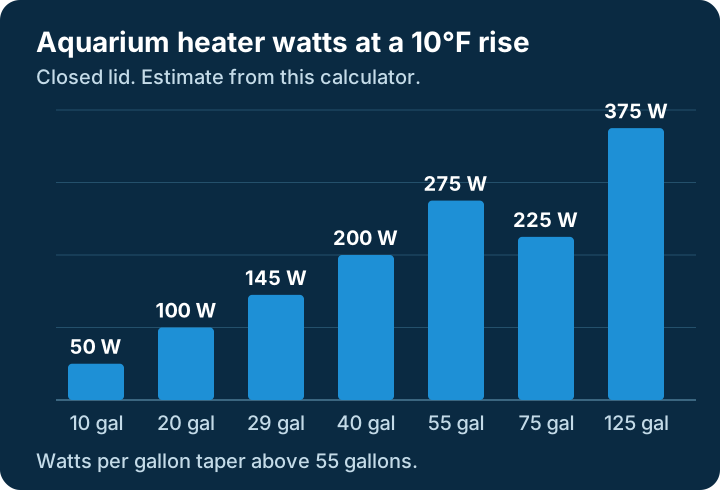
These watt figures come from the same estimate as the calculator, for a closed lid. Choose the nearest heater size at or above the number, then compare it with the maker's chart.
| Tank | +5°F rise | +10°F rise | +15°F rise | +20°F rise |
|---|---|---|---|---|
| 10 gal | 25 W | 50 W | 75 W | 100 W |
| 20 gal | 50 W | 100 W | 150 W | 200 W |
| 29 gal | 73 W | 145 W | 218 W | 290 W |
| 40 gal | 100 W | 200 W | 300 W | 400 W |
| 55 gal | 138 W | 275 W | 413 W | 550 W |
| 75 gal | 113 W | 225 W | 338 W | 450 W |
| 125 gal | 188 W | 375 W | 563 W | 750 W |
The dip after 55 gallons is intentional. Larger tanks lose heat more slowly relative to their volume, so the estimate tapers. Near that crossover, lean toward the higher figure if your room runs cold.
How the Fish Tank Heater Calculator Works
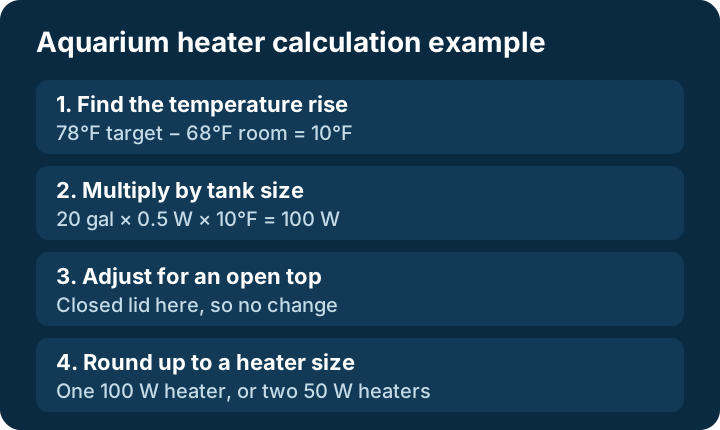
- Temperature rise: target temperature minus the coldest normal room temperature. Measure the room overnight rather than guessing.
- Base watts: 0.5 W per gallon for each °F of rise up to 55 gallons, which equals the 5 W per gallon rule at a 10°F rise. Above 60 gallons it uses 0.3 W, and it blends the two in between.
- Open top: adds 20% for extra heat loss. This percentage and the taper are our planning assumptions, not measured figures.
- Heater count: divides the total, then rounds up to a common heater size.
One Aquarium Heater or Two?
Two heaters can spread heat across a long tank and give some backup if one stops working. Add their wattages to check total capacity. They don't remove the risk of a heater stuck on, so a separate thermometer helps, and a temperature controller gives you a cut-off that works independently of the heater's own thermostat.
Avoid going far above your estimate. A large heater in a small tank can warm it quickly if it fails on. For the rest of your equipment, use the aquarium equipment calculator.
Aquarium Heater Calculator FAQ
What size heater do I need for a 20 gallon tank?
About 100 W for a 10°F rise with a closed lid. If the room is only 5°F below your target, 50 W may be enough; a 20°F rise calls for about 200 W.
What size heater do I need for a 55 gallon tank?
This estimate gives about 275 W for a 10°F rise, so a 300 W heater or two 150 W heaters would be the nearest common choices. Check the maker's chart for your room temperature.
How many watts per gallon does an aquarium heater need?
About 5 W per gallon is the common rule of thumb, and it corresponds to about a 10°F rise. Rooms that are colder need more, while larger tanks usually need fewer watts per gallon.
Do saltwater tanks need a different heater size?
This estimate treats saltwater and freshwater the same. What usually differs is the heater's material and rating, so confirm that the heater you buy is rated for saltwater.
Can an aquarium heater be too big?
Yes. A large heater that sticks on can overheat a small tank quickly. Stay close to the size you need, and use a thermometer or controller as a check.
How Accurate Is This Heater Estimate?
It's a planning estimate, not a measured heat-loss model. Room drafts, tank shape, glass thickness, lids, pumps and lights all change the real figure. We started from the temperature-rise approach and the common 5 W per gallon rule cited below, then added the taper and open-top adjustment as stated assumptions. FishCare AI didn't bench-test heaters for this tool.