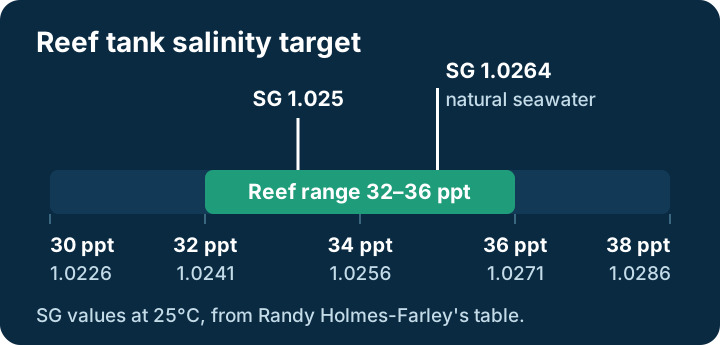
The usual reef tank salinity target is 35 ppt, a specific gravity of 1.0264 at 25°C, which matches natural seawater. Chemist Randy Holmes-Farley suggests 32–36 ppt (SG 1.024–1.027) as an acceptable reef range. Note that SG 1.025, often quoted as "35 ppt," works out closer to 33 ppt. Stability matters too, so correct any drift slowly.
Based on a straight-line fit to the 30–39 ppt table below, at 25°C. Treat values well below 30 ppt as approximate.

Reef Tank Salinity Chart: PPT to Specific Gravity
These values are from Holmes-Farley's table at 25°C. Use them to check a reading against the range you are aiming for.
| Salinity (ppt) | Specific gravity | What it means |
|---|---|---|
| 30 | 1.0226 | Low for a reef |
| 31 | 1.0233 | Low for a reef |
| 32 | 1.0241 | Low end of the suggested range |
| 33 | 1.0249 | In range; about where SG 1.025 sits |
| 34 | 1.0256 | In range |
| 35 | 1.0264 | Natural seawater, the usual target |
| 36 | 1.0271 | High end of the suggested range |
| 37 | 1.0279 | High for a reef |
Fish-only tanks are often run lower. Bulk Reef Supply lists SG 1.017–1.023 for fish with live rock and 1.023–1.026 for reefs. Keep corals and invertebrates close to natural seawater.
How to Measure Reef Tank Salinity Accurately
A calibrated reading is what counts, and each tool fails in its own way.
| Tool | Good to know |
|---|---|
| Refractometer | Calibrate with a 35 ppt seawater standard. A salt (NaCl) refractometer reads seawater about 1.7 ppt high, so it can show 35 ppt when the tank is really 33.3 ppt. |
| Conductivity meter | Natural seawater is about 53 mS/cm. Calibrate with a 35 ppt or 53 mS/cm standard. |
| Swing-arm hydrometer | Can't be calibrated, and must read water at its stated temperature. |
Some manufacturers tell you to zero a refractometer on fresh water. Holmes-Farley recommends a seawater standard instead, because it checks the instrument right where you read it. Bulk Reef Supply suggests calibrating before every use and checking salinity 1–3 times a week, plus before and after water changes.
How to Raise or Lower Salinity Safely
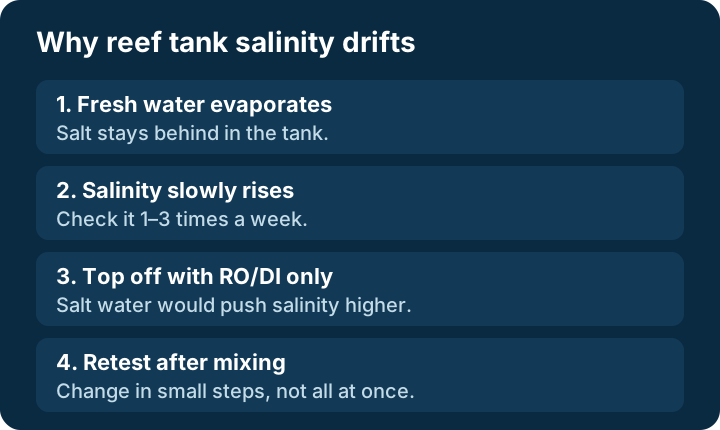
None of the sources we reviewed gives a fixed safe rate for a reef, so make small changes and retest. Bulk Reef Supply simply advises gradual change.
- To raise it: mix salt into RO/DI water in a separate container, then swap it in during small water changes. Never add dry salt to the tank.
- To lower it: replace a little tank water with RO/DI, then retest once the water has mixed.
- If it keeps rising: that's usually evaporation. Fresh water leaves and salt stays, so top off with RO/DI only. An auto top-off unit can handle this for you.
Fish in a treatment tank are a different case. The hyposalinity protocol in the saltwater ich treatment guide goes far below these ranges and isn't for tanks with corals or invertebrates.
How Much Salt to Mix for Reef Water
Follow the label and confirm with your refractometer, since brands differ. As one example, Bulk Reef Supply cites Aquaforest at 405 grams per 2.7 gallons for 35 ppt, or 150 grams per gallon. Add salt slowly to water heated to about 75–78°F, let it mix fully, then measure before using it.
Reef Tank Salinity FAQ
What should salinity be in a reef tank?
Aim for 35 ppt, which is specific gravity 1.0264 at 25°C. A range of 32 to 36 ppt, or SG 1.024 to 1.027, is the range Randy Holmes-Farley suggests for reefs.
Is 1.025 specific gravity good for a reef tank?
Yes, it falls inside the suggested range, but it is closer to 33 ppt than 35 ppt. If you want to match natural seawater, aim for about 1.0264.
Why is my salinity going up?
Evaporation is the most common cause. Fresh water leaves the tank while salt stays behind. Top off with RO/DI water, not salt water.
How often should I check salinity?
Bulk Reef Supply suggests 1 to 3 times a week and before and after water changes. An auto top-off doesn't remove the need to check.
Does temperature affect specific gravity?
Yes. Specific gravity readings depend on temperature, which is why this table is stated at 25°C and why swing-arm hydrometers must read water at their stated temperature.
How We Checked This Reef Salinity Guide
The conversion values come from Randy Holmes-Farley's published table. The converter uses a straight-line fit to that table, so it may differ from it in the fourth decimal. Practical ranges come from Bulk Reef Supply. FishCare AI did not measure instruments for this page.
References
- Randy Holmes-Farley, Reefkeeping: What is Salinity?
- Bulk Reef Supply: How to Measure Salinity in a Saltwater Aquarium
- Bulk Reef Supply: How Much Salt Do I Put in My Saltwater Tank?