Saltwater fish quarantine means keeping every new fish in a separate tank for 4 to 6 weeks before it joins your display. An aquatic veterinarian ties that length to how long pathogens take to incubate and show signs. The practical reason is simple: once marine ich reaches a reef, you can't treat the display with copper, because corals and invertebrates are highly sensitive to many ich medications.

How Long to Quarantine Saltwater Fish
Use 4 to 6 weeks as the default. Dr. Jessie Sanders, an aquatic veterinarian, applies that window to all new additions, including invertebrates and plants. Bulk Reef Supply gives the same 4–6 week range for isolating and observing new fish.
Treat that as a floor when ich is involved. The University of Florida advises at least 3–6 weeks at 24–27°C (75–81°F) for Cryptocaryon, and says 7–11 weeks may be needed because the off-fish stage is so unpredictable. If spots appear, restart the clock from the end of treatment rather than from the day the fish arrived.
Quarantine Tank Setup for Marine Fish
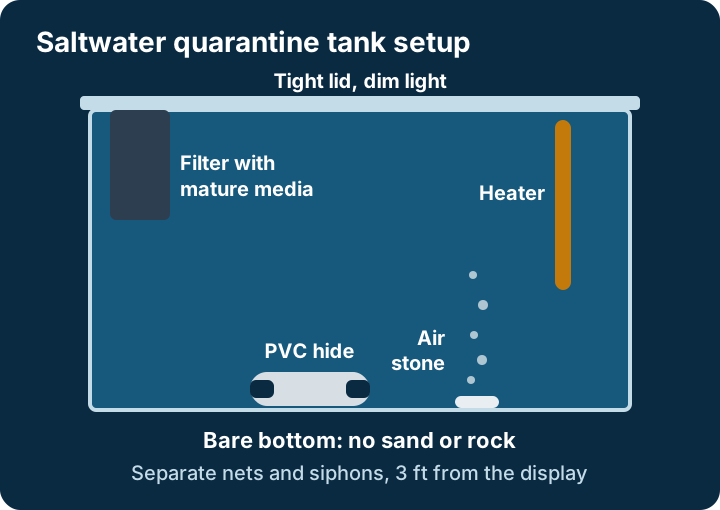
A quarantine tank should be plain, stable and easy to clean. Size it to the fish, not to the space you have left: Bulk Reef Supply suggests a 20-gallon, 24-inch tank for most fish up to 4 inches and a 40-gallon breeder or similar 36-inch tank for larger ones. Long-bodied swimmers such as tangs will need the bigger end of that range.
| Item | What to use | Why it matters |
|---|---|---|
| Bottom | Bare glass | Some parasites have a stage that develops on the substrate, and a bare floor is easier to siphon. |
| Filter | Hang-on or internal, with mature media | Uncycled media means ammonia can become the problem you are treating. |
| Oxygen | Air pump and stone | Parasites can make breathing harder, and some medications can lower oxygen. |
| Heater and thermometer | Sized for the tank | Temperature should hold steady. Use the heater calculator to size it. |
| Hides | PVC pipe, 2–4 inches wide | A hiding place lowers stress and can be disinfected between fish. |
| Lid and light | Tight lid, low-output light | New fish jump. A dim tank lets them settle while you can still see them. |
| Test kits | Ammonia, nitrite, nitrate, refractometer, plus a copper test if you dose copper | You can't manage what you aren't measuring. See the salinity guide for calibration. |
Keep biosecurity strict. Dr. Sanders recommends placing the tank at least 3 feet from the display, keeping separate labeled nets, siphons and scrubbers for each system, and sterilizing any media before it goes back to the main tank.
A Week-by-Week Quarantine Plan
This schedule is our editorial summary of the sources below, not a veterinary protocol. Adjust it with your vet if the fish is valuable or already looks unwell.
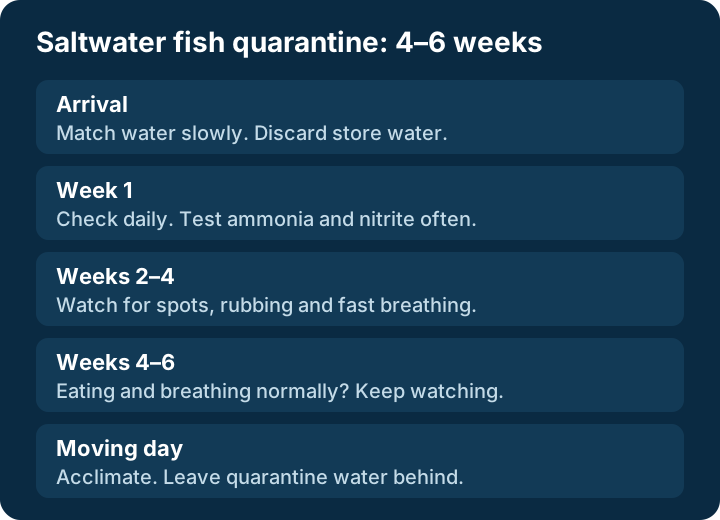
- Arrival day: match temperature and salinity slowly, net the fish across and discard the store water. Keep the lights low.
- Week 1: offer small meals and note what the fish eats. Check it closely every day, and test ammonia and nitrite often, since a new tank with a stressed fish can swing quickly.
- Weeks 2–4: keep watching for spots, cloudy eyes, rubbing, fast breathing or hanging at the surface. Do water changes based on your test results.
- Weeks 4–6: continue observing. A fish that is eating, breathing normally and showing no signs by the end is a much safer addition.
- Moving day: acclimate to the display, and don't pour quarantine water into it. Sterilize or dry out the quarantine gear before the next fish.
🧪 Test your water first
Ammonia, nitrite and temperature problems can cause or worsen many fish symptoms. Enter your readings in our free water parameter checker to see what's out of range.
Check My Water →Should You Treat Every New Fish in Quarantine?
Keepers disagree on this, so it helps to know both positions. Dr. Sanders advises no prophylactic treatments: dosing antibiotics or cure-alls without signs of disease encourages resistance. Many reef keepers still run copper or tank transfers on every new fish, because marine ich can be hidden in the gills and the cost of letting it into a reef is high.
Our default is to observe first and treat for a specific reason, with a fish health specialist involved where you can get one. If you do choose to treat, follow a defined protocol such as those in the saltwater ich treatment guide. Never guess at a copper dose.
Warning Signs During Quarantine
- White spots or nodules on the skin or fins suggest marine ich, though pale fish can hide them.
- Fast breathing, flashing or hanging at the surface can mean a gill infection even with no visible spots.
- Ragged fins, cloudy eyes, extra mucus or a thin body are also listed as signs of Cryptocaryon, but other diseases cause them as well.
- Refusing food for days needs a water test first, then a closer look at the fish.
UF/IFAS notes that white spots aren't enough for a diagnosis: confirming ich takes a microscope, and other parasites look similar. If you can reach an aquatic vet, this is the moment to call.
Saltwater Fish Quarantine FAQ
How long should you quarantine saltwater fish?
Plan on 4 to 6 weeks. If marine ich appears, count again from the end of treatment. UF/IFAS advises at least 3 to 6 weeks for Cryptocaryon and says 7 to 11 weeks may be needed.
Does a quarantine tank need to be cycled?
Yes. Use mature filter media from an established system, or keep media running in a sump or display ahead of time. Uncycled media makes ammonia a risk. Sterilize that media before it returns to your main tank.
Can I skip quarantine if the store treated the fish?
It's a risk. You can't confirm what the fish was treated with or whether the course was complete, and fish that survive ich can carry it. Isolating them yourself is the only check you control.
Do corals and invertebrates need quarantine too?
Dr. Sanders applies the 4 to 6 week guideline to all new additions, including invertebrates and plants. Never put copper in a tank that holds them, because they are sensitive to many ich medications.
Can I quarantine several new fish together?
You can, but a problem in one fish then affects them all, and the clock restarts for the whole group if you add another fish. Add new fish together rather than in stages.
How We Checked This Saltwater Quarantine Guide
FishCare AI did not run its own quarantine trials. We compared guidance from an aquatic veterinarian, the University of Florida's extension fact sheet and a large reef retailer, and we say where keepers disagree. This guide doesn't replace a diagnosis from an aquatic veterinarian.
References
- Fish Vet (Dr. Jessie Sanders): Correct Quarantine Tank Setup
- UF/IFAS Extension FA164: Cryptocaryon irritans Infections in Fish
- Bulk Reef Supply: How to Set Up a Quarantine Tank
- Bulk Reef Supply: The Life Cycle of Marine Ich