Saltwater ich treatment works best in a separate bare tank, because the options that clear marine ich aren't safe or practical in a reef. University of Florida guidance lists copper, hyposalinity and chloroquine as the standard baths, with copper considered by many the most effective. Plan on a minimum of 3 to 6 weeks. Marine ich (Cryptocaryon irritans) is a parasite, and most of its life happens where no medicine can reach it.

How to Recognize Marine Ich
Marine ich usually shows as small white spots, nodules or patches on the fins, skin or gills. Fish may also scratch against rock, breathe fast, hang at the surface or on the bottom, or turn lethargic. Ragged fins, cloudy eyes, extra mucus and weight loss are also listed.
Spots alone don't settle it, and a lack of spots doesn't rule it out. Pale fish can hide them, and an infection limited to the gills may show none. UF/IFAS says confirming it takes a microscope, and that inexperienced keepers can mistake it for other ciliates such as Uronema or Brooklynella.
Why the Marine Ich Life Cycle Makes Treatment Slow
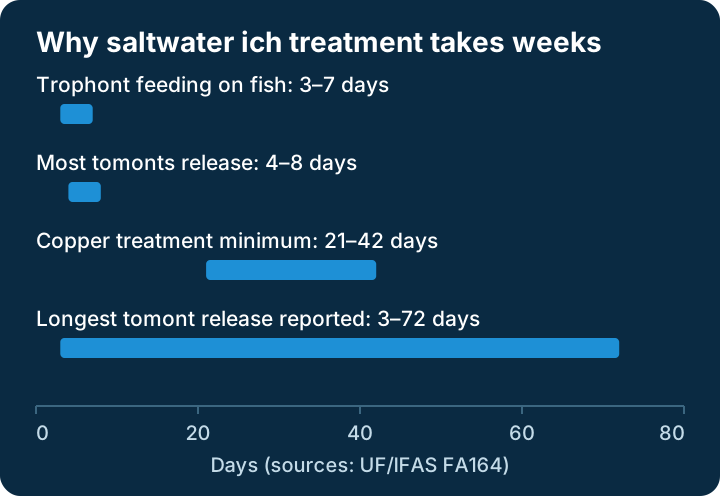
Spots that disappear haven't been cured. The parasite has simply dropped off the fish to reproduce, and only the free-swimming stage is really exposed to treatment. That is why every option below runs for weeks.
| Stage | Where it is | Timing | Can treatment reach it? |
|---|---|---|---|
| Trophont | Under the fish's skin | Feeds about 3–7 days | Relatively protected |
| Protomont | Moving onto a surface | About 2–18 hours | Possibly, for a short time |
| Tomont | Hard cyst on surfaces, producing about 100–1,000 tomites | Most release in 4–8 days; reported range 3–72 days | Well protected |
| Theront | Swimming, looking for a fish | Infectivity falls sharply after 6–8 hours | Yes, the main target |
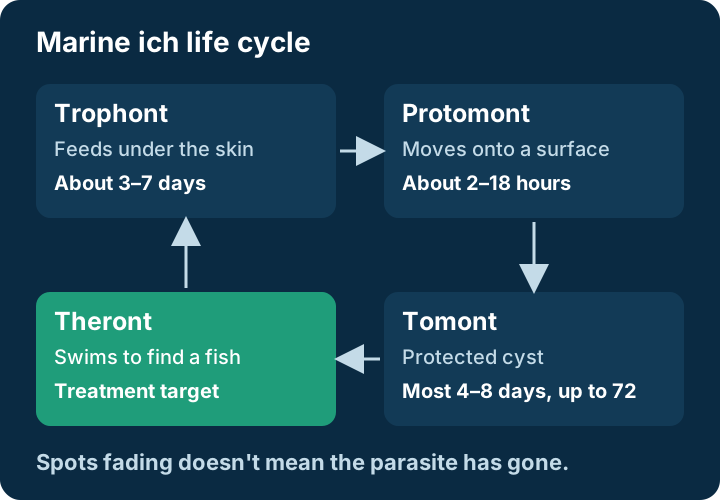
A full cycle averages 1–2 weeks but ranges from 6 days to 11 weeks. Fish that survive can resist reinfection for up to about 6 months while still carrying the parasite, so a calm tank doesn't prove the parasite is gone.
Saltwater Ich Treatment Options Compared
The figures below come from the UF/IFAS fact sheet. Commercial products vary, so follow the label for the product you actually bought.
| Option | Protocol | Limits |
|---|---|---|
| Copper sulfate | 0.15–0.20 mg/L free copper, reached gradually over 2–3 days. Test at least twice a day. Treat at least 3–6 weeks. | Toxic to invertebrates. Levels fluctuate, so a good test kit is essential. |
| Chelated copper | Follow the manufacturer's dose and test method. | Safety and effectiveness are more variable than copper sulfate. |
| Hyposalinity | Lower salinity by 5–10 g/L per day to 15 g/L, then hold 21–30 days. | Some strains tolerate low salinity, and many marine fish tolerate it poorly. |
| Tank transfer | Move fish to a clean, bare tank every 3 days, 3–5 times depending on temperature. Clean, disinfect and dry tanks between moves. | Not practical for large groups, and hard on weak fish. |
| Chloroquine diphosphate | 10 mg/L as a prolonged bath for 2–3 weeks or more. | Availability and legal use vary. Work with a vet. |
A salinity of 15 g/L is roughly specific gravity 1.011. Measure it with a calibrated instrument, as explained in the reef tank salinity guide, because a small reading error matters more at that level.
Saltwater Ich Treatments That Fall Short
- Freshwater dips: up to 18 hours in fresh water did not seem to affect trophonts in one study, so a short dip won't cure the fish.
- UV sterilizers: they only reach theronts passing through the unit, and required doses for marine ich are anecdotal or extrapolated. Cysts on the rock stay untouched.
- "Reef-safe" additives: they aren't among the standard treatments in the UF/IFAS list. Don't rely on one to clear an outbreak in a display, even if the spots fade for a while, because fading is normal in the life cycle.
🧪 Test your water first
Ammonia, nitrite and temperature problems can cause or worsen many fish symptoms. Enter your readings in our free water parameter checker to see what's out of range.
Check My Water →How to Clear Marine Ich From a Reef Tank
Corals and invertebrates can't catch ich, but they are highly sensitive to many of the medications, so the fish have to leave. Treating the fish alone isn't enough; the display has to stay without fish long enough for the parasite to die out.
- Move every fish to a bare treatment tank, including those that look healthy.
- Treat for the full course, then keep the fish isolated while the display sits empty.
- Leave the display fishless. Bulk Reef Supply gives roughly 4 weeks, but theronts have emerged as late as 72 days after a tomont formed. Many reef keepers wait about 76 days to cover that. If you can, use the longer period.
- Quarantine everything new afterwards, using the saltwater fish quarantine plan.
Tangs tend to be among the first fish to show it. See the tang fish diseases guide for how ich compares with velvet and black ich.
Saltwater Ich Treatment FAQ
What is the best saltwater ich treatment?
Many specialists consider copper the most effective, used in a bare tank at 0.15 to 0.20 mg/L free copper for at least 3 to 6 weeks. The right choice still depends on the fish species, your equipment and what is legal where you live.
Can you treat marine ich in a reef tank?
Not with copper. Corals and invertebrates are highly sensitive to many ich medications. Move the fish to a treatment tank and leave the display without fish.
How long does marine ich live without a fish?
Theronts lose most of their infectivity within 6 to 8 hours, but cysts can release new theronts for much longer. Release has been reported as late as 72 days after a tomont formed.
Why did the white spots go away and come back?
The feeding stage drops off the fish after about 3 to 7 days to reproduce on surfaces. New infective stages then return, often in greater numbers.
Is marine ich the same as freshwater ich?
No. They look alike and behave similarly, but UF/IFAS says the two parasites are only distantly related and differ in salinity tolerance and life cycle length.
How We Checked This Saltwater Ich Treatment Guide
The doses and timings here come from University of Florida extension publication FA164, with reef-keeping context from Bulk Reef Supply. FishCare AI did not test these treatments, and this page isn't veterinary advice. Medications can harm or kill fish if dosed incorrectly, so confirm the plan with a fish health specialist where possible.
References
- UF/IFAS Extension FA164: Cryptocaryon irritans Infections in Fish
- Bulk Reef Supply: The Life Cycle of Marine Ich
- Fish Vet (Dr. Jessie Sanders): Correct Quarantine Tank Setup