What angelfish tank size do you need?
Angelfish tank size is driven by height as much as by volume: a tall-bodied adult needs vertical swimming room that a long, shallow tank of the same gallonage cannot give it. Use the calculator above for a stocking figure, then check that the tank you have in mind is deep enough front to top.
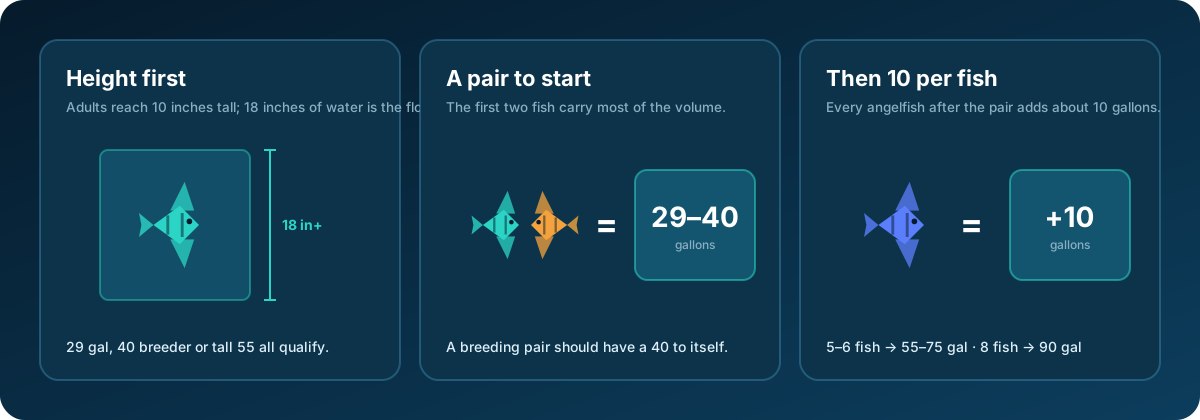
Freshwater angelfish are tall, laterally compressed fish that grow to 6 inches in body length and up to 10 inches tall including their extended fins. They need a tank with adequate vertical space — a minimum of 18 inches of water height, with 24 inches preferred.
This angelfish tank size calculator budgets 29 gallons (40 recommended) for the first pair and about 10 gallons for each angelfish after that. A single pair of angelfish needs a minimum of 29 gallons — a standard 29-gallon tank is exactly 18 inches tall, meeting the minimum height requirement. A 40-gallon breeder is the preferred starter tank for a pair because it provides more floor space for territories.
For a group of angelfish (5–6 fish), a 55- to 75-gallon tall tank is appropriate. Angelfish establish a social hierarchy in groups and are less aggressive when they have room to form natural pairs and defend small territories. Overstocking is a common cause of fin damage and aggression in angelfish tanks. If you are unsure, size up — the practical angelfish tank size for a mixed community is one bracket above the bare minimum, which leaves room for territories to shift as the group matures.
Angelfish become significantly more aggressive when breeding. A breeding pair will defend a large territory and may kill or injure tank mates during spawning. A dedicated 40-gallon tank per breeding pair avoids this problem. For wild-type measurements and habitat data, see the Seriously Fish profile for Pterophyllum scalare.
How many angelfish in a 55 gallon tank, a 29 or larger?
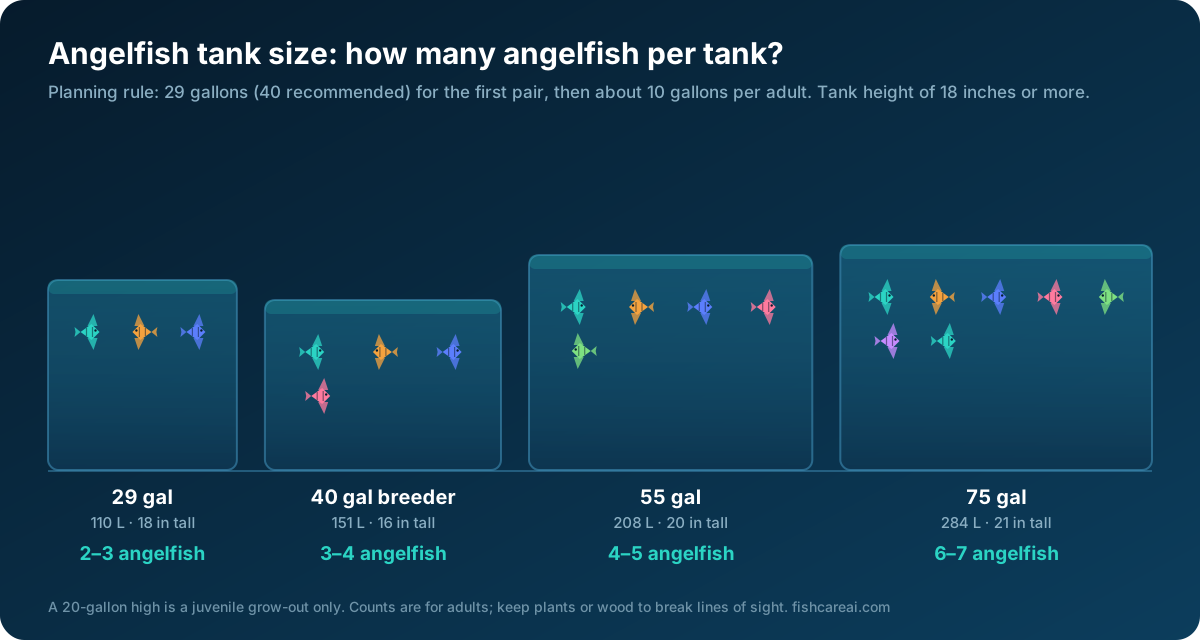
The table applies the same rule the calculator uses — 29 gallons covers a pair, then about 10 gallons per additional adult — assuming a cycled tank, weekly water changes and no other large fish. Because angelfish are tall, the tank's height column matters as much as its gallons: a 20-gallon long is longer than a 29 but too shallow for adults. If you are unsure of your tank's real volume, the aquarium size calculator converts dimensions to gallons.
| Tank size | Angelfish (comfortable–max) | Notes |
|---|---|---|
| 20 gal high (76 L) | Juveniles only | 24 x 12 x 16 in. Grow-out for young fish; adults outgrow the height and width within months. |
| 29 gal (110 L) | 2–3 | 30 x 12 x 18 in. The minimum for a pair; 18-inch height just meets the adult requirement. |
| 40 gal breeder (151 L) | 3–4 | 36 x 18 x 16 in. The recommended pair tank — the wide footprint gives a breeding pair its own territory. |
| 55 gal (208 L) | 4–5 | 48 x 13 x 20 in. Good height for a small group; keep plants or wood to break lines of sight. |
| 75 gal (284 L) | 6–7 | 48 x 18 x 21 in. The classic angelfish group tank: tall, wide and long enough for 5–6 adults plus dither fish. |
| 125 gal (473 L) | 11–12 | 72 x 18 x 23 in. Large display group or angelfish as the centrepiece of a big community. |
Sharing the tank with other fish? Angelfish are mid-water cichlids that will eat anything small enough to fit in their mouths, so neon tetras and shrimp are food, not tank mates. Subtract the space your other species need before applying the angelfish count, and check any pairing in the angelfish tank mates hub or the fish compatibility checker.
Breeding pairs change the maths. Once a pair forms it will claim roughly a square foot of glass or a broad leaf and drive everything else away from it. In a 29 or 40 that usually means the pair should have the tank to itself; in a 75 or larger a pair can coexist with the rest of the group if there is décor to hide behind.