What discus fish tank size do you need?
Discus fish tank size starts at 55 gallons for a group of four to six and 75 gallons recommended, with roughly 10 gallons for each adult after that. Use the calculator to estimate volume for your group or stocking for an existing tank. For dimensions, group-size tables, juvenile grow-out guidance and the limits of these estimates, read the discus tank size guide.
How the discus fish tank size numbers work
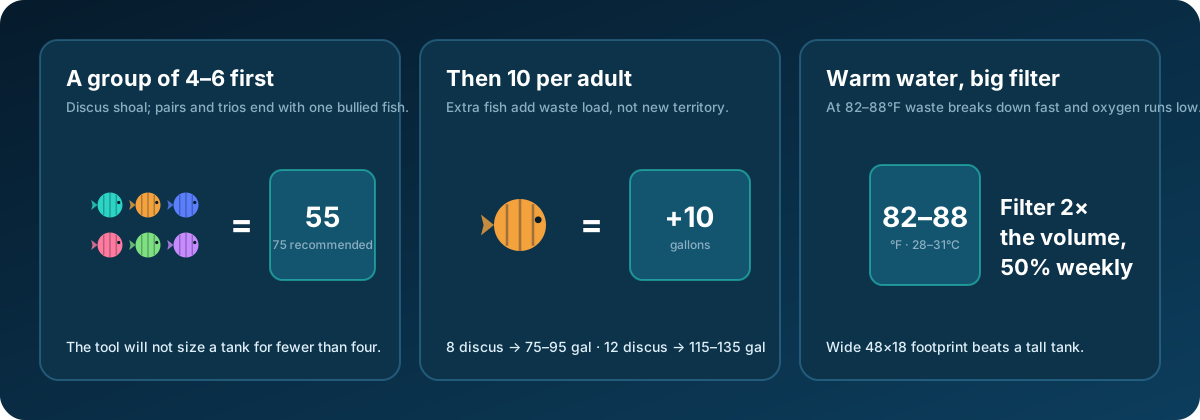
The calculator starts from a group, not a single fish. Discus are shoaling cichlids: kept alone or as a pair, one fish usually becomes a target and stops eating, so the tool assumes a minimum of four and recommends six.
That first group carries most of the volume — 55 gallons minimum, 75 gallons recommended — and each adult after that adds roughly 10 gallons. The curve flattens because the tank footprint is already paid for; what each extra fish adds is waste load, not territory.
Two things the gallon figure alone will not tell you. First, shape matters as much as volume: discus reach 8–10 inches and are almost as tall as they are long, so a standard 75-gallon tank at 48 x 18 inches suits them far better than a tall tank of identical volume. Second, discus are kept at 82–88°F, and warm water holds less oxygen while speeding up decay, so a correct discus tank size still depends on heavy filtration and frequent water changes to stay correct in practice.
Juveniles are the common exception. Grow-out fish are usually kept in a smaller, bare-bottom tank so that daily water changes are practical — there, the answer is more water changes rather than a bigger tank.
How many discus in a 55 gallon tank, 75 gallon tank or larger?
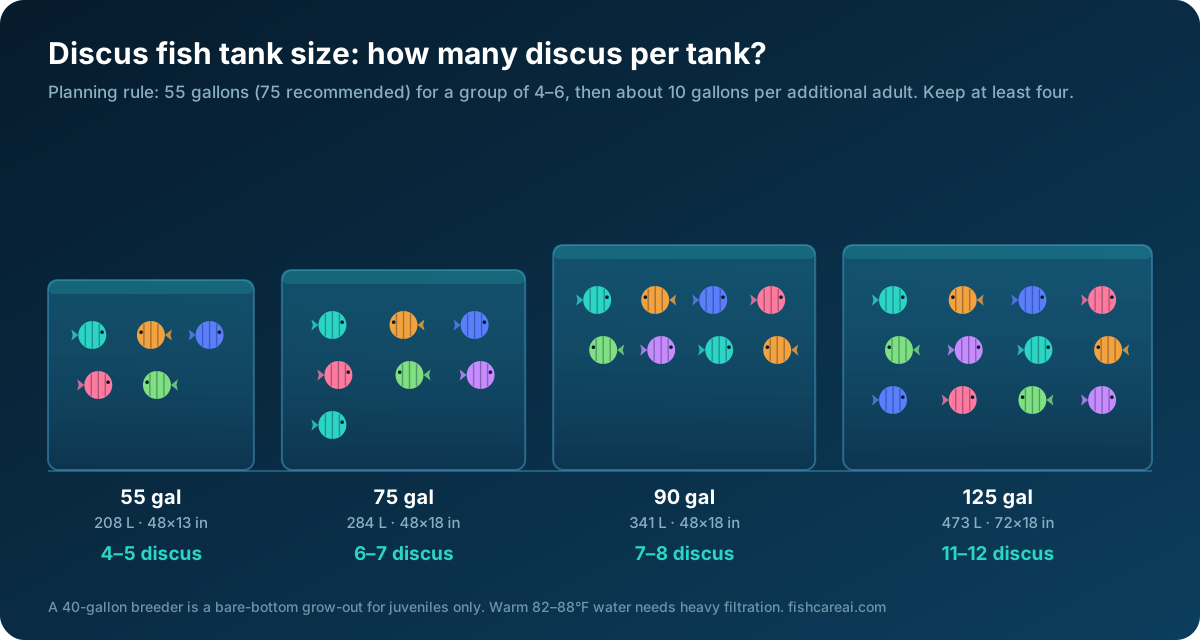
The table applies the same rule the calculator uses — 55 gallons (75 recommended) for a group of four to six, then about 10 gallons per additional adult — assuming a cycled tank at 82–88°F with filtration rated well above the tank volume and large weekly water changes. If you are unsure of your tank's real volume, the aquarium size calculator converts dimensions to gallons.
| Tank size | Discus (comfortable–max) | Notes |
|---|---|---|
| 40 gal breeder (151 L) | Juveniles only | 36 x 18 in. A bare-bottom grow-out for 6–8 young fish with daily water changes; adults outgrow it. |
| 55 gal (208 L) | 4–5 | 48 x 13 x 21 in. The minimum adult group tank; the narrow width is the limiting factor. |
| 75 gal (284 L) | 6–7 | 48 x 18 x 21 in. The classic discus tank — wide enough for 8-inch fish to turn and hold a loose shoal. |
| 90 gal (341 L) | 7–8 | 48 x 18 x 24 in. Extra height suits the tallest strains and gives more water to buffer waste. |
| 125 gal (473 L) | 11–12 | 72 x 18 x 23 in. A large display shoal, or a discus group with a planted community. |
| 180 gal (681 L) | 16–18 | 72 x 24 x 25 in. Show-tank territory; discus at this scale are usually kept with their own sump. |
Sharing the tank with other fish? Discus water is warm (82–88°F) and soft, which rules out most community fish. Cardinal tetras, rummy-nose tetras, sterbai corydoras and a bristlenose pleco are the usual companions. Subtract what those need before applying the discus count, and check any pairing in the discus tank mates hub or the fish compatibility checker.
Why the group comes first: Symphysodon discus (Wikipedia) are shoaling cichlids from slow Amazon blackwater. Kept in pairs or trios, one fish is bullied off its food; kept in six or more, aggression is spread thin. That is why the calculator refuses to size a tank for fewer than four.