Guppy Fish Care at a Glance
Guppies (Poecilia reticulata) are small, social livebearers from northern South America and parts of the Caribbean. They are colorful, active and adaptable, but modern fancy strains can be less forgiving than their reputation suggests. Good guppy care begins with a fully cycled aquarium, stable mineral-rich freshwater, gentle filtration and a plan for population growth.
Quick answer: Keep a small guppy group in a cycled 10-gallon aquarium or larger; a 20-gallon long tank is easier when mixing sexes or raising fry. Aim for about 72–82°F (22–28°C), pH around 6.8–7.8, zero ammonia and nitrite, and stable moderately hard to hard water. Feed a varied omnivore diet in small portions.
| Care requirement | Practical starting point |
|---|---|
| Care level | Beginner-friendly after the aquarium is cycled |
| Adult size | Usually about 1.5–2.5 inches; females are generally larger |
| Lifespan | Often about 2–3 years, with variation from genetics and care |
| Tank size | 10 gallons for a small group; 20 gallons long is more forgiving |
| Temperature | 72–82°F (22–28°C), kept stable |
| pH | Approximately 6.8–7.8 |
| Water hardness | Moderately hard to hard water is usually preferred |
| Diet | Omnivorous; complete small fish food plus varied supplements |
| Temperament | Peaceful, active community fish |
| Reproduction | Livebearer; mixed-sex groups reproduce readily |
Are Guppies Easy to Care For?
Guppies are frequently recommended as beginner fish because they accept prepared foods, tolerate a useful range of freshwater conditions and remain small enough for common home aquariums. That description is fair only when the aquarium has already completed its nitrogen cycle. Guppies placed into a new, uncycled tank can be poisoned by ammonia or nitrite just as quickly as more demanding species.
Modern fancy guppies may also arrive stressed from intensive breeding, crowded distribution systems or repeated transport. A fish that is genetically selected for an elaborate tail or rare color is not automatically as robust as a wild-type guppy. Beginners should buy alert fish from clean systems, acclimate them gradually and quarantine new arrivals when practical.
The easiest long-term setup is not the smallest possible container. A heated, filtered 10- or 20-gallon aquarium provides more stable temperature and chemistry than a bowl or tiny desktop tank. Test water, avoid overfeeding and increase the population slowly. These habits matter more than the guppy’s label as an “easy fish.”
Guppy Origin, Natural Habitat and Social Behavior
Wild guppies originate from tropical parts of northeastern South America and the Caribbean, including Venezuela, Guyana, Trinidad and Barbados. They inhabit streams, pools, canals and vegetated margins where water conditions can vary considerably. Guppies have also been introduced to many regions outside their native range, sometimes for mosquito control, and can become invasive in warm freshwater habitats.
In an aquarium, guppies spend much of their time in the middle and upper water levels. They investigate food constantly, display to one another and use plants as shelter rather than remaining hidden all day. A guppy that isolates itself, clamps its fins or rests at the surface should prompt a check of water quality, aggression and health.
Guppies are social, but they are not a tightly synchronized schooling fish in the same way as some tetras. A group provides visual security and natural interaction. Group composition matters: males display and chase, while females can be repeatedly pursued. Space, plant cover and sex ratio are therefore part of basic husbandry, not optional decoration.
Guppy Size and Lifespan
Adult guppy size varies by sex, strain, nutrition and early growth. Males are usually slimmer and often remain around 1.5–2 inches, while females commonly become heavier-bodied and may approach 2–2.5 inches. Long fins make some males look larger without increasing body mass. Plan the aquarium for the larger adult females and the total number of fish, not the size of juveniles at purchase.
Many captive guppies live about two to three years. Some individuals live longer, while weak genetics, chronic crowding, unstable temperature, poor water or untreated disease may shorten life substantially. Lifespan figures should be treated as a range rather than a guarantee.
Temperature affects metabolism: very warm water may speed growth and reproduction but can also increase oxygen demand and shorten lifespan if fish are kept near the top of their tolerated range continuously. Cooler water is not automatically healthier; temperatures that are too low or unstable can suppress appetite and immune function. A moderate, stable setting that matches the fish and tank mates is the safer goal.
Guppy Tank Size and How Many Guppies to Keep
Published care sheets give different minimums. Some allow a trio in five gallons, while others recommend ten gallons for a small group. FishCare AI uses 10 gallons as a practical starting point because it offers more dilution, swimming room and equipment options. A 20-gallon long aquarium is preferable for mixed sexes, a larger group or any setup where fry may remain.
A fixed “one inch of fish per gallon” rule does not account for group behavior, reproduction, filter capacity or maintenance. Stocking must consider adult body size, feeding, plant mass and how quickly nitrate rises between water changes. Use the Tank Size Calculator for physical volume, then plan below the calculated maximum.
Start with a group rather than one guppy. For an all-male display, provide enough room and visual breaks to diffuse chasing. For mixed sexes, keep roughly one male for every two or three females, and assume babies will appear. Do not solve crowding by adding filtration alone: a filter processes waste but does not create swimming space or reduce harassment.
| Example setup | Practical guidance | Main concern |
|---|---|---|
| 10-gallon guppy tank | A small, carefully managed group | Limited capacity for unexpected fry |
| 20-gallon long tank | Better footprint for a larger group or mixed sexes | Population still needs control |
| All-male group | No fry, but monitor persistent chasing | Fin damage and dominance |
| Mixed-sex group | About 1 male to 2–3 females | Frequent pregnancies and crowding |
Guppy Tank Setup: Equipment and Cycling
Set up and cycle the aquarium before buying guppies. A complete system needs a secure tank and stand, fitted lid, heater where room temperature is unreliable, thermometer, gentle filter, dechlorinator, liquid or reliable water test kit, substrate and plant cover. A light is useful for viewing and live plants, but direct sunlight can overheat the tank and fuel algae.
The biological filter is established when it can process an ammonia source and routine tests show zero ammonia and zero nitrite. Simply running a filter for a few days does not prove that the aquarium is cycled. Follow the fish tank setup guide and add livestock gradually after cycling.
Use a lid because guppies can jump. Leave open swimming space through the middle while planting the back and sides. Position the filter output so it creates surface movement without forcing long-finned males to fight a strong current. Place the heater where water circulation can distribute warmth evenly.
Guppy Water Parameters: pH, Hardness, Ammonia and Nitrate
Guppies usually perform best in stable, moderately hard to hard freshwater with useful calcium and magnesium content. A reasonable starting pH range is about 6.8–7.8, but consistency is often more important than forcing an exact number with quick chemical adjustments. Test the source water before choosing tank mates or adding mineral products.
| Parameter | Starting target | Action note |
|---|---|---|
| pH | About 6.8–7.8 | Avoid abrupt correction |
| GH | Moderately hard to hard | Confirm mineral content if tap water is very soft |
| Ammonia | 0 ppm | Any detectable reading requires immediate investigation |
| Nitrite | 0 ppm | Suggests an incomplete or disrupted cycle |
| Nitrate | Kept low by maintenance | Use the trend to set water-change frequency |
Do not add aquarium salt automatically because guppies are livebearers. Salt can have specific short-term uses, but routine dosing changes the environment for plants, snails and tank mates and can mask poor husbandry. If salt is considered, identify the exact purpose, calculate the dose and confirm compatibility first.
Use the Water Parameter Checker to organize readings and the Aquarium Water Parameters guide to interpret them. Neither replaces a properly cycled filter or qualified veterinary advice.
Best Guppy Temperature and Heater Settings
A broad published guppy temperature range is approximately 72–82°F (22–28°C). For many home aquariums, a stable middle setting around 75–78°F is a sensible starting point when it also suits the tank mates. Stability matters: repeated daily swings can stress fish even when every individual reading falls inside the advertised range.
Use a thermostatically controlled aquarium heater if the room cools below the target or changes markedly between day and night. Verify the setting with a separate thermometer rather than trusting the heater dial. Match replacement water closely during water changes so fish are not exposed to sudden temperature shocks.
Do not raise temperature as a universal treatment for sick guppies. Higher temperature accelerates metabolism, reduces dissolved oxygen and may worsen some conditions. Diagnose the water and likely cause first. If medication or temperature adjustment is needed, follow species-appropriate veterinary guidance.
Guppy Filtration, Flow and Oxygen Requirements
A guppy aquarium needs biological filtration and surface gas exchange. Sponge filters are especially useful in breeding tanks because they provide gentle flow and do not readily trap tiny fry. A protected hang-on-back or canister filter can also work when the intake has a pre-filter sponge and the output is not excessive.
Choose a filter rated for at least the aquarium’s actual water volume, but do not rely on manufacturer flow claims alone. Media capacity, fish load and maintenance affect performance. Rinse reusable biological media gently in removed aquarium water when flow declines; do not replace all media at once or wash it with chlorinated tap water.
A separate air pump is not mandatory if the filter creates adequate surface movement and fish breathe normally. Warm, crowded or medicated tanks may need additional aeration. Gasping at the surface is an urgent sign to test ammonia and nitrite, inspect temperature and equipment, and increase gas exchange while the cause is addressed.
Best Plants, Substrate and Decor for Guppies
Plants give female guppies relief from persistent males and provide fry with shelter. Java moss, guppy grass, water sprite, hornwort and floating plants can create dense cover, while Anubias and Java fern offer durable structure. Choose plants that match the lighting and water hardness rather than purchasing by appearance alone.
Sand or fine gravel can both work because guppies spend most of their time above the bottom. Rooted plants may need a nutrient-rich substrate or root tabs, while epiphytes attach to wood or rock. Rinse inert substrate before use and avoid sharp ornaments that can tear large tails.
Arrange tall plants and cover along the back and sides, leaving an open central swimming lane. Secure rocks and wood before fish enter the tank. Artificial plants are acceptable when they are smooth, but live plants can support biofilm, consume some nutrients and make the aquarium more forgiving.
Guppy Diet: What Do Guppies Eat?
Guppies are omnivores that eat small aquatic invertebrates, algae and plant material. In captivity, use a complete micro-pellet or quality flake formulated for small tropical fish as the nutritional base. Rotate appropriately sized frozen or live foods such as brine shrimp, daphnia and bloodworms rather than making one treat the entire diet.
Plant-based ingredients such as spirulina can complement animal protein. Variety is valuable, but it should not mean random feeding. Store dry food sealed and dry, replace stale products and thaw frozen foods before use. Avoid feeding chunks too large for a guppy’s mouth.
Color-enhancing food cannot correct poor water, parasites or genetic weakness. Judge the diet by steady body condition, active feeding, normal waste and clean water—not color alone. Pregnant females and growing fry need adequate nutrition, but chronic excess food creates bacterial growth and rising nitrate.
How Often to Feed Guppies Without Overfeeding
Most adult guppies can be fed one or two small meals per day. Offer only what the group can finish promptly—often within about one minute—and watch the slowest fish rather than only the most aggressive feeder. Remove persistent leftovers before they break down.
Fry can benefit from three to five very small feedings because their stomachs are tiny and growth is rapid. More meals require more observation and maintenance. If ammonia, nitrite or nitrate trends worsen, reduce waste and check filtration instead of assuming that fry always need more food.
Use the Fish Feeding Calculator as a conservative starting point. Adjust for age, body condition, temperature and pregnancy. A weekly fast is not a universal requirement; consistent small portions are more useful than alternating overfeeding and starvation.
Male vs Female Guppies: Size, Color and Sex Ratio
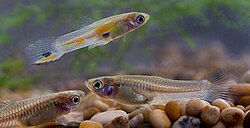
Male guppies are usually smaller, slimmer and more intensely colored, with larger decorative tails. Their anal fin develops into a narrow reproductive structure called a gonopodium. Females are typically larger and rounder, with a fan-shaped anal fin and a darker gravid area near the rear of the abdomen that may become more visible during pregnancy.
Sex young fish only after the differences are clear; early guesses can leave an “all-female” group producing fry. Females can store sperm and give birth after separation from males, so buying adult females may still lead to multiple broods.
For mixed groups, roughly one male to two or three females helps spread male attention, but it does not eliminate harassment or breeding. An all-male group avoids fry but can still develop dominance problems. Plants, adequate footprint and a backup separation plan remain important in both setups.
Guppy Pregnancy and Breeding
Guppies are livebearers: embryos develop inside the female and free-swimming fry are born rather than laid as external eggs. Under warm, well-fed conditions, females may give birth approximately every month, although timing varies. A growing abdomen and darker gravid area can suggest pregnancy, but bloating, constipation and illness should not be misidentified as normal gestation.
Breeding happens readily and often without special encouragement. The harder task is preventing uncontrolled population growth. Before mixing sexes, decide whether fry will stay, move to a grow-out tank or be responsibly rehomed. Never release aquarium fish into natural waterways.
A heavily planted tank allows some fry to survive naturally. A separate mature grow-out aquarium gives more control but requires its own cycled filtration, heating and maintenance. Small breeder boxes can stress adult females if used too early or for too long, so they should not substitute for an appropriate breeding plan.
Baby Guppy Care: Feeding and Growing Guppy Fry
Baby guppies are called fry. They are born able to swim and search for microscopic food, but adults may eat them. Dense Java moss, guppy grass, floating roots or a separate grow-out tank improves survival. Protect filter intakes and use gentle flow.
Feed fry very small portions of powdered complete food, finely crushed flakes, newly hatched brine shrimp or other appropriately sized foods three to five times daily. The goal is frequent access without leaving a layer of waste. Siphon debris carefully and monitor ammonia and nitrite because small tanks can deteriorate quickly.
Separate fry by size if larger individuals consistently outcompete smaller ones. Do not rush them into a community tank until they are too large to be swallowed and strong enough to handle normal flow. Color and sex differences often become easier to see over the first few months, but development varies by strain and temperature.
Best Guppy Tank Mates and Fish to Avoid
Suitable guppy tank mates are peaceful fish that share warm freshwater and compatible mineral requirements. Corydoras, small rasboras, some tetras, platies and peaceful snails may work in an appropriately sized aquarium. Every combination still needs enough floor space, swimming room and food access.
Avoid large predators and persistent fin nippers. Tiger barbs and aggressive cichlids can damage elaborate tails. Bettas are unpredictable with guppies because colorful male guppies may trigger aggression, while guppies may also bother a slow long-finned betta. Goldfish prefer different temperature conditions and grow large enough to make the pairing unsuitable.
Check proposed combinations with the Fish Compatibility Checker, then verify the exact species. For related peaceful fish, review the Corydoras care guide, Neon Tetra care guide, Platy care guide and Molly care guide.
Popular Guppy Types, Colors and Tail Shapes
Fancy guppies have been selectively bred into many color, pattern and fin combinations. Common labels include Cobra, Tuxedo, Moscow, Snakeskin, Mosaic and Grass, while tail shapes include Delta, Fan, Lyretail, Swordtail and Roundtail. Retail names are not always standardized, so two sellers may use the same label differently.
Endler-type livebearers are closely related but should not automatically be treated as just another color of guppy. They can hybridize with domestic guppies, which matters to keepers trying to preserve a line. Confirm the scientific name and breeding history before mixing populations.
Extreme fins and highly selected colors may come with reduced swimming efficiency or genetic bottlenecks. Choose active fish with intact fins and good body shape rather than selecting only the rarest appearance. Health and sustainable breeding matter more than a fashionable strain name.
Guppy Tank Cleaning and Weekly Maintenance
Use test results and waste production to set the schedule. A weekly partial water change of roughly 20–30% is a practical starting point for many stocked guppy aquariums, but lightly stocked planted tanks may need less and crowded breeding tanks may need more. Match replacement water for temperature and treat chlorine or chloramine before it enters the aquarium.
Vacuum exposed substrate without uprooting the whole planted tank. Wipe algae from viewing panels, remove dead leaves and inspect the heater and filter. Rinse mechanical sponges in removed aquarium water when flow falls. Never replace all biological media and deep-clean the entire tank on the same day.
- Observe breathing, appetite and swimming daily.
- Confirm heater and filter operation.
- Remove uneaten food and dead plant material.
- Test ammonia and nitrite after any problem.
- Track nitrate to adjust water changes.
- Condition and temperature-match new water.
- Keep a record of births and population.
- Inspect fins for early damage or disease.
Common Guppy Diseases and Warning Signs
Common problems include ich, fin rot, external parasites, bacterial infections, fungal-like growths and buoyancy disorders. Dropsy is a descriptive syndrome involving fluid accumulation and raised scales, not one single disease. Similar symptoms can have different causes, so a photograph alone is not enough for a reliable diagnosis.
Warning signs include clamped fins, rapid breathing, rubbing, white spots, receding fin edges, loss of color, swollen eyes, a sunken or enlarged abdomen, refusal to eat and isolation from the group. Test ammonia, nitrite, nitrate, temperature and pH immediately because poor water can cause symptoms directly or weaken fish against infection.
Quarantine new fish when possible and use separate nets between systems. Do not combine medications casually or dose the display tank without checking effects on plants, invertebrates and biological filtration. Seek an aquatic veterinarian when fish deteriorate quickly, multiple fish are affected or the diagnosis is uncertain.
Why Are My Guppies Dying?
When new guppies die, investigate the timeline rather than assuming they are inherently fragile. Death within hours may involve temperature shock, chlorine, severe ammonia or poor acclimation. Losses over several days can involve transport stress, parasites, bacterial disease or a tank that was not fully cycled. Gradual losses over weeks often point toward chronic water quality, crowding, poor genetics or repeated bullying.
Begin with measurements: ammonia, nitrite, nitrate, temperature and pH. Confirm that the filter is running and the heater has not failed. Increase surface movement if fish gasp, perform a measured partial water change when toxins are present and use conditioned, temperature-matched water. Avoid a complete tank reset, which can remove the biological filter and make the problem worse.
If water is stable, review the source and condition of the fish, recent additions, food, feces and visible symptoms. Isolate affected fish when practical. A structured record of dates, test results and symptoms gives a veterinarian or experienced aquatic professional much better evidence than “the water looks clean.”
Buying Healthy Guppies and Planning the Real Cost
Choose guppies that swim steadily, hold their fins open, breathe normally and respond to food. Avoid tanks containing unexplained deaths, heavy flashing, white spots, clamped fins or fish hanging at the surface. Ask how long the fish have been at the shop, what water they are kept in and whether males and females are separated.
Common guppies are inexpensive, while specialty strains and proven breeding pairs can cost much more. The aquarium, filter, heater, test kit, conditioner, food, quarantine setup and ongoing water care usually cost more than the fish. Budgeting only for livestock encourages rushed setups.
Buy a manageable group rather than every color at once. Additions from different sources can introduce pathogens, and each new fish increases the filter load. Quarantine, observe and expand slowly after the existing aquarium remains stable.
Frequently Asked Questions About Guppy Care
Can guppies live alone?
A single guppy may survive, but guppies generally display more natural behavior in a compatible group. Choose the group composition carefully to manage male chasing and reproduction.
Do guppies need a heater?
Use a heater when the room cannot maintain a stable temperature within the suitable range. Even warm homes can experience nighttime or seasonal swings.
Can guppies live in a bowl?
A bowl usually lacks stable temperature, filtration, swimming space and gas exchange. A cycled rectangular aquarium of at least 10 gallons is a much safer starting point.
How many babies do guppies have?
Brood size varies widely with the female’s age, size, genetics and condition. Plan for repeated broods rather than relying on one fixed number.
Do guppies need aquarium salt?
Not automatically. Stable mineral-appropriate freshwater is the priority. Salt should have a defined purpose and must be compatible with every animal and plant in the tank.
Can mollies and guppies live together?
They can share similar hard-water conditions, but mollies grow larger and create more waste. Use a sufficiently large tank and review the exact molly variety before combining them.
How We Reviewed This Guppy Care Guide
FishCare AI does not claim invented hands-on experience or veterinary credentials. This page was rewritten by comparing a veterinarian-authored guppy care sheet with experienced aquarium-retail husbandry guidance and a regional aquarium supplier’s overview. Facts were paraphrased and conflicting minimums were handled transparently.
Veterinary guidance supports health warnings; specialist aquarium sources support practical filtration, feeding and breeding context.
Because references differ between 5 and 10 gallons, the page recommends 10 gallons for a small group and explains why more volume helps.
Salt is not presented as routine guppy care because plants, invertebrates and tank mates respond differently.
Symptoms and first checks are educational; diagnosis and medication belong with qualified aquatic professionals.
Substantive corrections are reviewed and dated. To suggest a primary source or correction, contact the editorial team.
References and Further Reading
- PetMD — Guppy Fish Care Sheet, by Maria Zayas, DVM
- Aquarium Co-Op — Care Guide for Guppies
- East Ocean Aquatic — The Complete Guppy Care Guide
- Wikimedia Commons — Guppy image, Per Harald Olsen, CC BY 3.0
Published June 25, 2026 · Substantially rewritten and reviewed July 31, 2026 · FishCare AI Editorial Team