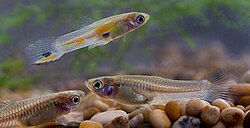
Guppies breathe by pumping water over their gills, and when those gills are damaged or the water carries too little oxygen, the fish pumps faster. That is why rapid breathing is one of the earliest and most reliable warning signs in a guppy tank. Ammonia burns the gill tissue, nitrite stops the blood carrying oxygen, and warm or stagnant water simply holds less oxygen to begin with.[1][2] In most cases the problem is the water, not a disease, and it can be fixed the same day.
Guppies also have a built-in emergency behaviour that owners often misread. When oxygen runs low they hang just under the surface with their mouths at the water line, skimming the thin, oxygen-rich top layer — a behaviour called aquatic surface respiration.[4] If your guppies are breathing fast and crowding at the surface, the tank is short of oxygen or something is stopping their gills from using it. If one guppy is breathing fast while the rest look fine, the cause is more likely to be in that fish: parasites, infection, or stress.
Why Is My Guppy Breathing Fast? The Common Causes
Ammonia or Nitrite in the Water
Most LikelyThis is the most common cause, particularly in a tank that is less than two months old, overstocked, overfed, or has recently had its filter cleaned too hard. Ammonia damages the gills even at levels that seem tiny: tissue damage has been seen when the toxic un-ionized form exceeds 0.05 mg/L.[1] A veterinary review of water-quality problems in ornamental fish lists the signs of ammonia poisoning as extra mucus, red or bleeding gills, darker body colour, gasping at the surface and an increased breathing rate.[2] Guppies are usually kept in hard, alkaline water, and the toxic fraction of ammonia rises as pH and temperature rise,[3] so a reading that would be mild in soft, acidic water can be significant in a guppy tank.
Nitrite works differently. It is absorbed through the gills and converts haemoglobin into methaemoglobin, which cannot carry oxygen — the condition is called brown blood disease because the blood and gills turn brown.[1][2] A fish with nitrite poisoning can be surrounded by oxygen and still suffocate, which is why it breathes fast even in a well-aerated tank. Nitrite spikes are typical of the second half of a new tank's cycle.
Low Oxygen or Water That Is Too Warm
Most LikelyWarm water holds much less dissolved oxygen than cool water,[5] while at the same time warmer water speeds up a guppy's metabolism so it needs more. A tank that creeps above about 28 °C in a heatwave, or one with a stuck heater, can run short of oxygen quickly, especially if it is crowded or has little surface movement. Oxygen is also lowest at night and first thing in the morning, when plants stop producing it but everything in the tank keeps using it,[5] so fish that are gasping at dawn and seem better by afternoon are a classic sign of marginal oxygen.
Guppies are well adapted to cope for a while. In laboratory studies they started skimming the surface once oxygen fell to roughly a third of normal, and spent more and more of their time there as oxygen dropped further; guppies prevented from reaching the surface died within minutes to hours at levels they could survive for much longer when allowed to skim.[4] The same research found that females spent more time at the surface than males, and that larger females did so more — so a big, heavily pregnant female is often the first fish you see breathing hard at the top.[4] Hypoxic fish gather near the surface and gulp, a behaviour called piping.[1]
Gill Parasites (Flukes, Trichodina, Ich, Velvet)
PossibleIf the water tests clean and the tank is well aerated, parasites on the gills are the next suspect. Monogenean flukes are the classic example: infected fish flash and rub against objects, breathe rapidly, and hold their gill covers flared, showing swollen, pale gills.[6] Guppies are well-known hosts of Gyrodactylus flukes, and a national survey of ornamental fish in India still found Gyrodactylus on guppies sold in aquarium markets despite the country's quarantine requirements.[7] Flukes are too small to see with the naked eye, so the clue is fast breathing combined with flashing, clamped fins and a fish that looks slightly ragged.
Other gill parasites cause the same picture. Trichodina causes a high breathing rate, gasping at the surface, excess mucus and flashing.[6] Ich (white spot) can infect the gills before any white spots appear on the body, leaving the gills pale and swollen and the fish breathing hard.[8] Velvet gives the skin a fine gold or brownish dusting and can kill quickly.[6] Parasites usually arrive with new fish, so suspect them most if you have added fish or plants in the last few weeks.
Chlorine, Chemicals or Medication
PossibleChlorine and chloramine from tap water are highly toxic to fish: harm starts at concentrations as low as 0.02 mg/L.[1] Rapid breathing that starts within minutes to hours of a water change points straight at a missed dose of dechlorinator, or at a water supply that has switched to chloramine. Sudden temperature differences between old and new water add to the stress.[1]
Other culprits are household sprays and cleaning products near the tank, new ornaments or rocks that leach chemicals, and medications — some treatments lower oxygen or irritate the gills, and some antibiotics damage the filter bacteria, which then lets ammonia rise.[3] If all the fish started breathing hard after something was added, remove it and change water.
Short-Term Stress, Late Pregnancy or a Fish That Is Dying
Less CommonSome fast breathing is normal. A guppy that has just been chased by a male, netted, moved to a new tank or has been giving birth will breathe hard for a while and settle within an hour or so. Late-pregnant females are large and carrying a heavy load, and as the research above shows, big females are the ones most likely to use the surface when oxygen is marginal.[4]
At the other end of the scale, rapid, laboured breathing is a common final sign of many serious illnesses. A guppy that is breathing fast while lying on the bottom, not eating and losing colour is often in the last stage of a bacterial or other systemic disease. That fish still deserves a water test, because the same conditions may be harming the rest of the tank.
How to Find Out Why Your Guppy Is Breathing Fast
Do these checks in order. The first three find the cause in most tanks and take less than half an hour.
-
Compare with the other fish
Watch the gill covers of the affected guppy and several others for a minute. If every fish is breathing fast or hanging at the surface, the problem is the water or oxygen. If only one fish is affected, it is more likely to be something in that fish — parasites, infection or pregnancy — though you should still test the water.
-
Test ammonia and nitrite
Both should read zero in an established tank. Any ammonia or nitrite is a problem when fish are breathing fast.[3] Check pH too: the same ammonia reading is more dangerous at higher pH and temperature.[3] If you have a dip-strip kit, confirm a positive result with a liquid test if you can.
Recommended: Water test kit -
Check temperature and surface movement
Guppies do best at about 22–28 °C. Read the thermometer, check the heater is not stuck on, and look at the surface: it should be rippling, not still. Fish that are worst early in the morning and better later in the day point to low oxygen overnight.[5]
-
Think about the last 48 hours
Water change (was dechlorinator added?), new fish or plants, new decorations, cleaning products or sprays nearby, a medication added, or a filter cleaned or switched off. Sudden breathing problems after any of these point to that change.[1]
-
Look for parasite signs
Watch for flashing (fish rubbing or darting against objects), clamped fins, excess mucus making the skin look cloudy, white spots, or a fine gold dust on the body.[6][8] Fast breathing with flashing in clean water strongly suggests gill parasites. A vet can confirm flukes or Trichodina by looking at a gill or skin sample under a microscope.
-
Check the fish for other signs of illness
Note whether the guppy is eating, whether its colour has faded or darkened, and whether there are red streaks, ulcers or raised scales. Darkened colour and gasping together fit ammonia exposure.[2] A fish that is thin, pale and lying on the bottom is likely to have a serious systemic illness.
What to Do for a Guppy That Is Breathing Fast
-
Add oxygen immediately
Add an air stone, turn up the filter or point its outflow at the surface so the water ripples. This helps whatever the cause and is safe to do before you know it. If the tank is too warm, lower the temperature gradually rather than with a sudden cold water change, because abrupt temperature swings are themselves a stress.[1][5]
-
If ammonia or nitrite is present: change water and cut feeding
Change 25–50% of the water with dechlorinated water at the same temperature, and stop feeding or feed very lightly for a day or two so less waste is produced.[3] Repeat daily until readings are zero. Do not clean the filter media hard; rinse it gently in removed tank water if it is clogged. Chloride competes with nitrite at the gills,[1] which is why some keepers use a small amount of aquarium salt during a nitrite spike — follow the product label and remember that salt treats the fish, not the cause.
-
If a water change was the trigger: dechlorinate and match temperature
Check that your water conditioner removes chloramine as well as chlorine, dose it for the full tank volume, and match the temperature of new water to the tank. Chlorine is toxic at very low concentrations,[1] so a second, correctly treated water change is often the quickest fix.
-
If the water is clean: treat for gill parasites
For confirmed or strongly suspected flukes, praziquantel in a prolonged bath is the treatment of choice in freshwater ornamental fish — use a commercial product and follow its label.[6] For ich, treatments must be repeated because only the free-swimming stage is vulnerable, and at typical guppy temperatures the parasite's life cycle takes only a few days.[8] Treat the whole tank, not just one fish, and keep aeration high during treatment.
-
Quarantine new arrivals in future
Many gill parasites arrive on new fish. Keep new guppies in a separate tank for at least 30 days before adding them, watching for flashing, fast breathing and white spots.[9] Surveys show that parasites still turn up on ornamental fish that have passed through official quarantine,[7] so your own quarantine is worth the effort.
Preventing Breathing Problems in Guppies
When Fast Breathing Needs Expert Help
🔬 AI Symptom Checker
Not sure what's wrong? Describe your fish's symptoms to the FishCare AI symptom checker for a second opinion before you treat.
Check Symptoms →Frequently Asked Questions
Why is my guppy breathing fast at the top of the tank?
Why is my guppy breathing fast at the bottom of the tank?
Is it normal for a pregnant guppy to breathe fast?
Why are my guppies breathing fast after a water change?
Can I tell if my guppy has gill flukes without a microscope?
Will aquarium salt help a guppy breathing fast?
This guide was researched against the veterinary and scientific sources listed below and reviewed for biological accuracy. Test water parameters before treating a sick fish, and consult an aquatic veterinarian if symptoms persist after 48 hours of correct treatment.
References
- Francis-Floyd, R., Yanong, R.P.E. & Petty, B.D. Environmental Diseases of Aquatic Animals in Aquatic Systems. Merck Veterinary Manual. Merck & Co., Inc. merckvetmanual.com
- Palić, D. (2015). Common Medical Conditions of Ornamental Fish Associated with Water Quality. Proceedings of the World Small Animal Veterinary Association (WSAVA) Congress 2015, via VIN. vin.com
- Francis-Floyd, R., Watson, C., Petty, D. & Pouder, D.B. Ammonia in Aquatic Systems. UF/IFAS Extension, FA16 (FA031). ask.ifas.ufl.edu
- Kramer, D.L. & Mehegan, J.P. (1981). Aquatic surface respiration, an adaptive response to hypoxia in the guppy, Poecilia reticulata (Pisces, Poeciliidae). Environmental Biology of Fishes 6(3–4): 299–313. doi:10.1007/BF00005759
- Francis-Floyd, R. Dissolved Oxygen for Fish Production. UF/IFAS Extension, FA27 (FA002). ask.ifas.ufl.edu
- Merck Veterinary Manual. Parasitic Diseases of Fish. Merck & Co., Inc. merckvetmanual.com
- Tripathi, A., Matey, C., Buchmann, K. & Hahn, C. (2025). Monogeneans on exotic Indian freshwater fish. 7. Results of a national study on ornamental fishes from 2019–2022. Parasite 32: 28. doi:10.1051/parasite/2025021
- Francis-Floyd, R., Yanong, R.P.E. & Pouder, D.B. Ichthyophthirius multifiliis (White Spot) Infections in Fish. UF/IFAS Extension, CIR920 (FA006). ask.ifas.ufl.edu
- Merck Veterinary Manual. Management of Aquarium Fish. Merck & Co., Inc. merckvetmanual.com