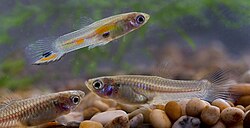
Most fish that jump out of an aquarium are escaping something. Guppies are a partial exception. Researchers filming guppies from Trinidad found that they jump spontaneously — not to catch food, not to migrate, and without any obvious stimulus — clearing on average about three and a half body lengths above the water.[1] The authors suggest jumping evolved as a way for guppies to move between pools in the streams where they live.[1] For an owner, the practical meaning is simple: a guppy tank without a lid is a tank that will lose guppies, even when nothing is wrong.
That does not mean every jumping guppy is fine. Guppies are sold as beginner fish, often into new tanks that have not finished cycling, and they are kept in mixed-sex groups where males chase females almost constantly.[3] Both of those make jumping more frequent. The causes below are ordered by how often they explain a guppy that jumps, followed by quick checks, fixes, and what to do if you find one on the floor.
Why Is My Guppy Jumping? The Common Causes
Guppies Jump Naturally
Most LikelyIn the study that first described guppy jumping in detail, fish jumped from a still position: they backed up slowly using their pectoral fins, then launched with a powerful bend of the body, reaching about 6.5 cm on average — roughly 3.5 times their own body length.[1] The researchers could find no trigger. The fish were not reaching for food and were not reacting to a visible threat; they simply jumped.[1] The fish in that study were males, and the authors note that male guppies move between pools more often than females.[1]
This matters because it changes what you should conclude. A single guppy found on the floor of an open tank, with good water and no chasing, may have done nothing more than behave like a guppy. The fix is a lid, not medication. Only when jumping is frequent, involves several fish, or comes with other signs does it point to a problem in the tank.
Females Escaping Constant Male Attention
Most LikelyMale guppies spend much of the day pursuing females, both with courtship displays and with sneak mating attempts. Across poeciliid species, females spent significantly less time feeding when a male was present, and the more mating activity the male showed, the less the female fed.[3] Females in species where males attempt many sneak copulations — guppies among them — respond by staying close to other females.[4]
In wild guppies, female avoidance goes further. In a field experiment, harassment by males drove females into deeper water that they would otherwise avoid, even though that water carried a measurably higher risk of predators.[2] No study has measured jumping out of an aquarium as an escape from males, so treat this as a strong inference rather than proof: a female that cannot get away from three or four males in a small tank has nowhere left to go but up. If the jumpers are mostly females and you have as many males as females, this is the likely driver.
Ammonia or Nitrite in a New or Crowded Tank
PossibleGuppies breed quickly, and a tank that started with six fish can hold thirty a few months later. At the other end of the story, many guppies are added to tanks only days old. The Merck Veterinary Manual describes "new tank syndrome", a water-quality problem usually seen in the first six weeks after a tank is set up, and "old tank syndrome" when water changes are small and infrequent; in both, ammonia or nitrite can reach toxic levels.[5]
UF/IFAS advises that ammonia should always read zero in a healthy tank, that even low levels damage the gills, and that a new biological filter needs six to eight weeks to build enough bacteria.[6] Guppies are kept warm, at around 22–28 °C, and un-ionised ammonia becomes more toxic as temperature and pH rise.[6] Jumping by several guppies at once, with gasping or clamped fins, points here rather than to normal behaviour.
Low Oxygen in Warm Water
PossibleWarm water holds less oxygen than cool water,[7] and a warm, crowded guppy tank with a still surface can run short, particularly overnight and in the early morning, when oxygen in planted tanks is at its lowest.[7] Fish short of oxygen gather at the surface and gulp — what fish farmers call piping.[7] Guppies are surface-feeding fish that already spend time near the top, so a fish gasping at the surface is well placed to leave the tank.
Low oxygen usually affects several fish at once, gets worse after heavy feeding and in hot weather, and improves quickly when surface movement or an air stone is added.
External Parasites
Less CommonParasites on the skin and gills cause itching; affected fish rub against objects ("flashing"), lose appetite, and may gasp at the surface.[8] Guppies bought from busy shop tanks sometimes carry them. Parasites are the likely cause if the jumping began after new fish arrived and comes with flashing, white spots, clamped fins or a greyish film on the skin.
How to Tell Why Your Guppy Is Jumping
These checks take ten minutes and will separate normal guppy behaviour from a problem that needs fixing today.
-
Note which fish are jumping
Is it one fish or several, males or females? Males are small and brightly coloured with a pointed, rod-like anal fin; females are larger and plainer. Occasional jumping by a healthy male in an open tank fits natural guppy behaviour.[1] Repeated jumping or hiding at the top by females points to harassment.[2][3]
-
Count the males and watch them for five minutes
If most of the fish are male, or males follow a female continuously and she spends her time fleeing or pressed against the glass or the surface, the tank is set up for harassment. In poeciliids, females feed less the more active the males around them are,[3] so a thin, pale female that is always being followed is a warning sign.
-
Test ammonia, nitrite and nitrate
Ammonia and nitrite should read zero.[6] Any reading, especially in a tank less than two months old or one that has not had a water change for weeks, points to water quality as the cause.[5] Note pH and temperature too, since both change how toxic ammonia is.[6]
Recommended: Liquid water test kit -
Check the surface and the temperature
Several guppies hanging at the surface and gulping means low oxygen or irritated gills.[7][8] Check that the filter outlet moves the surface and that the heater is not running the tank above about 28 °C, since warmer water holds less oxygen.[7]
Recommended: Aquarium thermometer -
Look for flashing and spots
Watch for fish rubbing against decorations, white specks, clamped fins or a dull film on the body.[8] If these are present in several fish, especially after new arrivals, parasites move up the list.
How to Stop a Guppy From Jumping
-
Cover the tank completely
Because guppies jump without any trigger,[1] a lid is the only reliable protection. Use a fitted hood or a glass or mesh cover and close the gaps around filters, heaters and cables — a guppy can get through a surprisingly small opening. Leave a small air gap above the water.
-
Fix the sex ratio
Keep more females than males — at least two females for each male is a common rule of thumb — or keep an all-male tank. Add floating and dense plants so females can break line of sight and rest. The aim is to reduce the time females spend being pursued, which is what costs them feeding time and drives them into poor places to be.[2][3][4]
-
If ammonia or nitrite shows: water change and less food
Reduce or stop feeding for a day and change 25–50% of the water with dechlorinated water at the same temperature, as UF/IFAS recommends when ammonia is present.[6] Repeat until ammonia and nitrite read zero. In a new tank, add no more fish until the filter has matured, which takes six to eight weeks.[6]
-
Add surface movement and control numbers
Angle the filter output to ripple the surface or add an air stone, and avoid overfeeding.[7] If the population is growing, rehome fish or separate the sexes before the tank becomes crowded — a crowded tank combines harassment, ammonia and low oxygen at once.
-
Get a diagnosis before treating parasites
If flashing and spots suggest parasites, ask an aquatic vet or experienced fish shop to confirm what they are before medicating, and quarantine new guppies in future.[8]
Preventing Guppies From Jumping
When a Jumping Guppy Needs Urgent Help
🔬 AI Symptom Checker
Not sure what's wrong? Describe your fish's symptoms to the FishCare AI symptom checker for a second opinion before you treat.
Check Symptoms →Frequently Asked Questions
Do guppies jump out of tanks on purpose?
Why do my female guppies keep jumping?
How long can a guppy survive out of water?
Can baby guppies (fry) jump out of the tank?
My guppy jumped out and now it's lying on the bottom — what should I do?
Is my guppy jumping because the water is bad?
This guide was researched against the veterinary and scientific sources listed below and reviewed for biological accuracy. Test water parameters before treating a sick fish, and consult an aquatic veterinarian if symptoms persist after 48 hours of correct treatment.
References
- Soares, D. & Bierman, H.S. (2013). Aerial Jumping in the Trinidadian Guppy (Poecilia reticulata). PLOS ONE 8(4): e61617. doi:10.1371/journal.pone.0061617
- Darden, S.K. & Croft, D.P. (2008). Male harassment drives females to alter habitat use and leads to segregation of the sexes. Biology Letters 4(5): 449–451. doi:10.1098/rsbl.2008.0308
- Plath, M., Makowicz, A.M., Schlupp, I. & Tobler, M. (2007). Sexual harassment in live-bearing fishes (Poeciliidae): comparing courting and noncourting species. Behavioral Ecology 18(4): 680–688. doi:10.1093/beheco/arm030
- Dadda, M. (2015). Female social response to male sexual harassment in poeciliid fish: a comparison of six species. Frontiers in Psychology 6: 1453. doi:10.3389/fpsyg.2015.01453
- Merck Veterinary Manual. Management of Aquarium Fish. Merck & Co., Inc. merckvetmanual.com
- Francis-Floyd, R., Watson, C., Petty, D. & Pouder, D.B. Ammonia in Aquatic Systems. UF/IFAS Extension, FA16 (FA031). ask.ifas.ufl.edu
- Francis-Floyd, R. Dissolved Oxygen for Fish Production. UF/IFAS Extension, FA27 (FA002). ask.ifas.ufl.edu
- Merck Veterinary Manual. Disorders and Diseases of Fish. Merck & Co., Inc. merckvetmanual.com
- Cook, K.V., Lennox, R.J., Hinch, S.G. & Cooke, S.J. (2015). Fish Out of Water: How Much Air Is Too Much? Fisheries 40(9): 452–461. doi:10.1080/03632415.2015.1074570
- Merck Veterinary Manual. Bacterial Diseases of Fish. Merck & Co., Inc. merckvetmanual.com