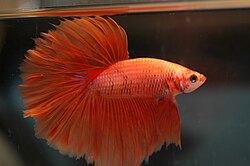
Black spots on a betta are alarming because they look like a disease, but in most cases they are pigment — the betta's own melanophores, the black pigment cells in the skin and fins, laying down colour in a new place. Bettas have been bred for an enormous range of colours and patterns, and some of the most popular types, sold as marble, koi, candy or galaxy bettas, have a mosaic pattern that is not fixed.[1] Pigment cells also move into skin and fins as they heal after damage from injury, infection or parasites.[2]
The job is to separate those harmless changes from the few causes that need action. The key questions are whether the spot is flat or raised, whether the fish is behaving normally, and what the water test says. Flat, painless colour in a lively betta is almost never an emergency. Darkening together with lethargy and gasping points to ammonia,[3] and a raised black lump that grows is a reason to see a vet, because bettas are unusually prone to pigment-cell tumours.[6]
Why Does My Betta Have Black Spots? The Common Causes
Marble Genes and Normal Colour Change
Most LikelyThis is the most common explanation, particularly in pale, white, cellophane, koi or multicoloured bettas. A genome study of more than 700 domestic bettas described the mosaic colour pattern as one of the most striking in the species, sold under names including koi, candy, galaxy, lemon and marble, and found it is controlled by several genes rather than one.[1] Breeders have long reported that bettas carrying the marble trait change colour through their lives: black, blue or red patches appear, spread, fade or move over weeks or months, and a fish bought almost white can end up largely dark, or the reverse.
Marble changes are flat, sit within the scales or fin tissue rather than on top, and can appear on the body, head and fins. The betta keeps eating, flaring and building bubble nests as usual. Domestic bettas have a complex breeding history that includes crossing with wild Betta species,[1] so a fish not sold as a marble can still carry the trait and gain dark spots as it matures. None of this is a disease, it is not contagious, and there is nothing to treat.
Healing Pigment After Fin Damage or Injury
Most LikelyThe second common cause is healing. Changes in fish skin pigmentation can follow trauma, parasite attachment or bacterial, viral and fungal skin infections, and experimental work shows the pigment cells actively move and redistribute as skin repairs.[2] In bettas this is usually seen as black or dark edges on fins that are growing back after fin rot or fin biting, or a dark patch where a scale was lost after the fish scraped itself on decoration.
The clue is location and timing: the dark area sits exactly where there was damage, and it appears as the damage stops getting worse. Healthy regrowth is often clear or pale at first, and the pigment follows behind it. Dark fin edges that are still receding, fraying or white and fluffy mean the fin rot is active, not healing, and the water needs attention.
Ammonia Burns and Poor Water Quality
PossibleBettas are often kept in small, unfiltered bowls or tanks where ammonia builds up quickly. Ammonia damages gill tissue at very low concentrations of its toxic un-ionized form,[5] and a veterinary review lists darkening of body colour among the signs of ammonia poisoning, together with extra mucus, red gills, gasping at the surface and faster breathing.[3] Many keepers describe dark or blackened patches, often along fin edges and on the head, appearing in fish from dirty tanks — and as the damaged skin heals after the water is corrected, it can remain dark for a while.[2]
Suspect this when the spots appear alongside lethargy, clamped fins, loss of appetite, gasping or fin damage, and when the tank is small, has no filter or has not had a water change recently. Chronic exposure to low ammonia also makes fish more prone to bacterial infections,[4] which leads straight back to fin rot and the dark healing edges described above.
Pigment-Cell Tumours (Chromatophoromas)
Less CommonBettas are one of the fish species in which pigment-cell tumours are reported most often. In a study of 71 tumours from farmed bettas, the masses appeared as whitish, grey or black friable lumps or plaques on the fins, body or head; most were iridophoromas (tumours of the light-reflecting cells), a few were mixed tumours, and 63% had invaded deeper tissue or spread. They were most common in young males and in royal blue and fancy copper bettas, suggesting an inherited tendency.[6] A separate case report described a malignant mixed tumour containing black pigment cells in a 10-month-old male blue betta, with several masses that enlarged rapidly.[7]
What sets a tumour apart is that it is raised: a lump, nodule or thickened plaque you can see in profile, not a flat colour change. It usually grows over weeks. Only a vet can confirm it, by sampling the tissue. Tumours are not contagious, but many are malignant, and the outlook depends on where the mass is and how fast it is growing.
Black Spot Disease (Trematode Parasites)
Less CommonTrue black spot disease is caused by the larval stage of certain flukes. The parasite needs three hosts: fish-eating birds shed the eggs, the larvae develop in water snails, and free-swimming larvae then burrow into fish and form cysts, which the fish surrounds with pigment — producing small black dots that look like black pepper sprinkled over the fins or flesh.[8] Fish can act as an intermediate host for many flukes of this type.[9]
Because the cycle needs both a suitable snail and a bird, it cannot keep going in a home aquarium, and black spot disease is rare in pet bettas. It is only realistic in a fish raised or kept outdoors in ponds or tubs, and the spots are pinhead-sized, many in number, and do not multiply once the fish is indoors. A few large, irregular patches are not black spot disease, and treating a marble betta for parasites only exposes it to unnecessary medication.
How to Tell What Your Betta's Black Spots Are
Work through these checks with the betta in good light. Most cases are answered by the first three, and none of them requires medication.
-
Check whether the spot is flat or raised
Look at the fish side-on and from above. Flat colour within the scales or fin is pigment — marble change, healing or ammonia darkening. A lump, nodule or plaque that stands up from the surface, or makes the outline of the fish or fin uneven, needs a vet to rule out a pigment-cell tumour.[6]
-
Think about what the betta looked like when you bought it
Pale, white, cellophane, koi, candy, galaxy or multicoloured bettas are the most likely to carry marble or mosaic genetics.[1] If the fish's colours have been shifting in other places too — blue or red patches appearing, spots fading — black spots are almost certainly part of the same process. Photographs taken every week or two will show whether patches are moving.
-
Match the spots to any old damage
Dark edges on fins that were torn, bitten or rotting, or a dark patch where there was a scrape or lost scale, are usually healing pigment.[2] Check that the fin edges are now smooth and clear regrowth is appearing, rather than still fraying.
-
Test the water
Test ammonia, nitrite, nitrate, pH and temperature. Ammonia and nitrite should both be zero, and bettas are most comfortable at about 24–28 °C. Any ammonia reading combined with darkening, gasping or lethargy points to ammonia burns.[3][4] Small unfiltered containers are the highest risk.
Recommended: Water test kit -
Watch behaviour and appetite
A betta that eats eagerly, swims, flares and builds bubble nests while it gains spots is showing a colour change. Spots with clamped fins, lethargy, hiding, rubbing against objects or loss of appetite point to water problems or illness. Rapid growth of a spot or swelling around it points to a tumour.[7]
-
Consider where the fish came from
Black spot disease is only realistic if the betta has lived outdoors with snails and wild birds around, and it shows as many tiny pepper-grain dots rather than a few patches.[8] If your betta has always lived indoors, this cause can be set aside.
What to Do About Black Spots on a Betta
-
If it is a colour change: do nothing
Marble and mosaic colour changes are normal and cannot and should not be treated.[1] Keep the water clean and the fish well fed; good condition makes colour look its best, but it will not stop the pattern shifting. Enjoy the changes — no two marble bettas end up the same.
-
If it is healing: keep the water clean while the fins regrow
Healing skin and fins need clean, warm, stable water. Change part of the water regularly, keep ammonia at zero, remove sharp decorations that may have caused the damage, and let the dark areas fade or settle in their own time.[2][4] No medication is needed for pigment in healed tissue.
-
If ammonia is present: fix the water today
Change 25–50% of the water with dechlorinated water at the same temperature, reduce feeding, and repeat until ammonia reads zero.[4] Move a betta living in an unfiltered bowl into a heated, filtered tank of at least 20 litres if you can. The dark patches from ammonia burns may take weeks to fade after the water is right, and some may remain.
-
If there is a raised lump: see an aquatic vet
A vet can take a small sample of a mass to find out what it is. Some skin tumours in bettas are restricted to the skin, but many invade deeper tissue or spread,[6] and one reported malignant case grew rapidly over a short time.[7] Surgery is sometimes possible for small masses on fins. Do not try to treat a lump with aquarium salt or antiparasitic medicines.
-
If it really is black spot disease: usually leave it
The cysts cannot complete their life cycle in an aquarium without snails and birds,[8] so they do not spread to tankmates, and light infections are mainly cosmetic. Keep the fish in good water and ask a vet only if the fish is heavily covered or unwell.
Preventing Harmful Black Spots in Bettas
When Black Spots Need Expert Help
🔬 AI Symptom Checker
Not sure what's wrong? Describe your fish's symptoms to the FishCare AI symptom checker for a second opinion before you treat.
Check Symptoms →Frequently Asked Questions
Why is my white betta turning black?
Are black spots on a betta contagious?
Why are my betta's fin edges turning black?
Can ammonia cause black spots on a betta?
Should I treat my betta for black spot disease?
What does a betta tumour look like?
This guide was researched against the veterinary and scientific sources listed below and reviewed for biological accuracy. Test water parameters before treating a sick fish, and consult an aquatic veterinarian if symptoms persist after 48 hours of correct treatment.
References
- Zhang, W., Wang, H., Brandt, D.Y.C., Hu, B., Sheng, J., Wang, M., et al. (2022). The genetic architecture of phenotypic diversity in the Betta fish (Betta splendens). Science Advances 8(38): eabm4955. doi:10.1126/sciadv.abm4955
- Blanco Cohene, T., Olea, G., Mendez Galarza, S., Honorato Da Silva, C.A. & Flores Quintana, C. (2026). Chromatophores and their role in the healing process of the integument of Gymnotus carapo (Teleostei: Gymnotiformes). Journal of Molecular Histology 57(1): 32. doi:10.1007/s10735-025-10677-z
- Palić, D. (2015). Common Medical Conditions of Ornamental Fish Associated with Water Quality. Proceedings of the World Small Animal Veterinary Association (WSAVA) Congress 2015, via VIN. vin.com
- Francis-Floyd, R., Watson, C., Petty, D. & Pouder, D.B. Ammonia in Aquatic Systems. UF/IFAS Extension, FA16 (FA031). ask.ifas.ufl.edu
- Francis-Floyd, R., Yanong, R.P.E. & Petty, B.D. Environmental Diseases of Aquatic Animals in Aquatic Systems. Merck Veterinary Manual. Merck & Co., Inc. merckvetmanual.com
- Diniz, S.L.P., Oliveira Filho, H.S., Santos, K.M.O.L., Duarte, J.L.C., Oliveira, R.L., Pierezan, F., Armién, A.G. & Leal de Araújo, J. (2025). Gross, histologic, and ultrastructural features of iridophoromas in Siamese fighting fish (Betta splendens). Veterinary Pathology 62(2): 237–247. doi:10.1177/03009858241281887
- Yu, Z.A., Corriveau, L.A. & Messick, J.B. (2025). Malignant Mixed Irido-Melanophoroma in a Betta splendens with Concurrent Mycobacterium chelonae Isolation — A Case Report. Journal of Fish Diseases 48(7): e14115. doi:10.1111/jfd.14115
- Minnesota Department of Natural Resources. Neascus (Black spot disease). Minnesota DNR, Fish Diseases. dnr.state.mn.us
- Merck Veterinary Manual. Parasitic Diseases of Fish. Merck & Co., Inc. merckvetmanual.com