Miniatus grouper care is the easiest entry into keeping a grouper: the coral hind (Cephalopholis miniata) stops at 12–16 inches, lives happily in a 100–125 gallon tank with a cave, eats frozen seafood within days of arrival, shrugs off water that would trouble a tang, and keeps its red-and-blue-spotted colour for a decade or more. The only rules are the grouper rules: buy the adult's tank, feed meaty food two or three times a week with a vitamin soak, and stock nothing it can swallow — which is anything under about 7 inches.
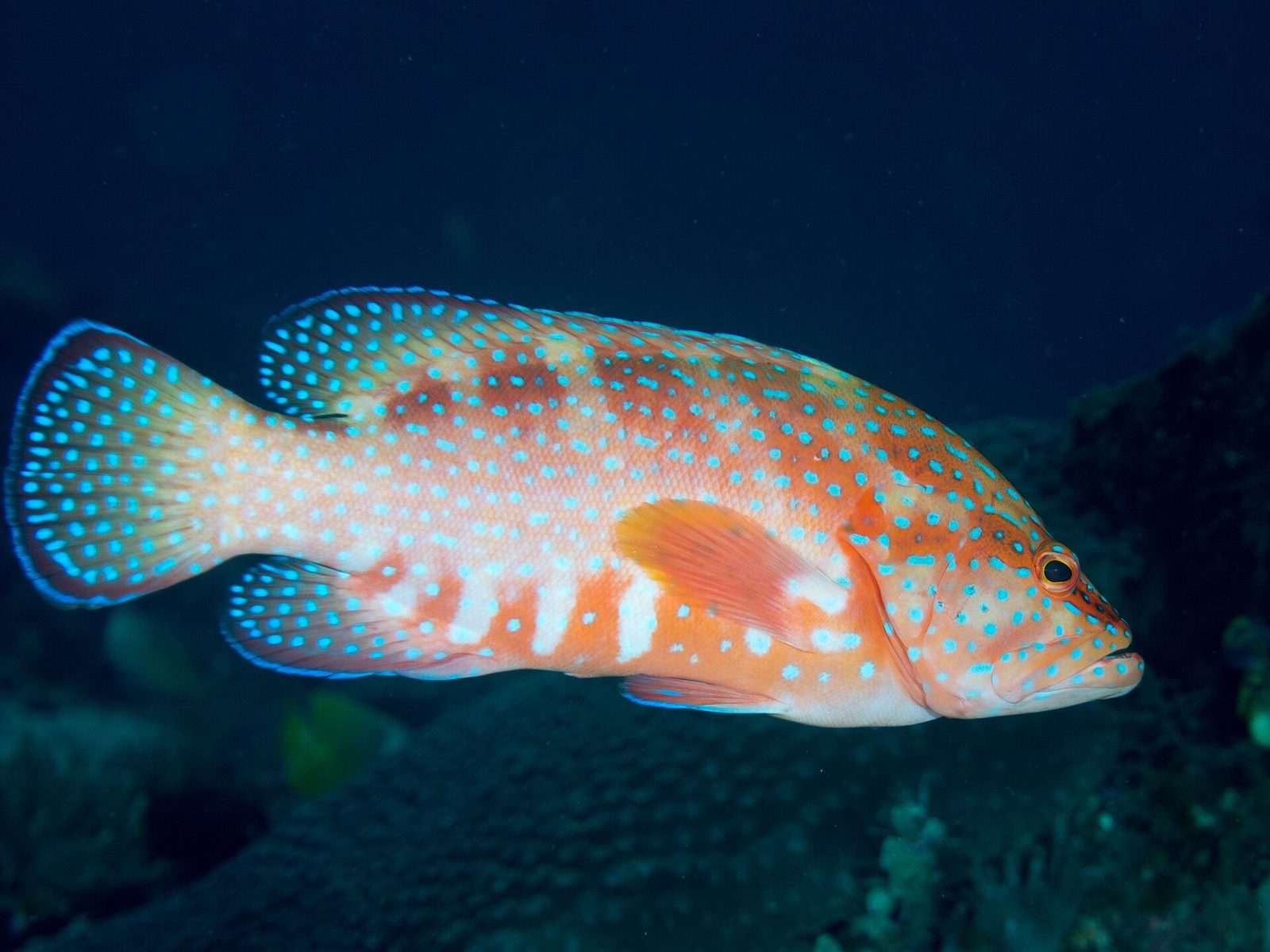
About the Miniatus Grouper
Cephalopholis miniata — coral hind, coral grouper, coral trout in some countries, miniatus or miniata grouper in the trade — lives on clear-water reef slopes from the Red Sea to the central Pacific, at 5–150 feet, always near a hole; the species entry describes the range. It is red to orange-red, densely covered in small blue spots ringed with black, with a rounded tail, and reaches 18 inches in the wild and 12–16 in an aquarium. Like all groupers it is a protogynous hermaphrodite — born female, the largest become male — and on the reef a male holds a territory with a harem of females. In the aquarium it is kept alone and is one of the most personable marine fish in the hobby, learning its keeper within weeks.
Miniatus Grouper Care at a Glance
| Care factor | Requirement |
|---|---|
| Adult size | 12–16 in (18 in wild) |
| Lifespan | 10–15 years |
| Minimum tank | 100 gal; 125 gal / 5–6 ft preferred |
| Temperature | 74–80°F (23–27°C) |
| Salinity / pH | 1.023–1.026 / 8.1–8.4 |
| Nitrate | Under 30 ppm; skimmer rated 2× the tank |
| Diet | Frozen silversides, shrimp, krill, squid; carnivore pellets |
| Feeding | 2–3× a week (adult); daily (juvenile) |
| Temperament | Predatory; peaceful with fish over 7 in |
| Reef safe | Corals yes; inverts and small fish no |
| Care level | Easy |
Miniatus Grouper Tank Size and Water
One adult miniatus needs 100 gallons at minimum and 125 comfortably, at least 5 feet long, with the two things every grouper tank has: a rock cave at the back that the fish can fit its whole body into, and open sand in front of it to strike across. Add 25% for each large tank mate. Water is standard reef water — 74–80°F, 1.023–1.026, pH 8.1–8.4 — and the miniatus is tolerant of all of it; what it needs is filtration for a predator: a protein skimmer rated for twice the tank volume, a sump, filter socks changed twice a week, and 20–25% weekly water changes to keep nitrate under 30 ppm. Dim or moderate lighting suits it; under bright reef lights it stays in the cave. The general figures are on the grouper fish tank size and water parameters pages.
Miniatus Grouper Care: Food and Feeding
Frozen marine seafood on a feeding stick: one or two silversides or lancefish, or three or four shell-on shrimp, per feed, two or three times a week, soaked in a vitamin and HUFA supplement. Squid, clam and krill for variety; a large sinking carnivore pellet once the fish is trained onto it, usually within a month. Juveniles under 5 inches eat daily in small pieces. The miniatus is a greedy, tame fish that will rush the glass every time you pass and take a finger if offered one; feed from a stick, to a slightly rounded belly, and then leave it for two days. Never feed live goldfish — fatty liver and B1 deficiency are the commonest causes of an early death in this species. The full schedule is on the grouper fish food page.
Miniatus Grouper Tank Mates
Anything it cannot swallow and cannot bully: a lionfish (the classic pair), a large tang (naso, sailfin, blue), a large angelfish (emperor, koran), a big wrasse (harlequin tusk, banana wrasse), a foxface, a moray or snowflake eel, a trigger or large puffer in a 180 or bigger. Add the tank mates before the grouper, or at the same time as juveniles, and keep everything at least half the grouper's length. Clownfish, gobies, damsels, dwarf angels, shrimp, crabs and snails are eaten. Two miniatus, or a miniatus and another Cephalopholis, fight in anything under 300 gallons. The full list is on the grouper fish tank mates page; the compatibility checker handles specific pairs.
Miniatus Grouper Care Problems
- Ich or flukes in the first month. Almost all are wild-caught. Four weeks of quarantine with copper or praziquantel before the display tank; see grouper fish diseases.
- Fading red. Miniatus pale at night and when stressed — normal. Dull for weeks means poor diet (add krill and vitamins), high nitrate, bright lighting or a tank too small.
- Swollen belly, lethargy. Overfeeding or feeder fish; fast for a week, switch to lean marine food.
- Pits around the eyes (HLLE). Frozen-only diet without vitamins, carbon dust, stray voltage. Reverses early with vitamin-soaked food and pellets.
- Vanishing tank mates. The grouper ate them, at night. Re-check the size rule.
- Hiding after a move. A week in the cave is normal; food on a stick brings it out.
How the miniatus compares with the other eleven aquarium groupers is on the types of grouper fish page; the larger and more popular panther grouper has its own guide; and the general routine is in the grouper fish care guide.
Grouper Fish Care FAQ
What tank size does a miniatus grouper need?
100 gallons minimum and 125 preferred, at least 5 feet long, for one adult of 12–16 inches, with a cave it can sit inside and open sand in front. Add 25% for each large tank mate.
Are miniatus groupers aggressive?
Toward anything it can eat, yes; toward large tank mates, mildly territorial around its cave. It will not bother a lionfish, a large tang or an eel, and it never bothers corals.
What do miniatus groupers eat?
Frozen silversides, lancefish, shrimp, krill, squid and clam, two or three times a week, soaked in a vitamin supplement, plus a large carnivore pellet once trained. Never live goldfish.
Are miniatus groupers reef safe?
With corals and anemones, yes. With shrimp, crabs, snails and small fish, no — the coral hind is a night hunter that clears a reef of its clean-up crew within weeks.
How long do miniatus groupers live?
Ten to fifteen years in a 125-gallon tank with good filtration and a varied frozen diet. They are among the hardiest marine fish once past quarantine.
Why is my miniatus grouper losing its red colour?
Groupers change colour with mood and light — paler at night and when stressed. Colour that stays dull for weeks points to poor diet (add krill and vitamins), high nitrate, or a tank too small for the fish.