Dwarf neon rainbowfish care is the small-tank version of the rainbowfish recipe: a school of eight or more in a 20-gallon long or bigger, water that is warm (75–82°F), hard and alkaline, and food small enough for a 2-inch mouth. Melanotaenia praecox is the smallest of the common Melanotaenia, violet-blue with red fins on the males and yellow on the females, and the one rainbowfish that fits a 30-inch tank. It has two quirks the bigger species do not: it ships badly and hates a new, unstable tank, and it runs a few degrees warmer than its relatives.
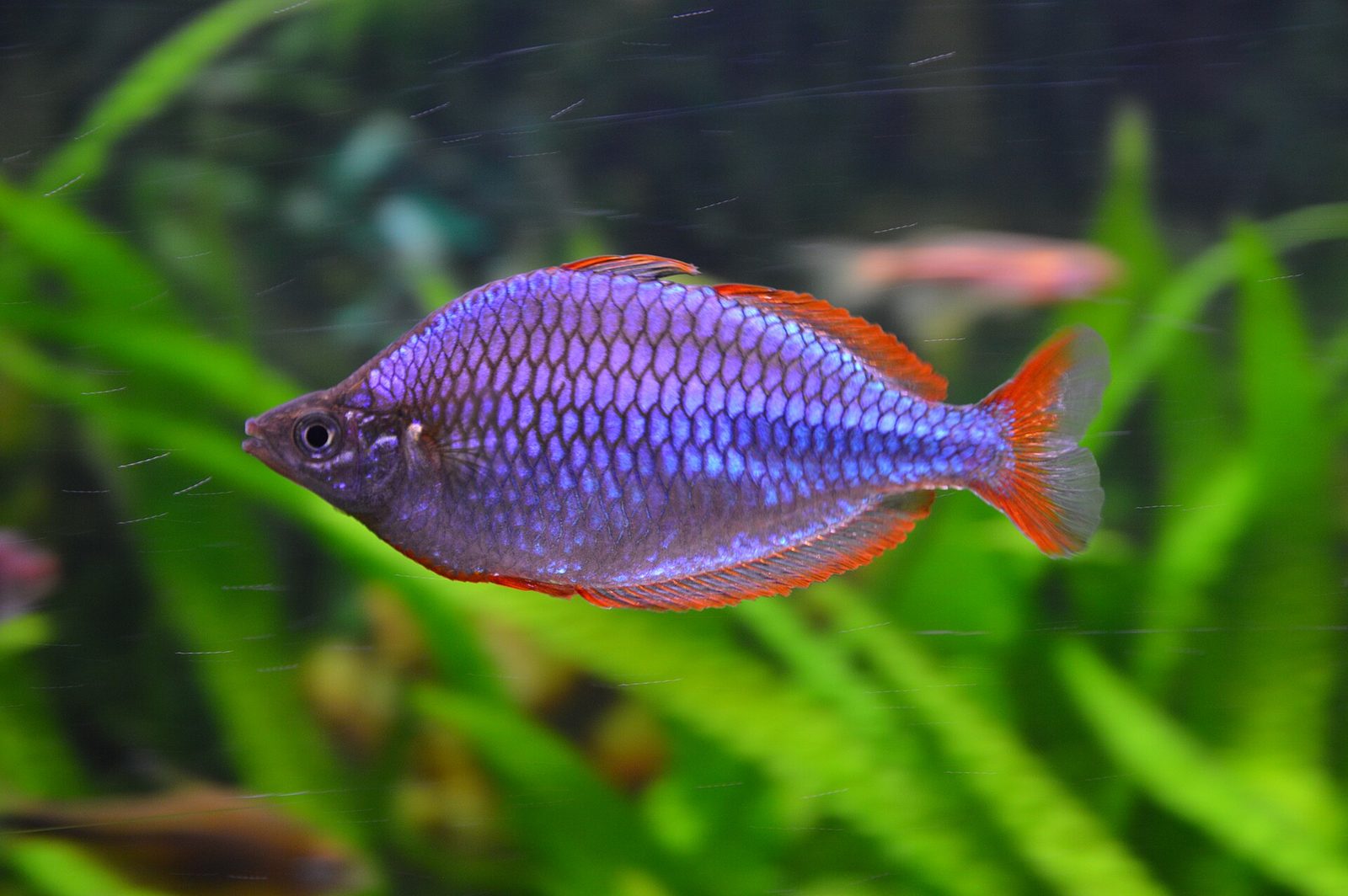
About the Dwarf Neon Rainbowfish
Melanotaenia praecox comes from the Mamberamo river system in northern New Guinea, where it lives in shoals in warm, clear, slow-flowing tributaries over sand and leaf litter; the species entry describes the habitat. It was only introduced to the hobby in the 1990s and has become one of the most-sold rainbowfish because of its size. Males reach 2–2.5 inches with a deeper body, brilliant blue scales that flash violet, and red dorsal, anal and tail fins; females are slimmer at 2 inches with yellow or orange fins. Unlike the boesemani, dwarf neons colour up young — at 4–6 months — so the shop fish often already shows its blue.
Dwarf Neon Rainbowfish Care at a Glance
| Care factor | Requirement |
|---|---|
| Adult size | 2–2.5 in (male), 2 in (female) |
| Lifespan | 4–5 years |
| Group | 8 minimum; 10–12 in a 30 gallon |
| Minimum tank | 20 gal long (30 in); 30–40 gal with tank mates |
| Temperature | 75–82°F (24–28°C) |
| pH / hardness | 7.0–8.0 / 8–15 dGH |
| Diet | Micro pellets, crushed flake, frozen daphnia and cyclops, baby brine shrimp |
| Temperament | Peaceful, busy; males spar |
| Care level | Easy in a mature tank; poor in a new one |
Dwarf Neon Rainbowfish Tank Size and Water
Eight dwarf neons need a 20-gallon long — 30 inches of run — and a dozen with a corydoras group need a 30 or a 40-breeder. A 10-gallon or a 20-high is too short. Set it up dark: black sand, a dark background, plants along the back and sides (dwarf neons look their best over a carpet with tall stems behind), an open front lane, floating plants to soften the light, and a tight lid. Water: 75–82°F (78°F is the sweet spot and lets them share a tank with most tropicals), pH 7.0–8.0, 8–15 dGH, ammonia and nitrite zero, nitrate under 20 ppm, moderate flow.
The part of dwarf neon rainbowfish care that trips people up is the new tank: praecox are sensitive to ammonia and to fluctuating parameters in a way the big species are not, and a school added to a freshly cycled tank often loses half its number in the first fortnight. Add them to a tank that has been running with fish for two months or more, quarantine for three weeks, and add the school in two halves a week apart. The general targets are on the rainbow fish water parameters page.
Dwarf Neon Rainbowfish Food
Small mouths, big appetites. Feed 0.5–1 mm micro pellets or finely crushed flake twice a day, frozen cyclops, daphnia and baby brine shrimp three or four times a week, and a spirulina flake or two twice a week. Live baby brine shrimp or daphnia once a week keeps the males red-finned and displaying. Standard flake straight from the tub is too big; they spit it, chase the pieces and go hungry. Two-minute rule for portions — a school of ten begging at the glass will talk you into overfeeding a 20-gallon tank very quickly. See rainbow fish food for the full schedule.
Dwarf Neon Rainbowfish Tank Mates
Anything peaceful, small and warm-water: neon, ember and rummy-nose tetras, harlequin and chili rasboras, corydoras (pygmy, panda, sterbai), otocinclus, kuhli loaches, honey gouramis, and a second dwarf rainbowfish species such as the threadfin or forktail blue-eye in a 30 or larger. Adult cherry shrimp usually survive; shrimplets do not. Avoid: bettas (the busy school stresses them and they may attack red-finned males), angelfish and larger gouramis (will eat a 2-inch fish), tiger barbs and serpae tetras (fin nippers), and cold-water fish. Pairings are on the rainbow fish tank mates page and the neon rainbowfish compatibility hub.
Breeding Dwarf Neon Rainbowfish
Dwarf neons spawn easily in the community tank and constantly in a breeding setup: a conditioned trio in a 10-gallon at 79°F with a spawning mop or a clump of Java moss lays a few adhesive eggs every morning for weeks. Eggs hatch in 6–8 days, the fry are tiny and need infusoria or a liquid fry food for the first week, then baby brine shrimp, and they reach an inch at three months and colour at four to six. In a heavily planted tank with floating plants a handful of fry survive on their own — more than with any other rainbowfish. Full method on the rainbow fish breeding page.
Common Dwarf Neon Rainbowfish Problems
- Deaths in the first two weeks. Shipping stress plus a new tank. Buy from a shop that has held them a week, quarantine, and add to a mature tank only.
- Pale or grey fish. Group under eight, soft water, bright substrate, or a larger tank mate keeping them nervous. Dwarf neons also lose colour at night — normal.
- Spitting food. Pieces too large. Size down.
- Wasting with a bent spine. Fish tuberculosis, which the species is prone to from crowded farm tanks. Remove the fish; see rainbow fish diseases.
- Jumping. A gap at the back of the lid is enough.
How the dwarf neon compares with the other dwarf species and with boesemani is on the types of rainbow fish page; the routine that applies to the whole genus is in the rainbow fish care guide. Species facts: neon rainbowfish profile.
Rainbow Fish Care FAQ
How many dwarf neon rainbowfish should I keep?
Eight or more; ten to twelve in a 30-gallon looks best. They are a schooling species that stays nervous and pale in groups under six.
What tank size do dwarf neon rainbowfish need?
A 20-gallon long (30 inches) for eight; a 30-gallon or 40-breeder for a dozen with tank mates. A 10-gallon is too short for them to swim properly.
What temperature do dwarf neon rainbowfish like?
75–82°F, warmer than most rainbowfish, because Melanotaenia praecox comes from lowland New Guinea streams. Keep pH 7.0–8.0 and hardness 8–15 dGH like the rest of the genus.
Why are my dwarf neon rainbowfish losing colour?
Small school, soft or acidic water, a bright substrate, or bullying by a larger tank mate. Dwarf neons also lose colour at night, which is normal, and the blue only shows well under good lighting over a dark background.
Can dwarf neon rainbowfish live with a betta?
Not well. Dwarf neons are fast, busy and constantly moving, which stresses a betta, and a betta may flare at the red-finned males. Keep them with tetras, rasboras and corydoras instead.
Are dwarf neon rainbowfish hard to keep?
They are hardy once settled but ship badly and are sensitive to ammonia in a new tank. Add them to a cycled, mature tank, quarantine for three weeks, and feed small foods; then they are as tough as any rainbowfish.