Rainbow fish care is easy once you accept the one rule that everything else follows from: rainbowfish are schooling fish, and a school means six or more of the same species in a tank at least three feet long. Give a group of Melanotaenia that, plus hard alkaline water and small food twice a day, and you get one of the most colourful, active and long-lived freshwater fish in the hobby — a boesemani rainbowfish takes a year to colour up and then holds its blue-and-orange for a decade. Keep two in a 20-gallon and you get a pair of nervous grey fish that never colour at all.
This guide is the hub of the rainbow fish care series. It covers what a rainbowfish is, the numbers that apply to every species, and the decisions that matter, with a dedicated page for each: tank size, water parameters, food, types of rainbow fish, tank mates, breeding, behavior, diseases and size and lifespan, plus species guides for the boesemani and the dwarf neon. If you are choosing a tank, start with the rainbow fish tank size calculator.

What Is a Rainbow Fish?
Aquarium rainbowfish are the family Melanotaeniidae: about 100 species of small, deep-bodied, fast-swimming fish from the rivers, lakes and swamps of Australia and New Guinea, with a couple of outliers in Madagascar and Sulawesi. The genus that matters in the shop is Melanotaenia — boesemani, turquoise, Australian, dwarf neon, splendid — alongside the red rainbowfish (Glossolepis), the celebes rainbowfish and the tiny threadfin and blue-eye rainbowfish (Iriatherina, Pseudomugil). The family account on Wikipedia's rainbowfish page lists the genera; almost every fish sold is captive-bred.
Three things about their wild life shape rainbow fish care in a tank:
- They live in schools of dozens, in open water. Colour, confidence and courtship all happen inside the group.
- They come from hard, alkaline water — limestone rivers and lakes at pH 7–8 — not the soft blackwater of tetras.
- They are sprinters that cross a tank dozens of times an hour, so tank length matters more than gallons.
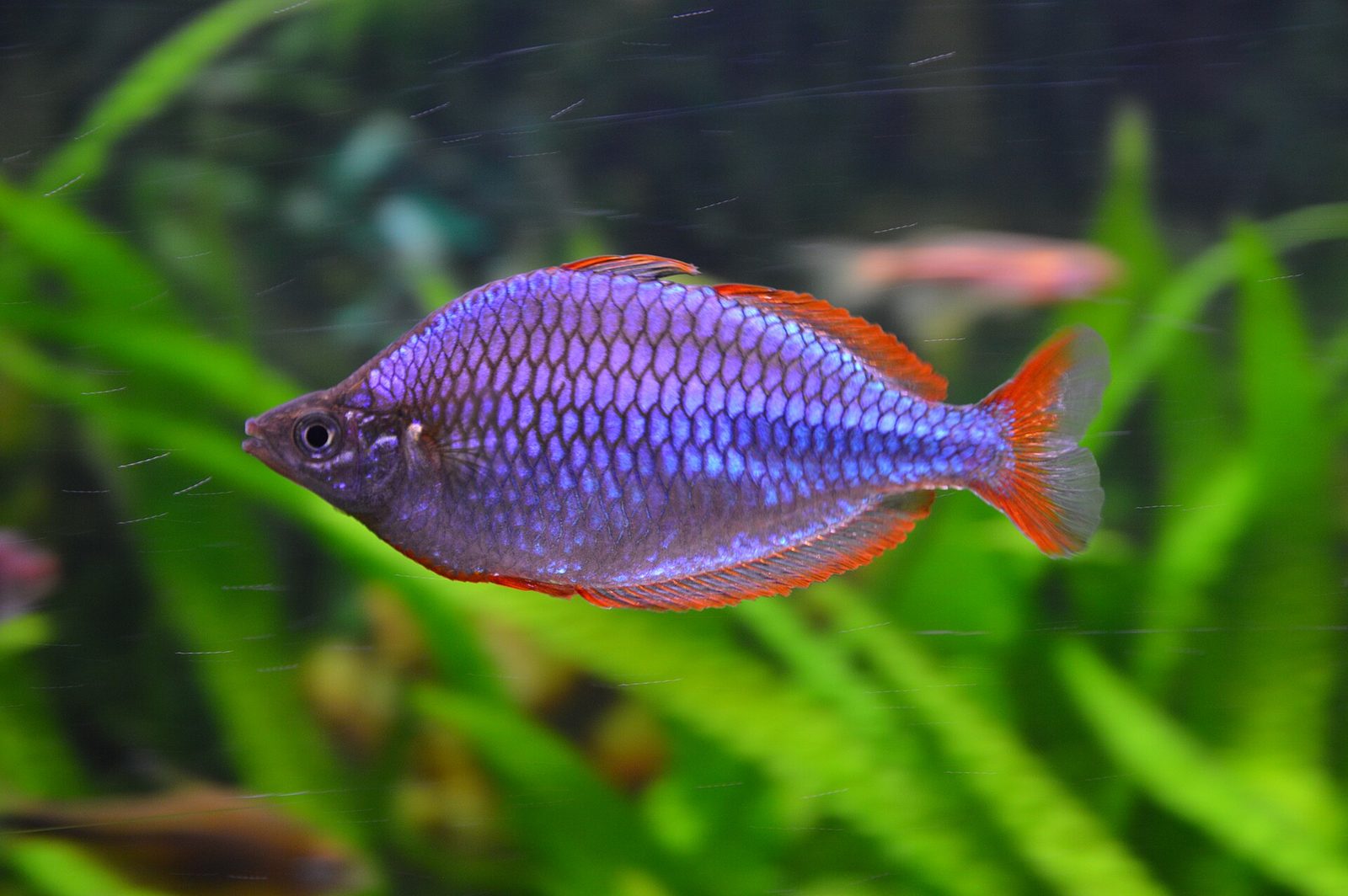
The name is literal: a mature male shows a different colour from every angle, and the colour changes minute to minute with mood and light. Juveniles are silver, which is why the fish in the shop looks nothing like the photo.
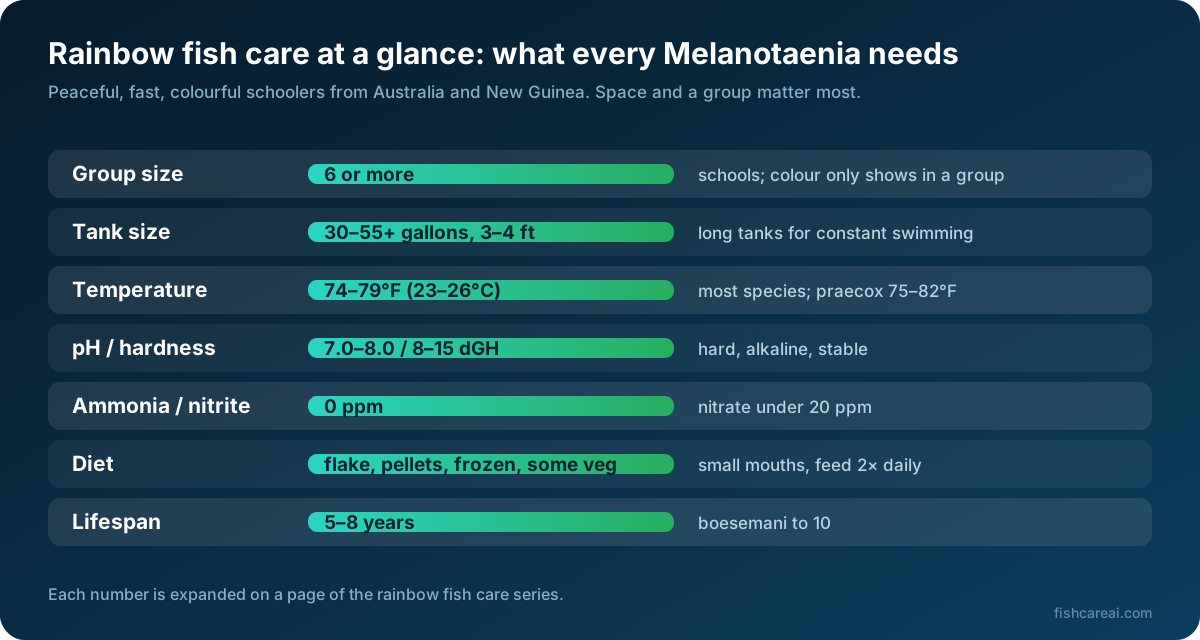
Rainbow Fish Care at a Glance
| Care factor | Requirement |
|---|---|
| Group size | 6 minimum, 8–10 better, one species per school |
| Adult size | 2–2.5 in (dwarf species) to 4–6 in (boesemani, Australian, red) — size by species |
| Lifespan | 5–8 years; boesemani to 10 |
| Minimum tank | 20 gal / 30 in (dwarf); 40–55 gal / 3–4 ft (medium); 55–75 gal / 4 ft (large) |
| Temperature | 74–79°F (23–26°C); dwarf neon and red 75–82°F |
| pH / hardness | 7.0–8.0 / 8–15 dGH, 5–12 dKH |
| Ammonia / nitrite / nitrate | 0 / 0 / under 20 ppm |
| Diet | Omnivore: small flake or micro pellets, frozen, live, some vegetable |
| Temperament | Peaceful, very active; males display at each other |
| Care level | Beginner, once the school and the tank length are right |
Schooling: The First Rule of Rainbow Fish Care
Everything a rainbowfish does — colouring up, displaying, feeding boldly, spawning — it does inside a group. Six is the working minimum; at eight to ten the males stop harassing one female and spread their sparring across the school, and the whole tank lights up at dawn. One rainbowfish, or a pair, or a “mixed school” of one each of five species, does not count: those fish stay pale, hide, and are the ones that turn up in forum posts as “my rainbow fish never coloured up”. Buy the school in one go, from one tank, at the same size. Why they behave this way and what the daily chasing means is on the rainbow fish behavior page.
Rainbow Fish Tank Size
Because they are sprinters, the tank's length is the number to plan around. The school minimums:
- 20–30 gallons, 30 inches — dwarf neon (praecox), threadfin, forktail and Gertrude's rainbowfish, 8–10 fish.
- 40–55 gallons, 3–4 feet — boesemani, turquoise, neon-blue and celebes, 6–8 fish.
- 55–75 gallons, 4 feet — Australian, splendid, red and parkinson's rainbowfish, 6 or more.
A 4-foot 55 or 75 gallon is the classic rainbowfish tank and holds two schools of different species. A 10-gallon holds none. Dark substrate and background, plants along the back and sides, an open lane down the front, moderate flow and a tight lid complete the setup — see the rainbow fish tank size page for species-by-species figures and the 20/55/75 gallon stocking answers.
Rainbow Fish Water Parameters
Rainbowfish want hard, alkaline, stable water: pH 7.0–8.0, 8–15 dGH, 74–79°F, ammonia and nitrite at zero and nitrate under 20 ppm. This is the opposite of the soft, acidic water most tetra and discus advice pushes, and it is the second most common rainbow fish care mistake after the small group: in soft water below pH 6.8 the colour fades and breeding stops. Most tap water suits them as it comes; if yours is soft, a bag of crushed coral in the filter fixes it. They love current and hate swings. The targets and how to hold them are on the rainbow fish water parameters page; test against the ranges with the water parameter checker.
Rainbow Fish Food and Feeding
Rainbowfish eat everything and have surprisingly small throats. The staple is a small-particle flake or 1 mm micro pellet twice a day, as much as the school clears in two minutes; frozen daphnia, bloodworm and brine shrimp three or four times a week; spirulina flake or blanched spinach twice a week for the plant matter they graze in the wild; and colour-enhancing food for the reds. Live daphnia or brine shrimp once a week keeps them in spawning condition. They beg at the glass constantly and are easy to overfeed. Full detail, and what to do when a rainbowfish stops eating, is on the rainbow fish food page.
Types of Rainbow Fish
About a dozen species are common in shops, and they fall into three size bands that change the tank you need:
| Band | Species | Adult size | Minimum tank | Notes |
|---|---|---|---|---|
| Dwarf | Dwarf neon (praecox), threadfin, forktail blue-eye, Gertrude's | 1.5–2.5 in | 20–30 gal | Schools of 8+; small food |
| Medium | Boesemani, turquoise (lacustris), neon-blue, celebes | 3–4.5 in | 40–55 gal | The classic community rainbowfish |
| Large | Australian, splendid, red (Glossolepis), parkinson's | 4–6 in | 55–75 gal | Hardiest; need 4 ft |
The types of rainbow fish page compares all twelve, with species guides for the two most popular: boesemani rainbowfish care and dwarf neon rainbowfish care. Profiles for the rest are in the encyclopedia: turquoise, Australian, threadfin, celebes.
Rainbow Fish Tank Mates
Rainbowfish are peaceful with everything they cannot swallow, so the question is who can keep up with them and who shares their water. Good: tetras, rasboras, danios, barbs, corydoras, plecos, loaches, platies, mollies, swordtails, gouramis, rams, and angelfish with the medium and large species. Poor: bettas (too slow and easily stressed), discus (wrong temperature and water, too slow to feed), goldfish (too cold). Two rainbowfish species share a 55 or 75 happily as long as each has its own school of six — but Melanotaenia hybridise if the groups are too small. The full list and the common pairings (guppies, angelfish, betta, discus) are on the rainbow fish tank mates page; species-level pairings on the boesemani and neon rainbowfish compatibility hubs.
Rainbow Fish Health and Diseases
Rainbowfish are hardy, but two diseases kill more of them than everything else combined. Columnaris is a bacterial infection that shows as a grey-white saddle behind the dorsal fin and frayed fins, and kills in days in warm water. Fish tuberculosis (Mycobacterium) shows as slow wasting and a bent spine in an adult fish, has no cure, and arrives with the fish — which is why the single most important rainbow fish care habit is to buy from a tank with no thin or crooked fish and quarantine for three to four weeks. Ich, velvet, bloat and internal parasites are all treatable and covered, with a symptom table, on the rainbow fish diseases page. Fading colour is not a disease; it is the school, the water or the food.
Common Rainbow Fish Care Mistakes
- Buying two or three. They will never colour up. Six minimum, eight is better.
- Mixing singles of several species. Not a school, and Melanotaenia hybridise.
- Soft, acidic water. Following tetra advice; rainbowfish want pH 7–8 and 8–15 dGH.
- A short tank. A 20-high or a 10-gallon gives sprinters nowhere to go.
- Large pellets. Rainbowfish spit them out and slowly starve; crush flake, use 1 mm pellets.
- No lid. They jump, especially during a dawn spawning chase.
- Judging by the shop fish. A silver 1.5-inch juvenile is a year away from its colour. Buy the school and wait.
Work through the series page by page and none of these will happen. Start with the tank: rainbow fish tank size, or size it with the calculator.
Rainbow Fish Care FAQ
Are rainbow fish easy to care for?
Yes. Rainbow fish care is beginner-friendly once two things are in place: a school of at least six and a tank 3 feet or longer with hard, alkaline water. They eat anything, tolerate a range of temperatures and rarely get sick if bought healthy.
How many rainbow fish should be kept together?
Six is the minimum; eight to ten is better and is when the males colour up and stop harassing one another. A single rainbow fish or a pair stays pale, hides and is stressed for life.
What size tank do rainbow fish need?
20–30 gallons for a school of dwarf species (praecox, threadfin), 40–55 gallons and 3–4 feet for boesemani and turquoise rainbowfish, 55–75 gallons for the 5–6 inch Australian and red rainbowfish. Length matters more than volume.
Why are my rainbow fish not colourful?
Juveniles are silver and colour up at 6–9 months; after that, pale fish mean stress: too few in the group, soft acidic water, a bare tank, or poor food. A school of eight over a dark substrate with colour-enhancing food shows the full colour.
Do rainbow fish need hard water?
They do best in it. Most Melanotaenia come from rivers and lakes at pH 7–8 and 8–15 dGH. They survive softer water but colour fades and breeding stops; crushed coral in the filter fixes soft tap water.
How long do rainbow fish live?
Five to eight years for most species, and boesemani rainbowfish regularly reach ten. Buy from a tank with no thin or crooked fish, because fish tuberculosis is the disease that cuts rainbowfish lives short.
Are rainbow fish aggressive?
No. Males chase each other at dawn and display constantly, which looks dramatic but does no harm in a school of six or more. Toward other species they are peaceful, if fast enough to outcompete slow feeders.