Almost every question about rainbow fish behavior has the same answer: they are schooling fish, and most of what looks like a problem — pale colour, hiding, nervousness, a male that chases everything — is a school that is too small. Given six or more of their own kind in a long tank, rainbowfish are busy, bold and constantly moving: sprinting the length of the tank, sparring at dawn, flashing colour at each other and playing in the filter current. This page explains schooling, the daily chasing and displays, why the colour comes and goes, their love of flow, jumping, and the handful of signals that really do mean something is wrong.
Rainbow Fish Behavior Starts With the School: Can They Live Alone?
Yes and no, in that order. In the wild, Melanotaenia live in shoals of dozens to hundreds in open river water (see the genus account), and a rainbowfish's whole life — feeding boldly, colouring up, courting, resting at night — happens inside the group. In an aquarium the working minimum is six of the same species, and eight to ten is where the behaviour becomes what it should be: the males spread their sparring across several rivals instead of persecuting one, the females stop being chased, and the school moves as a unit. A single rainbowfish, a pair, or a “mixed group” of one each of four species is not a school and shows it: pale colour, hiding behind the filter, a fish that darts at any movement and never comes to the front to feed. It does not settle with time. The answer to “can rainbow fish live alone” is that they survive alone and live in a group.
Chasing, Sparring and Displays: Is My Rainbow Fish Aggressive?
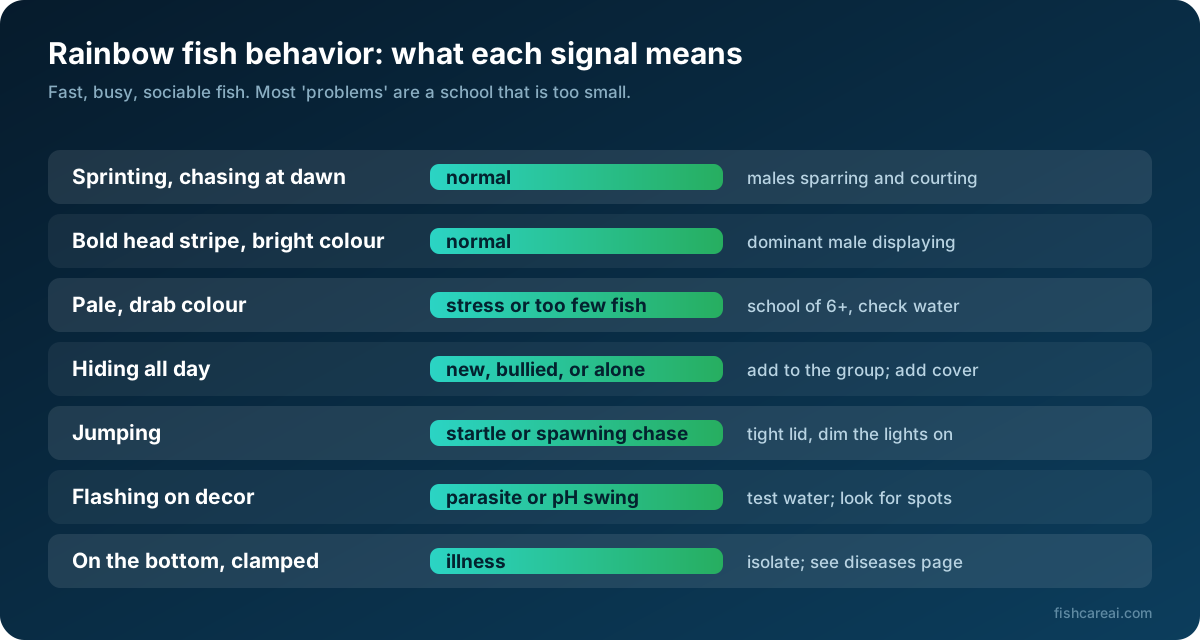
Every morning, for an hour or two after the lights come on, the males of a rainbowfish school chase each other, circle side by side with every fin spread, flash a pale or brilliant stripe down the forehead, and drive females into the plants. It looks like fighting and is not. No fins are torn, nobody is injured, and the loser simply rejoins the school; it is courtship and rank-sorting, and it is the moment the tank shows its best colour. Rainbowfish are not aggressive toward other species at all. The only real aggression is a single dominant male in a group that is too small, who has one rival or one female to focus on and pesters that fish all day — the fix is more rainbowfish, not fewer. A male that chases a fish of another species is almost always defending a spawning mop or a clump of moss for an hour at dawn. Species-level notes: rainbow fish aggressive.
Rainbow Fish Behavior and Colour: Why It Comes and Goes
Rainbowfish colour is structural — reflected light from the scales — and the fish can switch much of it on and off with mood. Normal changes: brilliant at dawn during displays, duller by evening, pale at night when they rest, and washed-out for a day after a move or a water change. A displaying male also raises a pale bar on the forehead that vanishes when he stops. Colour that stays poor for weeks is a message: the school is too small, the water is too soft or acidic, the substrate and background are too light, the food lacks carotenoids, or a larger tank mate is keeping them nervous. Juveniles are grey for the first 6–12 months whatever you do. Feeding for colour is on the rainbow fish food page; the water on the water parameters page.
Rainbow Fish Behavior in Current: Do They Like Flow?
Yes, a lot — playing in flow is normal rainbow fish behavior. They come from flowing rivers and streams, and a school will spend hours swimming into the outflow of a filter or powerhead, letting the current carry them back and doing it again. Moderate flow — 6–10 times the tank volume an hour, with a powerhead across a 4-foot tank — keeps them active, oxygenated and bright. Angle the flow along the front so the back of the tank stays calm for the night, and expect the fish to choose the fast lane every time.
Rainbow Fish Jumping
Rainbowfish jump: at dawn during a spawning chase, when the lights snap on in a dark room, when a net goes in, and for no visible reason in their first week in a new tank. A dwarf neon on the floor behind the tank is one of the commonest ways they are lost. A tight-fitting lid or a mesh screen with no gap at the back, lights that come up in stages, and floating plants to break the surface all help; do not leave the tank open even for a cleaning session with the fish in it. Notes: rainbow fish jumping.
Rainbow Fish Stress Signals That Mean Something
| What you see | Likely cause | What to do |
|---|---|---|
| Pale, grey school for days | Too few fish, soft water, light substrate | Six or more; test GH and pH; darken the tank |
| One fish hiding constantly | Alone in its species, bullied, or ill | Add to the school; check for thinness or a saddle mark |
| Hanging at the surface, gasping | Ammonia, low oxygen, high temperature | Test; add flow and surface movement; water change |
| Flashing on rocks or gravel | Parasites (ich, velvet, flukes) or a pH swing after a water change | Look for spots or dust; test and match water. See rainbow fish diseases |
| Sitting on the bottom, clamped fins | Illness, cold water, or exhaustion from bullying | Isolate; check temperature; watch the school |
| Swimming erratically or darting | Startle, a chemical spike, or a jumped fish that hit the lid | Check what changed in the last hour |
| Thin behind the head, curved spine | Fish tuberculosis | Remove the fish; disinfect nets |
Notice that most rows come back to the same two things — the group and the water — which are set out on the rainbow fish tank size page and in the rainbow fish care guide. Who to keep them with so the school stays confident is under rainbow fish tank mates; species notes on hiding are at rainbow fish hiding.
Rainbow Fish Care FAQ
Do rainbow fish school?
Yes, tightly. In the wild Melanotaenia live in groups of dozens, and in the aquarium they need six or more of their own species to behave normally. A lone rainbowfish is pale, hides and often stops eating.
Can rainbow fish live alone?
No. A single rainbowfish, or a pair, lives in a constant state of stress. Six is the minimum, and the group should be the same species; a mixed group of singles does not count as a school.
Are rainbow fish aggressive?
No. Males chase, flare and circle each other every morning, sometimes for hours, and it looks violent. It is display: no fins are torn and no fish is injured in a proper school. Toward other species they are peaceful.
Do rainbow fish like current?
Yes. They come from rivers and will play in the filter outflow all day. Moderate flow from a canister or hang-on filter, with a powerhead in tanks over 4 feet, keeps them active and bright.
Do rainbow fish jump?
Yes, especially when startled by lights, during a spawning chase, or in the first week in a new tank. A tight-fitting lid is essential; a jumped rainbowfish is one of the commonest ways they are lost.
Why is my rainbow fish hiding?
New fish hide for a few days. An established rainbowfish that hides is alone or in too small a group, bullied by a larger tank mate, in water that has swung, or ill — check the group size first, then test the water.