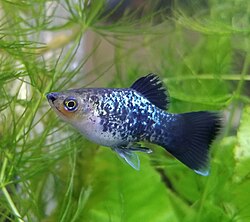
Platy Overview
The Southern Platyfish (Xiphophorus maculatus) is a freshwater fish belonging to the family Poeciliidae. It thrives at temperatures of 18–28 °C with a pH of 7.0–8.3, and requires a minimum tank volume of 60 litres. Known for its very peaceful community fish; ideal beginner livebearer, it is considered a beginner-level species. One of the easiest fish to breed; females drop 20–80 fry every 4–6 weeks. Water changes of 25–30 % weekly, stable parameters, and appropriate tank mates are key to long-term success with this species.
Platy Scientific Classification
| Rank | Classification |
|---|---|
| Family | Poeciliidae |
| Genus | Xiphophorus |
| Species | Xiphophorus maculatus |
| Water type | freshwater |
| Native range | Reunion|Middle America|North America|Oceania|Afrotropical|Australasian|Nearctic|Neotropical|Oriental (Indomalaya)|Palaearctic|Pacific (Oceania)|Austria |
Platy Natural Habitat
Xiphophorus maculatus originates from Reunion|Middle America|North America|Oceania|Afrotropical|Australasian|Nearctic|Neotropical|Oriental (Indomalaya)|Palaea. It inhabits freshwater environments and is adapted to the water conditions found in its native range.
Platy Appearance & Size
Adults reach 4–6 cm in length. The body is freshwater and the species displays characteristic coloration suited to its environment.
Platy Behavior & Temperament
This species is described as a very peaceful community fish; ideal beginner livebearer. It does not school and can be kept individually or in small numbers. Activity level is moderate. One of the easiest fish to breed; females drop 20–80 fry every 4–6 weeks.
| Trait | Value |
|---|---|
| Temperament | very peaceful community fish; ideal beginner livebearer |
| Schooling | No |
| Activity level | moderate |
Platy Water Requirements
| Parameter | Ideal Range | Notes |
|---|---|---|
| Temperature | 18–28°C (64–82°F) | Use a reliable adjustable heater |
| pH | 7–8.3 | Avoid sudden swings |
| Hardness (GH) | 10–28 dGH dGH | Soft to moderately hard |
| Ammonia | 0 ppm | Any detectable ammonia signals a problem |
| Nitrite | 0 ppm | Toxic even at low levels |
| Nitrate | <20 ppm | Manage through regular partial water changes |
| Min. tank | 60L (16 gal) | Larger tanks are easier to keep stable |
Interesting Facts About Platy
- Platies are available in more than 30 selectively bred colour varieties including sunset, tuxedo, and Mickey Mouse.
- The Mickey Mouse Platy has a marking near the tail base that resembles the Disney character silhouette.
- Platies tolerate cooler water than most tropical fish, down to 18 °C.
Species Related to Platy
Related Species & Guides
This species profile was reviewed for biological accuracy and practical aquarium care guidance. For suspected illness or disease, test your water parameters first and consult an aquatic veterinarian if symptoms persist.