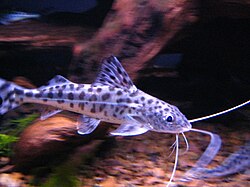
The Pictus Catfish is an active, fast-swimming South American catfish known for its long, sensitive barbels and striking black-spotted, silver body. Unlike many bottom-dwelling catfish, pictus cats patrol the whole lower-to-mid water column constantly, bringing near-constant motion and personality to a tank โ but their predatory streak toward smaller fish means tank mate selection needs real care.
Taxonomy & Classification
First described by Franz Steindachner in 1876, Pimelodus pictus belongs to the family Pimelodidae โ the "long-whiskered catfish," a diverse South American family with around 100 species. It's sometimes mislabeled in stores as the "Angelicus catfish," a different species with the opposite black-and-white color scheme.
| Rank | Classification |
|---|---|
| Order | Siluriformes |
| Family | Pimelodidae |
| Genus | Pimelodus |
Natural Habitat
Native to the Amazon and Orinoco river basins across Venezuela, Colombia, Peru, and Brazil, pictus catfish inhabit shallow, flowing waters with sandy or muddy bottoms, often moving in loose shoals through the main river channels and tributaries.
Tank Setup
Despite their modest adult size, pictus catfish are highly active swimmers that need real space: 55 gallons minimum for a small group of 3, with 75+ gallons preferred. Favor a long tank footprint over a tall one. Use fine sand or smooth gravel to protect their barbels, provide caves and driftwood for cover, and ensure a secure lid โ this species is a capable jumper, especially during feeding or when startled.
Water Parameters
| Parameter | Ideal Range |
|---|---|
| Temperature | 74โ81ยฐF (23โ27ยฐC) |
| pH | 6.5โ7.5 |
| Hardness (GH) | Soft to moderately hard |
| Ammonia / Nitrite | 0 ppm |
| Nitrate | <20 ppm |
Diet & Feeding
Omnivorous with a hearty appetite: offer sinking pellets or wafers as a base, supplemented with bloodworms, brine shrimp, and tubifex worms (frozen or live). Pictus catfish will eat any tank mate small enough to swallow โ factor this into feeding and stocking, not just diet variety.
Tank Mates
Pictus catfish are peaceful toward same-sized fish but predatory toward anything under about 1.5 inches โ guppies, small tetras, and fry are all at risk. Good tank mates are similarly sized, active fish: larger tetras, robust barbs, peaceful cichlids, and other mid-to-large community fish. Keep in a group of at least 3, ideally 5โ6, since this is a social, shoaling species.
Breeding
Pictus catfish do not breed in home aquariums. Wild breeding conditions are extremely difficult to replicate, and virtually all specimens in the trade are either wild-caught or produced via hormone-induced spawning on commercial fish farms.
Common Health Issues
- Ich โ white spots; raise temperature gradually and treat with a scaleless-fish-safe medication at reduced dosage
- Spine injuries during handling โ always use a container, never a net, to avoid tangling their sharp spines
- Stress from poor water quality โ pictus cats are sensitive to ammonia/nitrite spikes and chlorine; use a quality dechlorinator and maintain consistent weekly water changes
Reviewed for Pimelodidae biology accuracy and predatory-tank-mate risk guidance.
Frequently Asked Questions
Will a pictus catfish eat my small fish?
Yes โ anything small enough to fit in its mouth, including guppies, small tetras, and fry, is at risk. Stock with similarly sized tank mates.
How big of a tank does a pictus catfish need?
55 gallons minimum for a small group of 3, with 75+ gallons strongly preferred given their active swimming style.
Can pictus catfish be kept alone?
They can survive alone, but as a social, shoaling species they display more natural behavior and confidence in a group of 3 or more.