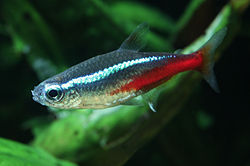
Few freshwater fish rival the neon tetra for sheer visual impact in an aquarium setting. A school of 20 or more neons moving in synchronized flashes of electric blue and vivid red through a planted tank is one of the most striking sights in the hobby. Despite their delicate appearance, neon tetras are hardy, adaptable fish that thrive in a wide range of aquarium conditions โ provided water quality is consistently maintained and they are kept in a proper school.
Taxonomy & Classification
Neon tetras belong to the family Characidae (characins), a vast New World family that includes piranhas, pacus, silver dollars, and hundreds of other popular aquarium fish. They were first described scientifically in 1936 after a French aquarium fish exporter discovered them in Peru. Their closest relatives in the aquarium trade include the Cardinal Tetra (P. axelrodi) and the Green Neon Tetra (P. simulans).
| Rank | Classification |
|---|---|
| Kingdom | Animalia |
| Phylum | Chordata |
| Class | Actinopterygii |
| Order | Characiformes |
| Family | Characidae |
| Genus | Paracheirodon |
| Species | P. innesi |
Natural Habitat
In the wild, neon tetras inhabit blackwater streams and tributaries in the western Amazon basin โ particularly in Peru, Colombia, and Brazil. These environments are characterized by:
- Extremely soft, acidic water (pH 4.0โ6.0; GH below 5 dGH) stained dark brown by tannins from decomposing leaf litter
- Dim lighting filtered through dense rainforest canopy and the tannin-darkened water itself
- Warm, stable temperatures of 73โ81ยฐF (23โ27ยฐC)
- Dense schools โ neons congregate in large groups in open water away from vegetated banks, using their iridescent stripe for group cohesion in low-light conditions
Understanding this habitat helps explain why neon tetras thrive in planted aquariums with soft, slightly acidic water, subdued lighting, and plenty of open swimming space in the middle of the tank.
Water Requirements
| Parameter | Wild Preference | Aquarium Range |
|---|---|---|
| Temperature | 73โ77ยฐF (23โ25ยฐC) | 72โ80ยฐF (22โ27ยฐC) |
| pH | 4.0โ6.0 | 6.0โ7.5 (captive-bred tolerate neutral) |
| Hardness (GH) | <3 dGH | 1โ8 dGH |
| Ammonia | 0 ppm | 0 ppm (sensitive to ammonia) |
| Nitrite | 0 ppm | 0 ppm |
| Nitrate | Near zero | <20 ppm |
Tank Setup
A minimum of 10 gallons is suitable for a school of 6โ10 neon tetras, though 20 gallons allows for a more impressive school of 15โ20 fish. Key setup elements:
- Schooling space: Open areas in the middle of the tank where the school can maneuver freely
- Plants and cover: Live or artificial plants along the back and sides for security; neons feel exposed without vegetation
- Dark substrate: Black sand or fine dark gravel makes colors pop and reduces stress
- Subdued lighting: Floating plants or dim LEDs on a timer; avoid intense lighting
- Driftwood and leaf litter: Indian almond leaves and spider wood leach tannins, slightly acidifying water and darkening it to a golden tone the fish love
Maintain a stable, consistent environment โ neon tetras are sensitive to sudden changes in temperature or water chemistry.
Schooling Behavior
Keeping neon tetras in a school is not optional โ it is essential for their wellbeing. Isolated or small-group neons become stressed, pale, and disease-prone. The minimum recommended school size is six fish, but ten or more produces dramatically better behavior: synchronized swimming, confident mid-water movement, and vivid coloration. In large schools of 20+, neons display their full natural behavior โ dashing together in synchrony, with each directional change rippling through the group in a fraction of a second.
Diet & Feeding
Neon tetras are micro-predators and omnivores in the wild, eating tiny invertebrates, zooplankton, and algae. In captivity they accept a wide range of small foods:
- Staple: High-quality micro pellets or small flake food (choose foods small enough to fit in their tiny mouths)
- Frozen food: Micro worms, baby brine shrimp, cyclops, daphnia โ excellent for condition and breeding
- Live food: Vinegar eels, Walter worms, blackworms (in small amounts)
Feed small amounts 2โ3 times daily, only what can be consumed in 2 minutes. Remove uneaten food promptly โ neon tetras produce little waste individually, but missed food decays quickly in planted tanks.
Compatible Tank Mates
Neon tetras are peaceful community fish that coexist well with many species. Good companions include:
- Other small, peaceful tetras (Cardinal Tetra, Ember Tetra, Rummy-nose Tetra)
- Corydoras catfish (Cory, Pygmy Cory)
- Rasboras (Harlequin Rasbora, Chili Rasbora)
- Dwarf gouramis
- Otocinclus catfish
- Shrimp (Amano, Cherry Shrimp โ juveniles may be eaten)
Avoid: large or aggressive fish (cichlids, Oscar), known fin nippers (Tiger Barbs in small groups), or large catfish that might view neons as food.
Common Health Issues
- Neon Tetra Disease (NTD) โ caused by the microsporidian parasite Pleistophora hyphessobryconis; causes progressive color fading and white lumps in muscle tissue; incurable; affected fish must be humanely euthanized and all tankmates quarantine-monitored
- False Neon Tetra Disease โ caused by bacteria (Flavobacterium columnare); similar appearance to NTD but responds to antibacterial treatment
- Ich โ white spots; treat with temperature increase and medication
- Fin rot โ usually secondary to poor water quality; maintain clean water and treat with antibacterial medication
- Velvet โ golden dust; treat with copper medication in a hospital tank (remove snails and invertebrates first)
This species profile was reviewed for biological accuracy and practical aquarium care guidance. NTD information cross-checked against peer-reviewed parasitology literature.