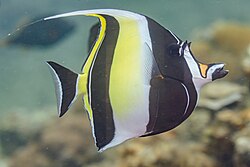
The Moorish Idol is arguably the single most recognizable reef fish in the world β the striking black, white, and yellow banding and the long, trailing dorsal filament made it the visual template for "Gill" in a well-known 2003 animated film. It is also, by wide and consistent agreement among experienced reef keepers, one of the two or three hardest marine fish to keep alive in a home aquarium. This guide covers what real care requires and is honest about the odds, rather than presenting this as a fish suitable for a typical saltwater tank.
Taxonomy & Classification
First described by Linnaeus in 1758, Zanclus cornutus is the sole living member of its family, Zanclidae β it has no close aquarium relatives, though it's often confused with butterflyfish in the related genus Heniochus, which resemble it superficially. True Moorish Idols have a longer, more tubular, tweezer-like snout, a distinctive orange-and-black triangular patch on the bridge of the nose, and a taller, more angular body than any Heniochus species.
| Rank | Classification |
|---|---|
| Order | Acanthuriformes |
| Family | Zanclidae (monotypic) |
| Genus | Zanclus |
Natural Habitat
Moorish Idols are exceptionally widely distributed for a reef fish, found across nearly the entire Indo-Pacific from the east coast of Africa through Hawaii and as far as the GalΓ‘pagos Islands. They inhabit clear, well-oxygenated water from shallow lagoons down to reef slopes roughly 600 feet deep, typically foraging in pairs or small, loose groups across rubble flats and coral heads. Wild fish spend much of the day grazing, using their long snout to extract sponges, tunicates, and small invertebrates from crevices other reef fish can't reach.
Tank Setup
A single Moorish Idol needs 125 gallons as an absolute floor, with 180β220+ gallons strongly preferred; a bonded pair needs 200 gallons or more. Footprint matters far more than volume β prioritize a long tank (6-foot minimum) over a tall or deep one, since this species swims in long horizontal sweeps all day and develops stress pacing behavior in short tanks even when the total gallon count looks adequate.
Aquascape with a mature, centralized rock structure that the fish can swim through and around rather than a solid wall of rock, since Moorish Idols need open water and multiple sightlines rather than a maze of tight caves. Strong, consistent lighting on a 10β12 hour photoperiod helps encourage the sponge and coralline algae growth on live rock that supports natural grazing behavior between feedings.
Water Parameters
| Parameter | Ideal Range |
|---|---|
| Temperature | 74β78Β°F (23β26Β°C) |
| Salinity | 1.023β1.026 SG |
| pH | 8.1β8.4 |
| Ammonia / Nitrite | 0 ppm |
| Nitrate | <10 ppm |
Water quality needs to be genuinely pristine and stable, not just "good enough." Moorish Idols come from clear, low-nutrient water and are unusually sensitive to swings in temperature and chemistry β sudden parameter shifts have been documented killing established, previously healthy specimens within days.
Diet & Feeding
Feeding is where most attempts to keep this species fail. In the wild, Moorish Idols graze almost constantly on sponges, tunicates, and other encrusting invertebrates β food sources that are extremely difficult to replicate in captivity. Many wild-caught individuals never successfully transition to prepared aquarium foods and starve within the first few weeks despite an owner's best efforts.
A realistic feeding plan offers small amounts several times a day rather than one or two large feedings: enriched frozen mysis and brine shrimp, sponge-based prepared foods, and marine algae sheets, ideally attached to rocks or feeding clips to mimic natural grazing rather than dropped into open water. Vitamin supplements such as Selcon or a garlic-based appetite stimulant, added to food, can help encourage a reluctant eater and support immune health during the difficult acclimation period. A large volume of mature live rock gives the fish something to graze between feedings, which matters more for this species than almost any other reef fish in the trade.
Before buying, always confirm the specific individual fish is already eating in the store's tank. A Moorish Idol that refuses food at the shop will very likely refuse food at home as well.
Tank Mates
Temperamentally, Moorish Idols are peaceful and shy, coexisting well with other non-aggressive reef fish such as tangs, wrasses, clownfish, and butterflyfish, and they're easily bullied by aggressive tank mates. The bigger compatibility issue is with invertebrates rather than fish: this species is not reliably reef safe and will often pick at LPS corals, zoanthids, and clams, so a mixed reef system carries real risk to sessile invertebrates even if the fish itself gets along with other fish. Keep singly unless the tank is very large and set up for a bonded pair from the start β this is not a schooling fish for a typical mixed community reef tank.
Breeding
There is no confirmed history of Moorish Idols breeding successfully in a home aquarium, and every specimen in the trade is wild-caught. This has real ethical and sustainability implications worth weighing before purchase: given documented first-year mortality rates in the 80β90% range, the aquarium trade in this species represents an ongoing draw on wild reef populations with very little offsetting captive-bred supply.
Common Health Issues
- Starvation β by far the leading cause of death, especially in the first 30 days; solving feeding immediately after purchase is the single highest-leverage thing an owner can do
- Marine ich (Cryptocaryon irritans) β this species is unusually prone to it under stress, poor water quality, or after transport; quarantine new arrivals before adding to a display tank
- Copper sensitivity β Moorish Idols tolerate copper-based medications very poorly; avoid copper treatments and use alternative protocols (quarantine, stress reduction, nutritional support) under experienced guidance instead
- Stress-related decline β sudden noises, rough handling, or being chased by tank mates can trigger a rapid health crash in this notably nervous species; keep handling to an absolute minimum
Easier Alternatives
If the goal is the Moorish Idol's look rather than the specific species, the Schooling Bannerfish (Heniochus diphreutes) and Longfin Bannerfish (Heniochus acuminatus) are true butterflyfish that share a similar black-and-white banded look and trailing fin, but are hardy, generally accept standard frozen mysis within days of arrival, and β unlike the Moorish Idol β do well in groups of three or more in a well-run reef or fish-only tank. Neither is fully reef safe with corals, but both are dramatically easier to feed and keep long-term, and are widely considered the responsible choice for aquarists drawn to the Moorish Idol's appearance without the specialized expertise, tank size, and acceptance of high failure risk that species genuinely requires.
Reviewed for Zanclidae biology accuracy and honest survival-rate framing, cross-checked against multiple published marine aquarist sources on captive husbandry outcomes.
Frequently Asked Questions
Are Moorish Idols good for beginners?
No. They are widely considered one of the hardest marine fish to keep alive, and are not recommended for beginner or even intermediate saltwater aquarists.
Why won't my Moorish Idol eat?
Its natural diet of sponges and tunicates is very hard to replicate in captivity, and many wild-caught individuals never fully transition to prepared foods. Offer small, frequent feedings of enriched frozen foods and sponge-based diets, and always confirm a fish is already eating before purchase.
What's an easier fish that looks like a Moorish Idol?
The Schooling Bannerfish (Heniochus diphreutes) and Longfin Bannerfish (Heniochus acuminatus) share a similar black-and-white look and are dramatically hardier and easier to feed.
Can Moorish Idols be bred in captivity?
No successful captive breeding has been documented. All Moorish Idols in the aquarium trade are wild-caught.