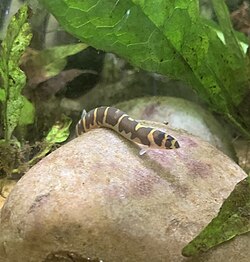
The Kuhli Loach is a slender, eel-like bottom-dweller prized for its peaceful nature, striking banded pattern, and nocturnal, burrowing behavior. Native to the blackwater streams of Southeast Asia, it spends its days buried in sand and emerges at dusk to forage โ a fascinating "character species" for planted community tanks rather than a showy centerpiece fish.
Taxonomy & Classification
First described in 1846 as Cobitis kuhlii, this species was reclassified into the genus Pangio in 1981. It belongs to the family Cobitidae (true loaches) and is completely unrelated to true eels despite its elongated shape. The species name honors German naturalist Heinrich Kuhl. Two color forms are common in the trade: the standard black-and-yellow banded form and an all-orange "black kuhli" variant.
| Rank | Classification |
|---|---|
| Order | Cypriniformes |
| Family | Cobitidae |
| Genus | Pangio |
Natural Habitat
Wild kuhli loaches inhabit slow-moving, tannin-stained blackwater streams, peat swamps, and forest floodplains across Sumatra, Borneo, Peninsular Malaysia, and Thailand. These waters are soft, acidic, and low in light, with soft sandy or leaf-littered bottoms โ conditions worth replicating with fine sand and driftwood or dried leaves in the home aquarium.
Tank Setup
Floor space matters more than height for this bottom-dwelling species. A 20-gallon long tank suits a small group; go larger for groups of 8 or more. Fine sand is not optional โ kuhlis burrow constantly and sharp gravel damages their scaleless undersides and sensitive barbels. Provide abundant hiding spots (PVC pipe, driftwood caves, dense plant roots) and a tight-fitting lid, since kuhlis are accomplished escape artists. Use a gentle filter and cover intakes with a sponge pre-filter โ loaches will investigate (and can get stuck in) any gap that fits their body.
Water Parameters
| Parameter | Ideal Range |
|---|---|
| Temperature | 75โ86ยฐF (24โ30ยฐC) |
| pH | 6.0โ7.0 |
| Hardness (GH) | 2โ12 dGH (soft to moderately soft) |
| Ammonia / Nitrite | 0 ppm |
| Nitrate | <20 ppm |
Diet & Feeding
Kuhli loaches are opportunistic omnivores and enthusiastic scavengers. Offer sinking pellets or wafers as a staple, supplemented with frozen or live bloodworms, brine shrimp, and daphnia. They're also effective at hunting down pest snails. Feed after lights-out or at dusk, since this species is nocturnal and often won't compete for food during the day until well settled.
Tank Mates
Excellent companions for other peaceful community fish: small tetras, rasboras, corydoras (with enough floor space to share), peaceful gouramis, and dwarf shrimp with plenty of cover (kuhlis will opportunistically eat shrimplets they find while foraging). Avoid aggressive or territorial fish such as cichlids โ a stressed kuhli loach will simply disappear into hiding for weeks rather than compete.
Breeding
Kuhli loaches are egg-scatterers and breeding in home aquariums is uncommon and mostly accidental. Females become visibly plumper with eggs; in nature, spawning is triggered by seasonal rains and shifting water levels, conditions that are difficult to replicate reliably in a tank. Most kuhlis sold in the trade are wild-caught or farmed in outdoor ponds in Southeast Asia rather than bred indoors.
Common Health Issues
- Ich โ white spots on skin and fins; treat with gradual temperature increase and a gentle, loach-safe medication (avoid full-strength copper or dyes, which scaleless fish tolerate poorly)
- Skin/barbel abrasion โ caused by sharp gravel; switch to fine sand and smooth decor
- Bacterial infections โ often secondary to abrasion or poor water quality; treat promptly with a broad-spectrum antibacterial at reduced dosage
- Stress hiding โ kuhlis kept singly or in small numbers hide constantly; keep in groups of 5+ for confident, visible behavior
Reviewed for loach biology accuracy and cross-checked against SeriouslyFish and FishBase care parameters.
Frequently Asked Questions
How many kuhli loaches should be kept together?
At least 5, though groups of 8โ10 produce noticeably more confident, visible behavior. Kuhlis kept alone or in pairs tend to hide constantly.
Do kuhli loaches need sand?
Yes. Sand is a health requirement, not a preference โ sharp gravel abrades their scaleless skin and sensitive barbels over time.
Are kuhli loaches nocturnal?
Yes. They're most active at dusk and during the night, spending much of the day buried in sand or tucked into hiding spots.