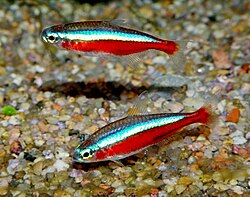
Cardinal Tetra Overview
The Cardinal Tetra (Paracheirodon axelrodi) is a freshwater fish belonging to the family Characidae. It thrives at temperatures of 23–27 °C with a pH of 4.5–7.0, and requires a minimum tank volume of 80 litres. Known for its peaceful schooling fish; ideal with other small south american species, it is considered a beginner-level species. The red stripe covers the full length of the body — key visual difference from the Neon Tetra. Water changes of 25–30 % weekly, stable parameters, and appropriate tank mates are key to long-term success with this species.
Cardinal Tetra Scientific Classification
| Rank | Classification |
|---|---|
| Family | Characidae |
| Genus | Paracheirodon |
| Species | Paracheirodon axelrodi |
| Water type | freshwater |
| Native range | Orinoco|Neotropical |
Cardinal Tetra Natural Habitat
Paracheirodon axelrodi originates from Orinoco|Neotropical. It inhabits freshwater environments and is adapted to the water conditions found in its native range.
Cardinal Tetra Appearance & Size
Adults reach 4–5 cm in length. The body is freshwater and the species displays characteristic coloration suited to its environment.
Cardinal Tetra Behavior & Temperament
This species is described as a peaceful schooling fish; ideal with other small south american species. It naturally schools and should be kept in groups of 6 or more. Activity level is moderate. The red stripe covers the full length of the body — key visual difference from the Neon Tetra.
| Trait | Value |
|---|---|
| Temperament | peaceful schooling fish; ideal with other small South American species |
| Schooling | Yes |
| Activity level | moderate |
Cardinal Tetra Water Requirements
| Parameter | Ideal Range | Notes |
|---|---|---|
| Temperature | 23–27°C (73–81°F) | Use a reliable adjustable heater |
| pH | 4.5–7 | Avoid sudden swings |
| Hardness (GH) | 1–8 dGH dGH | Soft to moderately hard |
| Ammonia | 0 ppm | Any detectable ammonia signals a problem |
| Nitrite | 0 ppm | Toxic even at low levels |
| Nitrate | <15 ppm | Manage through regular partial water changes |
| Min. tank | 80L (21 gal) | Larger tanks are easier to keep stable |
Interesting Facts About Cardinal Tetra
- The vast majority of Cardinal Tetras sold are wild-caught from the Rio Negro in Brazil.
- Cardinal Tetras are economically vital to indigenous communities in the Amazon — a sustainable fishery model.
- Prefers very soft, acidic black-water conditions; avoid hard tap water for long-term health.
Species Related to Cardinal Tetra
Related Species & Guides
This species profile was reviewed for biological accuracy and practical aquarium care guidance. For suspected illness or disease, test your water parameters first and consult an aquatic veterinarian if symptoms persist.