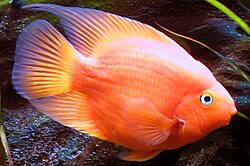
The Blood Parrot Cichlid is a man-made hybrid, not a wild species β instantly recognizable by its rounded body, oversized eyes, and permanently open, beak-like mouth. First bred in Taiwan in the mid-1980s, it remains one of the hobby's most divisive fish: beloved for its bright color and surprisingly interactive personality, but controversial because its distinctive look comes from genetic deformities inherent to its hybrid origin.
Origin & Genetics
Blood parrot cichlids have no formal scientific name because they're a hybrid, not a species β most likely a cross between the Midas Cichlid (Amphilophus citrinellus) and the Redhead Cichlid (Paraneetroplus synspilus), though the exact parentage is disputed and some breeders cite Severum or Red Devil cichlid ancestry instead. The hybridization produces a compressed, round body and a mouth that cannot fully close β a permanent genetic trait, not an injury.
| Rank | Classification |
|---|---|
| Order | Cichliformes |
| Family | Cichlidae |
| Genus | Hybrid (no single genus) |
No Natural Habitat
As a hybrid created in captivity, the blood parrot cichlid has no wild population or natural habitat. Its care requirements are inferred from its Central American cichlid parent species, which come from warm, slightly acidic freshwater rivers and streams.
Tank Setup
A single blood parrot needs 30 gallons minimum; a pair or small group needs 55β75+ gallons, allowing roughly 10 extra gallons per additional fish. Use a fine sand substrate (they dig), provide clay pots or caves for security, and invest in strong filtration β blood parrots produce a heavy bioload. Keep lighting subdued, as this species tends to be shy, especially when first settling into a new tank.
Water Parameters
| Parameter | Ideal Range |
|---|---|
| Temperature | 76β82Β°F (24β28Β°C) |
| pH | 6.5β7.4 |
| Hardness (GH) | 6β18 dGH |
| Ammonia / Nitrite | 0 ppm |
| Nitrate | <30 ppm |
Diet & Feeding
Because the mouth can't fully close, sizing food correctly matters: small color-enhancing cichlid pellets are easier to eat than large pellets or flakes. Offer frozen bloodworms, brine shrimp, and mysis shrimp 2β3 times weekly, plus occasional shelled peas or vegetable-based food to prevent constipation and support swim bladder health.
Tank Mates
Blood parrots are noticeably less aggressive than most of their Central American cichlid relatives, making them a reasonable centerpiece for a semi-aggressive community tank. Good tank mates include Severums, larger tetras, plecos, and Pictus catfish. Avoid small fish that could be seen as food and very aggressive cichlids (Oscars, Midas, Red Devils) that could bully or outcompete them despite the parrot's larger size.
Breeding
Blood parrots will pair off and go through spawning behavior, but male blood parrots are almost always sterile due to their hybrid genetics, so eggs from a same-hybrid pairing typically don't hatch. Females can produce viable eggs if crossed with a male of a compatible non-hybrid Central American cichlid (such as a convict or Severum), though this produces further hybrid offspring and is generally discouraged by responsible breeders.
Common Health Issues
- Feeding difficulty β the permanently open mouth makes eating harder; use appropriately small, sinking food and monitor body condition
- Swim bladder disorder β linked to diet; feed shelled peas weekly and avoid overfeeding dry pellets
- Color fading β usually a sign of stress, poor diet, or improper lighting; stabilize water quality and diversify diet
- Ich β white spots; standard freshwater treatment, with caution around medication sensitivity in some individuals
Reviewed for hybrid cichlid husbandry accuracy, including feeding adaptations and known genetic health considerations.
Frequently Asked Questions
Why does my blood parrot's mouth never close?
This is a permanent structural trait from its hybrid genetics, not an injury or illness. The fish adapts and feeds normally with appropriately sized food.
Can blood parrot cichlids breed?
Males are almost always sterile. Females can sometimes produce viable eggs when paired with a male of a different, non-hybrid Central American cichlid species.
Are "Jellybean" or "Bubblegum" parrots a different species?
No β they're blood parrot cichlids that have been injected with dye for unnatural bright colors, a process that harms the fish and shortens its lifespan. Avoid buying dyed fish.