Freshwater angelfish (Pterophyllum scalare) are hardier than discus but they are still Amazon cichlids, and most angelfish health problems come from the same three sources: water that has drifted cold, hard or high in nitrate; long fins that get torn and then infected; and parasites carried in by new fish. Tank-bred angelfish also inherit a few problems of their own, from Hexamita to the so-called angelfish virus.
This hub is the index for angelfish health problems on FishCare AI. Use the symptom finder to jump to the guide that matches what you see, read the profiles of the diseases angelfish actually get, and run the checklist before you medicate. The angelfish care guide covers the routine that prevents most of them, and angelfish health problems on the symptom checker is the interactive version of this page. Marine angelfish (emperor, flame, French, Koran, bicolor) have their own hubs listed at the bottom.
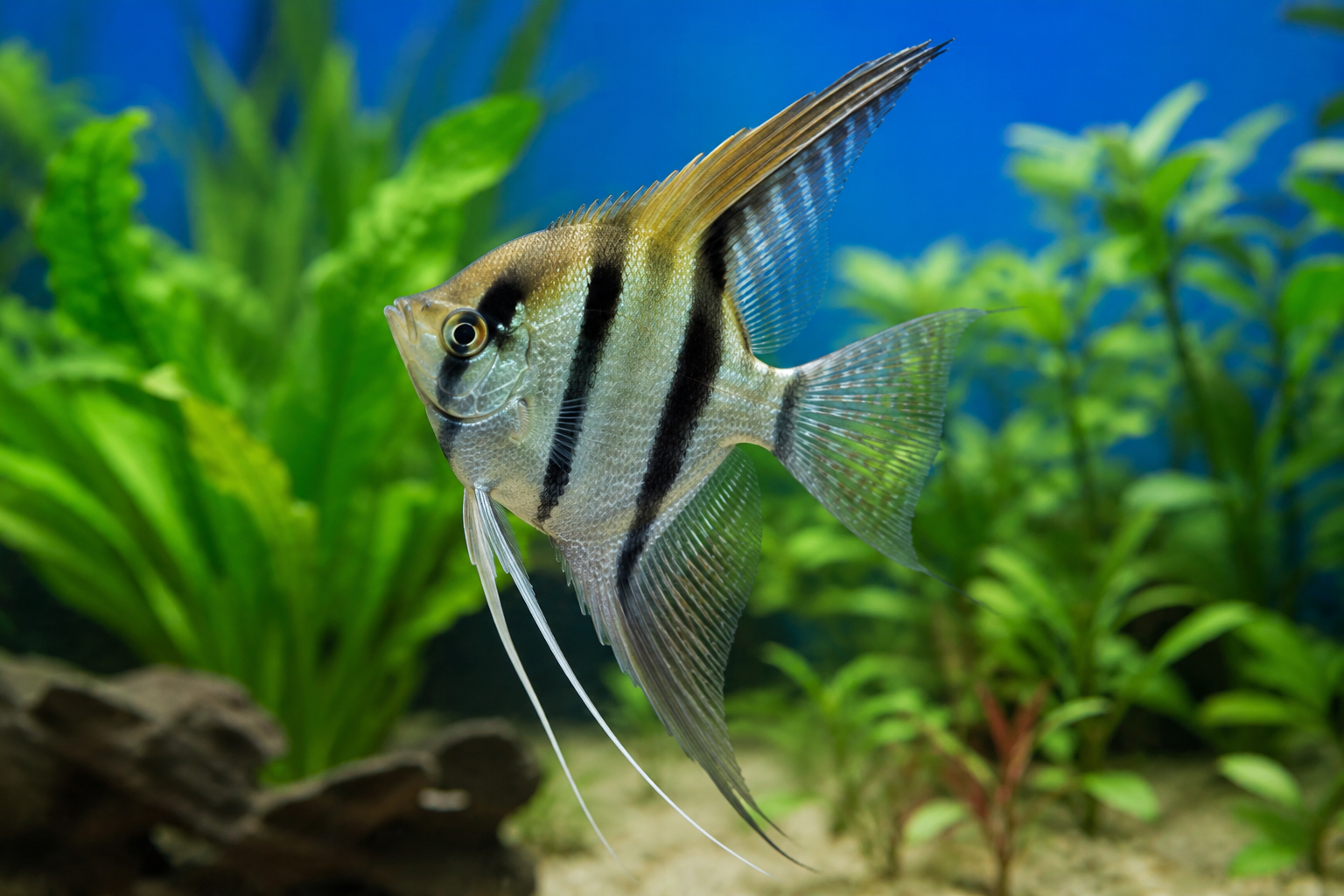
Angelfish Health Problems by Symptom: Quick Finder
Every symptom below links to a dedicated angelfish guide with causes, a diagnosis walk-through and treatment steps. Start with the sign that appeared first.
Angelfish behaviour and breathing symptoms
| Symptom | What it usually means | Guide |
|---|---|---|
| Not Eating | Refusing food for more than a day or two | Angelfish not eating → |
| Hiding | Staying behind plants or in a corner all day | Angelfish hiding → |
| Lethargic | Hovering motionless, slow to react | Angelfish lethargic → |
| Darting | Sudden bursts of frantic swimming | Angelfish darting → |
| Rubbing / Flashing | Scraping the body on décor or substrate | Angelfish rubbing / flashing → |
| Jumping | Leaping at the surface or out of the tank | Angelfish jumping → |
| Aggressive | Chasing, nipping or pinning tank mates | Angelfish aggressive → |
| Swimming Sideways | Tilted or listing while swimming | Angelfish swimming sideways → |
| Floating | Stuck at the surface, unable to dive | Angelfish floating → |
| Sinking | Resting on the bottom, unable to rise | Angelfish sinking → |
| Gasping | Mouthing at the surface for air | Angelfish gasping → |
| Rapid Breathing | Gill covers pumping fast at rest | Angelfish rapid breathing → |
| Coughing | Repeated jerky gill flushing | Angelfish coughing → |
Angelfish body, skin and colour symptoms
| Symptom | What it usually means | Guide |
|---|---|---|
| White Spots | Salt-grain dots on body or fins (ich) | Angelfish white spots → |
| Black Spots | Dark speckles or patches on the skin | Angelfish black spots → |
| Spots on Fins | Marks confined to the fins | Angelfish spots on fins → |
| Pale Color | Washed-out body colour | Angelfish pale color → |
| Losing Color | Colour fading over days or weeks | Angelfish losing color → |
| Fuzzy Growth | Cotton-like tufts on skin or mouth | Angelfish fuzzy growth → |
| Mucus Coating | Cloudy or grey slime film over the body | Angelfish mucus coating → |
| Red Streaks | Blood lines in fins or on the body | Angelfish red streaks → |
| Missing Scales | Bare patches where scales have lifted off | Angelfish missing scales → |
| Bloated | Swollen belly, sometimes with raised scales | Angelfish bloated → |
| Sunken Belly | Pinched, concave abdomen | Angelfish sunken belly → |
| Curled Body | Spine bent into a C or S shape | Angelfish curled body → |
Angelfish fin and eye symptoms
| Symptom | What it usually means | Guide |
|---|---|---|
| Fin Rot | Ragged, milky or receding fin edges | Angelfish fin rot → |
| Torn Fins | Splits or bite marks in the fins | Angelfish torn fins → |
| Clamped Fins | Fins held tight against the body | Angelfish clamped fins → |
| Cloudy Eyes | Milky film over one or both eyes | Angelfish cloudy eyes → |
| Bulging Eyes | One or both eyes protruding (pop-eye) | Angelfish bulging eyes → |
Most Common Angelfish Health Problems and Diseases
These are the conditions behind the symptoms above, in roughly the order a angelfish keeper is likely to meet them.
Ich (white spot) in Angelfish
The most common angelfish disease. Salt-grain spots on the fins first, then the body; the fish flashes against décor and clamps its fins. It usually follows a temperature drop or a new fish. Raise the temperature to 84–86°F, add aeration, and treat the whole tank for at least ten days so the free-swimming stage is killed.
Symptom guides: Angelfish white spots → Angelfish spots on fins → Angelfish rubbing / flashing → Angelfish clamped fins →
Fin rot and torn fins in Angelfish
Angelfish fins are long and easily damaged by nipping tank mates, sharp décor or a net. Once torn, Aeromonas or Flavobacterium turn the edge milky, then ragged and red. Clean water alone heals torn fins; fin rot with a white or red edge needs an antibacterial in a hospital tank.
Symptom guides: Angelfish fin rot → Angelfish torn fins → Angelfish red streaks →
Hexamita and hole-in-the-head in Angelfish
Like discus, angelfish carry Hexamita at low levels and break down with it under stress: white stringy faeces, refusing food, a dark body and, later, pits on the head. Metronidazole in food or a hospital tank, with nitrate pulled below 20 ppm, resolves early cases.
Symptom guides: Angelfish not eating → Angelfish sunken belly → Angelfish losing color → Angelfish hiding →
Internal parasites (Capillaria, tapeworm) in Angelfish
An angelfish that eats but stays thin, or passes clear or white faeces, usually has nematodes or tapeworms. Wild-caught and farm-raised fish both carry them. Levamisole (nematodes) or praziquantel (tapeworms) chosen after looking at the faeces; repeat in two weeks.
Symptom guides: Angelfish sunken belly → Angelfish lethargic → Angelfish pale color →
Swim bladder and bloat in Angelfish
Floating head-up, sinking to the bottom or tilting sideways in angelfish is most often the swim bladder squeezed by a swollen gut: overfeeding dry food, constipation, or an internal infection. Fast for two days and feed a blanched pea or daphnia. If the belly swells and scales lift (dropsy), it is systemic and needs antibiotics plus Epsom salt.
Symptom guides: Angelfish floating → Angelfish sinking → Angelfish swimming sideways → Angelfish bloated →
Velvet (Oodinium) and gill flukes in Angelfish
Rapid breathing, coughing and a fine gold-to-grey dust on the body point to velvet; rapid breathing with rubbing and no dust points to gill flukes. Velvet is treated like ich with the lights off; flukes need praziquantel.
Symptom guides: Angelfish rapid breathing → Angelfish coughing → Angelfish gasping → Angelfish mucus coating →
Bacterial ulcers, pop-eye and cloudy eyes in Angelfish
Missing scales with a red or white crater, one or both eyes bulging, or a milky eye all point to bacteria taking hold on a stressed fish. Cloudy eyes after a water-quality dip clear with water changes; ulcers and pop-eye need a hospital tank and a broad-spectrum antibiotic.
Symptom guides: Angelfish missing scales → Angelfish bulging eyes → Angelfish cloudy eyes → Angelfish fuzzy growth →
Angelfish virus and aggression injuries in Angelfish
"Angelfish virus" or angelfish plague is a fast-moving infection that arrives with new fish: every angelfish goes dark, slimy and clamped and hangs at the surface. There is no direct cure, only support and quarantine. Separately, angelfish pair up and defend territory, so many torn fins, black spots and missing scales are simply fight damage.
Symptom guides: Angelfish aggressive → Angelfish darting → Angelfish black spots → Angelfish torn fins →
Why Angelfish Get Sick: The Conditions Behind Most Angelfish Health Problems
Very few angelfish health problems start as a disease. They start as a husbandry gap that a parasite or bacterium then exploits. Close these and most of the list above never appears.
- Temperature swings — Angelfish want a steady 76–82°F (24–28°C). Ich outbreaks almost always follow a drop of a few degrees from a failed heater, a cold water change or a winter room. See angelfish temperature.
- Nitrate and stale water — Angelfish tolerate nitrate up to about 40 ppm but Hexamita blooms and fins start to fray long before that. A weekly 25–30% change on a lightly stocked tank keeps nitrate under 20 ppm.
- Tank too small or too short — An adult angelfish is 6 inches tall with fins; a tank under 18 inches high or under 29 gallons for a pair means constant fin damage and fighting. Use the angelfish tank size calculator.
- Fin-nipping tank mates — Tiger barbs, serpae tetras and some danios shred angelfish fins, and every tear is a route for fin rot. The angelfish tank mates guide and compatibility ranking list the safe ones.
- Pairs and aggression — Two angelfish that pair off will bully the rest of the group, and a lone bullied fish stops eating and hides. Keep six or more, or a single pair; see are angelfish aggressive.
- Diet — Flake-only diets lead to constipation and thin fish. Rotate quality pellet with frozen bloodworm, brine shrimp and daphnia; the angelfish diet guide has a schedule.
Before You Treat Angelfish Health Problems: Checklist
- Test water: Ammonia 0 ppm, nitrite 0 ppm, nitrate under 20 ppm, pH 6.5–7.5, temperature 76–82°F. Angelfish usually show cloudy eyes or clamped fins within a day of an ammonia spike.
- Check the fins: Tears with clean edges are injury and heal on their own; milky or red edges are fin rot; white dots on the fins are ich.
- Look at the faeces: White, clear or stringy faeces mean internal parasites and change the treatment completely.
- Watch the group: One fish bullied into a corner is a social problem, not a disease; every fish gasping is oxygen or water; spots spreading fish to fish is ich or velvet.
- Set up a hospital tank: A bare 10–20 gallon tank at 82°F with an air stone and a seeded sponge filter is where antibiotics, metronidazole and wormers go, never the display tank.
- One treatment at a time: Identify the problem from the symptom guide, treat it, and reassess after five days before adding a second medication.
More Angelfish Health and Care Resources
Angelfish Health Problems: Symptom Checker
Interactive version of this hub with every symptom guide.
Angelfish Care Guide
Tank size, water parameters, diet and the routine that prevents disease.
Angelfish Temperature
The range that keeps ich and Hexamita away.
Angelfish Tank Mates
Which fish will not shred angelfish fins.
Are Angelfish Aggressive?
Pairing, territory and how to stop bullying.
What Do Angelfish Eat
Diet rotation that prevents bloat and thin fish.
Angelfish Compatibility
Ranked pairings for an angelfish community tank.
Angelfish Tank Size Calculator
How many angelfish a tank can hold.
Marine angelfish health problems (separate species)
Saltwater angelfish are unrelated to Pterophyllum and have their own symptom hubs:
Emperor Angelfish health problems
Marine species — separate symptom guides
Flame Angelfish health problems
Marine species — separate symptom guides
French Angelfish health problems
Marine species — separate symptom guides
Koran Angelfish health problems
Marine species — separate symptom guides
Bicolor Angelfish health problems
Marine species — separate symptom guides
Angelfish Health Problems: Frequently Asked Questions
A: Ich, fin rot on torn fins, Hexamita (white stringy faeces, then hole-in-the-head), internal worms that keep a fish thin, and swim-bladder trouble from overfeeding cover most angelfish health problems in home tanks. Nearly all of them follow a temperature drop, rising nitrate, fin damage from tank mates, or a new fish that was not quarantined.
A: A swollen gut pressing on the swim bladder is the usual cause: too much dry food, constipation, or an internal infection. Fast the fish for two days, then feed a blanched pea or daphnia. If the belly is swollen and the scales stand out, it is dropsy and needs antibiotics in a hospital tank. See the angelfish swimming sideways guide.
A: Ragged fins with clean tears are injury from tank mates or décor and regrow in clean water. A milky or red edge that keeps receding is fin rot and needs an antibacterial. Clamped fins on their own are stress, usually from a water-quality problem or the first stage of ich.
A: Small pits above the eyes and along the lateral line, often with a dark body, refusal to eat and white stringy faeces. It is caused by Hexamita and made worse by nitrate. Treat with metronidazole and daily water changes; early pits heal within a few weeks.
A: A steady 76–82°F (24–28°C). Angelfish tolerate the range, but a sudden drop of a few degrees is the most common trigger for ich. 84–86°F is the treatment temperature for ich and velvet; keep it there for the full course, not just until spots vanish.
A: Ich, velvet and water-quality problems are treated in the display tank, because the parasite is in the whole tank. Antibiotics, metronidazole and wormers go in a hospital tank so they do not harm the filter or the other fish. Move the sick fish, not the medication.
A: Angelfish change contrast with mood: bars fade when the fish is relaxed or asleep and darken when it is stressed or dominant. A fish that stays very dark, clamps its fins and hides is stressed by water quality, bullying or the start of Hexamita. Faded, washed-out colour with fast breathing points to velvet or poor water.
A: Yes. Angelfish virus (angelfish plague) is a fast-spreading infection, thought to be viral, that turns every angelfish in a tank dark, slimy and listless within days of a new fish arriving. There is no cure; keep water perfect, raise the temperature slightly, treat secondary bacterial infections, and quarantine all new angelfish for four weeks so it never gets in.
Sources and Editorial Method
This guide draws on:
- Merck Veterinary Manual – Management of Aquarium Fish
- Merck Veterinary Manual – Parasitic Diseases of Fish
- Merck Veterinary Manual – Bacterial Diseases of Fish
- UF/IFAS Extension – Introduction to Freshwater Fish Parasites
- World Organisation for Animal Health – Aquatic Animals
- The 30 angelfish symptom guides on FishCare AI, which cite the sources above per condition
Last reviewed: September 2026 | Reviewed for: species-specific accuracy, symptom terminology, water-quality guidance and treatment ranges.
Not a substitute for professional diagnosis. This guide is educational. Consult an aquatic veterinarian for persistent or severe symptoms.
← Back to All Fish Diseases Hub
Browse guides for 200+ other fish species and 30 symptom categories