The altum angelfish (Pterophyllum altum) is the largest of the three angelfish species and the one kept least often, a wild blackwater cichlid rather than the farmed common angelfish sold in most shops.
It lives in the upper Rio Negro and in tributaries of the upper Orinoco, including the Inírida and Atabapo rivers, in Colombia, Venezuela and northern Brazil.[1][2][3] These are very soft, clear blackwaters with almost no conductivity, a pH of about 4.5–5.8 and temperatures of 26–29 °C.[3]
Most altums in the trade are wild-caught, and they are much less common than the common angelfish, P. scalare.[1] They arrive stressed and are sensitive to water quality, so they suit keepers who already manage soft-water fish such as discus. This profile covers how to set up for them and how to tell an altum from a scalare.
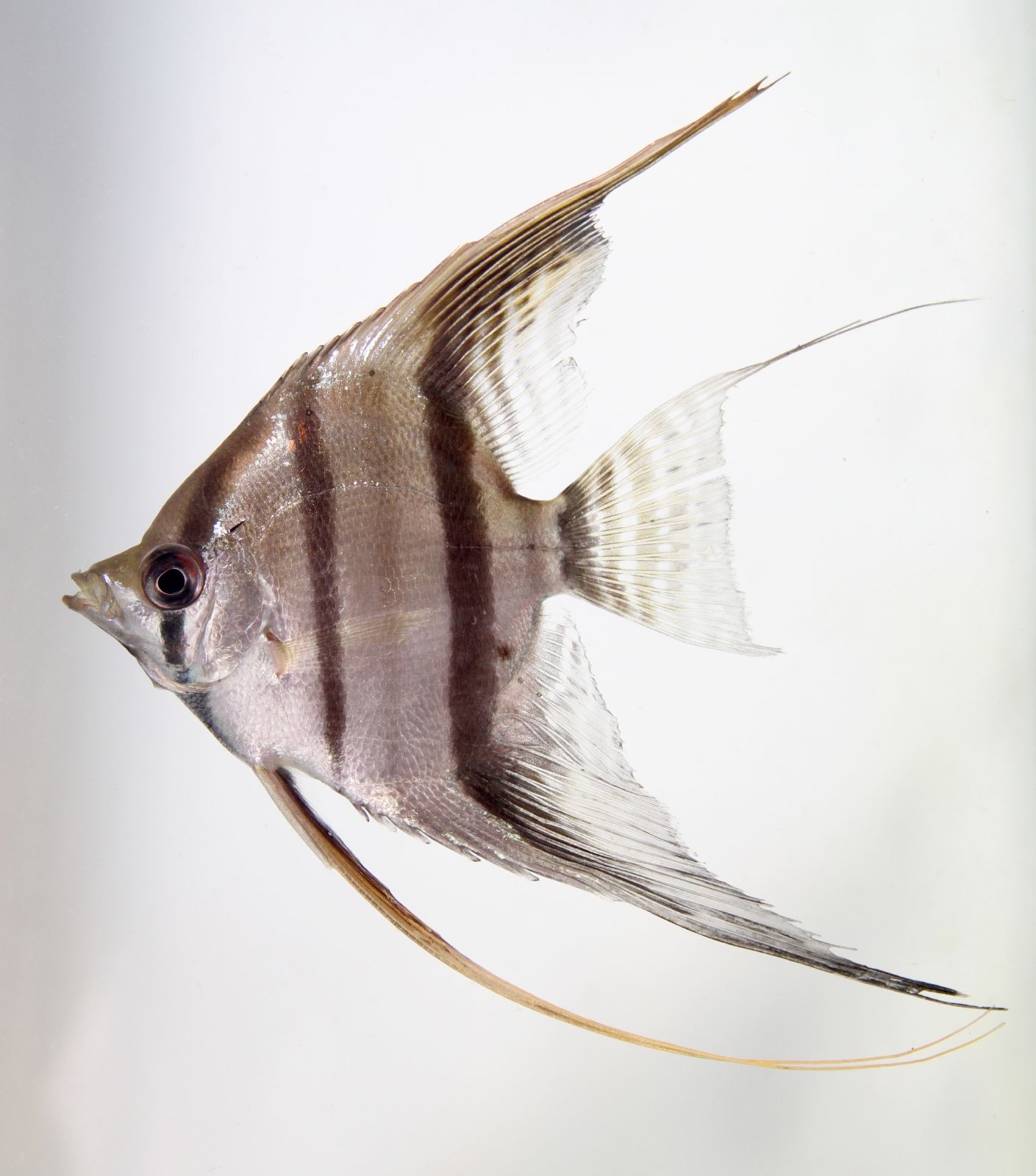
How to Tell an Altum From a Common Angelfish
The most reliable sign is a sharp notch or incision above the nostrils, a supraorbital indentation that all true Orinoco altums show.[3] In profile the forehead looks dented just in front of the eyes, where a common angelfish has a smooth slope.
- Height: altums grow taller, up to about 38 cm fin tip to fin tip, while common angelfish stay noticeably smaller.[3]
- Size: FishBase records a maximum length of 18 cm, and notes that the fish may reach about 20 cm in body height.[2]
- Origin: true altums come from the Orinoco and upper Rio Negro. Ask the seller where the fish were collected.[3]
Fish sold as "altum" are sometimes crosses or tall-finned strains of P. scalare. If the fish lacks the notch and came from a farm, treat it as a common angelfish.
Altum Angelfish Tank Size and Setup
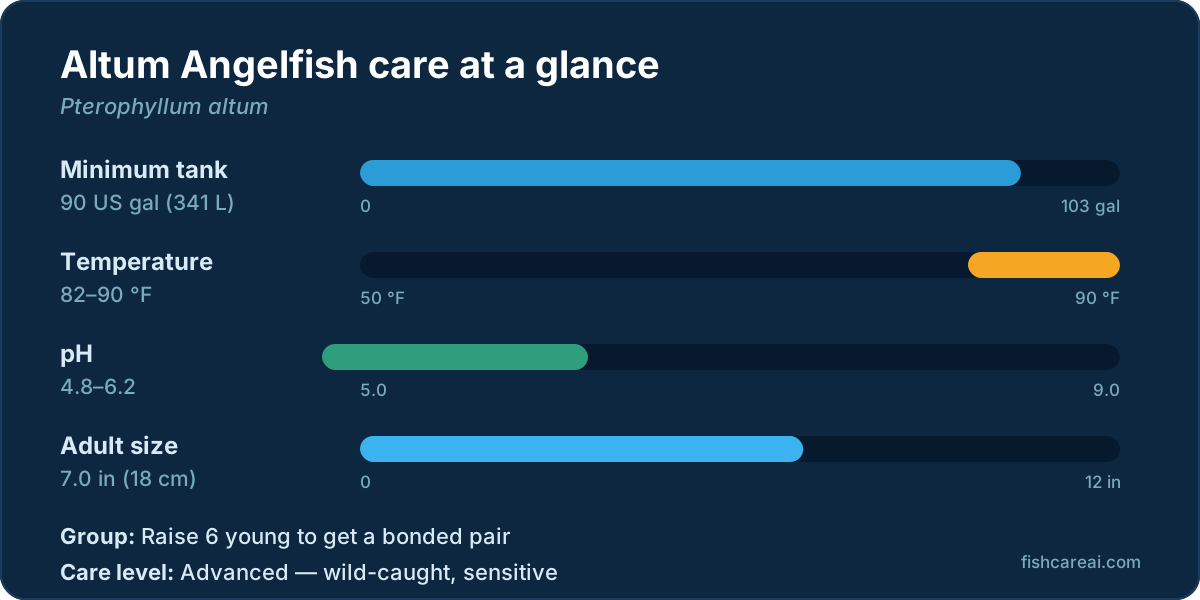
Seriously Fish rates the species as needing a large tank, and Fishkeeper calls for a large, soft-water aquarium that is taller than average.[1][4] Neither gives a volume. Because adults can measure 38 cm (15 in) from fin tip to fin tip, we suggest a tank at least 60 cm (24 in) tall. In standard sizes that means a 90-gallon (48 × 18 × 24 in) tank or larger, especially for a group.[3]
- Plants and cover: dense planting, floating plants and broad-leaved plants, with dimmed lighting.[1]
- Wood: mopani, driftwood or bogwood roots overhanging the water as cover.[1]
- Substrate: soft sand or fine gravel, since they may dig.[1]
- Flow: keep water movement low.[1]
Soft, Acidic Water Requirements
Seriously Fish gives 28–32 °C (82–90 °F), pH 4.8–6.2 and 0–5 dGH, and says the species usually does not do well at all in less acidic water.[1] FishBase gives 27–31 °C, pH 4.8–6.2 and 1–5 dH.[2] Fishkeeper gives the same pH and up to 5 dH.[4] Soft water with almost undetectable hardness is mandatory, not optional.[1]
In most homes that means reverse osmosis water, softened with peat or leaf litter and remineralised only slightly. Keep the temperature steady. Seriously Fish warns that altums are very sensitive to nitrate build-up and prone to hole-in-the-head disease and stress-related illness, so frequent water changes with matched water are essential.[1]
Feeding Wild-Caught Altums
Wild fish can be hard to feed. Seriously Fish recommends starting with regular live food, then weaning them onto frozen food by mixing the two.[1] Fishkeeper lists frozen mosquito larvae, bloodworm, enriched brine shrimp, Mysis and Daphnia, with small cichlid pellets once the fish are feeding well.[4] Tank-bred fish are more likely to take flake.[1]
Feed small amounts two or three times a day and remove leftovers quickly. Overfeeding raises nitrate, which this species tolerates poorly.[1]
Altum Angelfish Tank Mates
Altums are peaceful but timid, and anything that fits in the mouth is food, including neon tetras, guppies and small rasboras.[1][4] Good companions are other peaceful, larger soft-water fish. They are often kept with discus, which need similar water, although altums may eat discus spawn.[1]
Avoid fin-nippers and boisterous fish, which stress them. Seriously Fish suggests raising a group of six young fish to give the best chance of a bonded pair.[1] Pairs can become territorial when breeding.[4]
Settling New Wild-Caught Altums
Most altums are wild-caught, and the weeks after import are when most are lost.[1] Seriously Fish lists them as prone to hole-in-the-head disease and stress-related illness, and very sensitive to nitrate.[1]
- Match the shop's water closely, especially pH and hardness, and acclimatise over an hour or more with a slow drip.
- Keep the lights dim and the tank quiet for the first days, with plenty of plant and wood cover.[1]
- Offer live food first, then mix in frozen food until they accept it.[1]
- Keep nitrate low with frequent, small water changes using matched soft water.[1]
- Quarantine before adding them to a tank with discus or other valuable fish.
Buy a group of young fish rather than one or two adults if you hope to breed them later. Seriously Fish suggests six young fish to raise a pair, and young fish usually adapt to tank life more easily.[1]
Sexing and Breeding
Sexing is difficult. Males develop a small nuchal hump, usually only around breeding time.[1] Breeding is very difficult and needs very soft, acidic water.[1][4] In the wild they spawn on submerged roots and branches in moderate current, unlike the common angelfish.[3]
When they do spawn, both parents fan the eggs, which hatch after about two to three days, and the fry swim freely four to five days later, when they can take baby brine shrimp.[4] Parents often eat the spawn. Seriously Fish describes moving the eggs or fry to a small tank and gradually changing the water to RO water once they are free-swimming.[1]
Altum Angelfish FAQ
How big do altum angelfish get?
What size tank does an altum angelfish need?
What water do altum angelfish need?
Can altum angelfish live with discus?
How do I tell an altum from a regular angelfish?
Related Species
Water, diet and behaviour follow Seriously Fish and FishBase, the size, identification notch and habitat follow the Wikipedia species article, and breeding timings follow Fishkeeper.[1][2][3][4] The 90-gallon tank is our own suggestion derived from adult height, since none of the sources gives a volume.
References
- Seriously Fish. Pterophyllum altum (Altum Angel). Species profile. seriouslyfish.com
- Froese, R. & Pauly, D. (eds.). Pterophyllum altum Pellegrin, 1903. FishBase, version 2025. fishbase.se
- Wikipedia contributors. Pterophyllum altum. Wikipedia, The Free Encyclopedia. en.wikipedia.org
- Fishkeeper. Altum Angelfish (Pterophyllum altum). Species guide. fishkeeper.co.uk