A filtration canister is an external, pressurized aquarium filter holding 5 to 10 times the media of a hang-on-back filter. Size a tank canister filter at 4 to 6 times the tank volume per hour and clean it every 4 to 8 weeks.
That is 220 to 330 GPH for a 55 gallon, loaded sponge first and ceramic media last, rinsed in old tank water so the bacteria survive. For tanks from 30 to 180 gallons a canister is the quietest, most capable option short of a sump, and for planted tanks, goldfish, cichlids and plecos it is the difference between a tank that stays clear and one that grows algae in every dead corner.
This guide explains how the canister works, the flow you need by tank size, what to put in the trays and in which order, how it compares to a hang-on-back and a sump, and the cleaning routine that keeps it running. It closes with what type of fish tanks and filtration public aquariums use, because the same principles scale up. Run the numbers for your own tank with the aquarium equipment calculator.
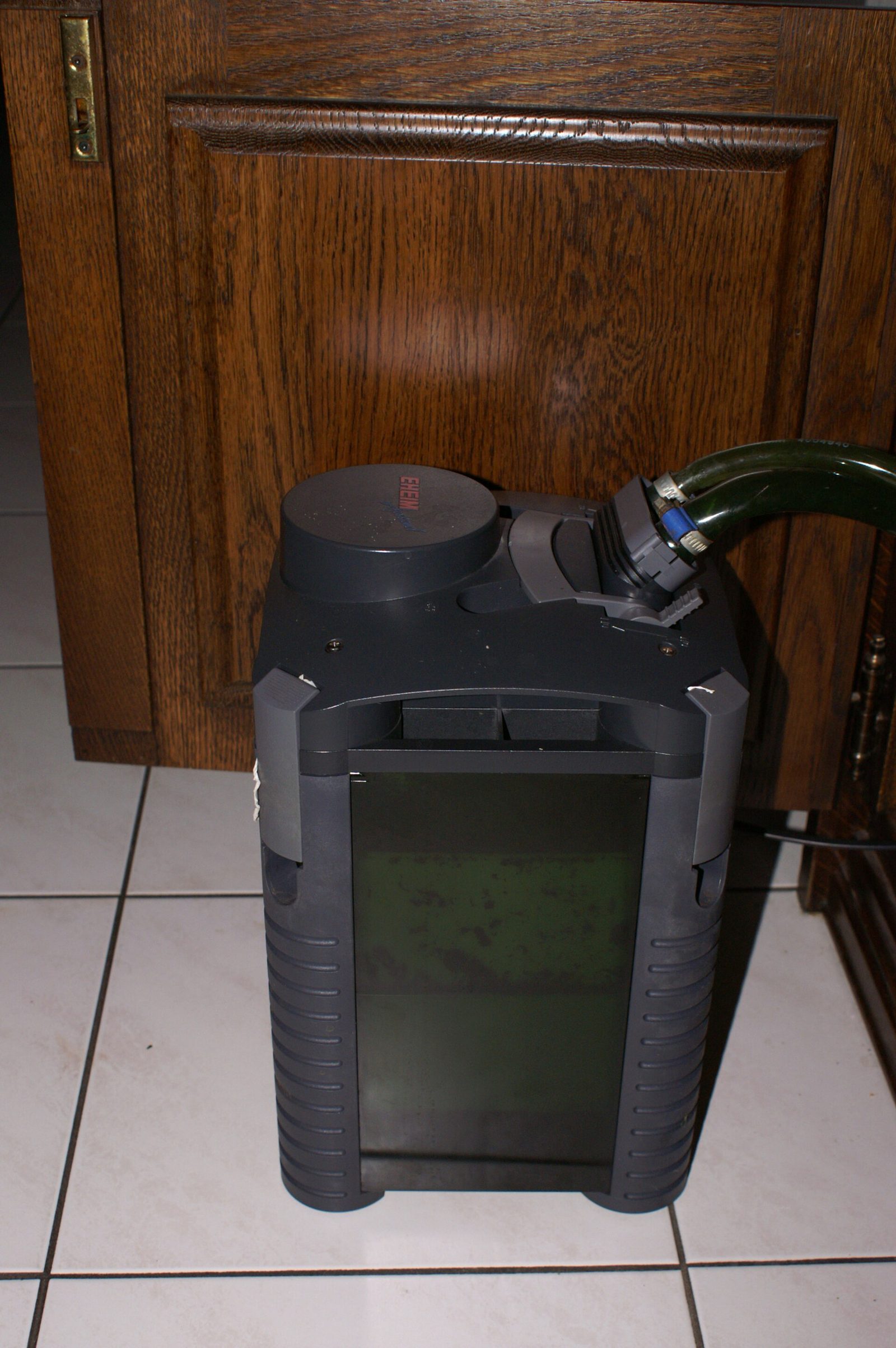
How a Filtration Canister Works
Water leaves the tank through an intake tube with a strainer, drops by siphon down a hose to the sealed canister, is pushed by the pump head up through a stack of media baskets (or from the outside of a sleeve to the inside, in the Eheim Classic layout) and returns to the tank through a spray bar or lily pipe. Because the canister is sealed and below the water line, the pump only has to overcome the resistance of the media, not lift the water, so a 20-watt pump moves 300 gallons an hour. The media stack does three jobs in order:
- Mechanical: coarse then fine sponge catches particles so they do not clog the biological media.
- Biological: ceramic rings, sintered glass or lava rock hold the nitrifying bacteria that turn ammonia into nitrite and nitrate. This is the media that matters; it is why a canister keeps a heavily stocked tank at 0 ppm ammonia.
- Chemical (optional): activated carbon for tannins and medication, phosphate remover, purigen. Replace monthly or leave out.
The aquarium filter entry on Wikipedia covers the other designs; a canister is the only common one that combines large media volume, adjustable flow and no equipment in the tank.
Filtration Canister Flow Rate by Tank Size
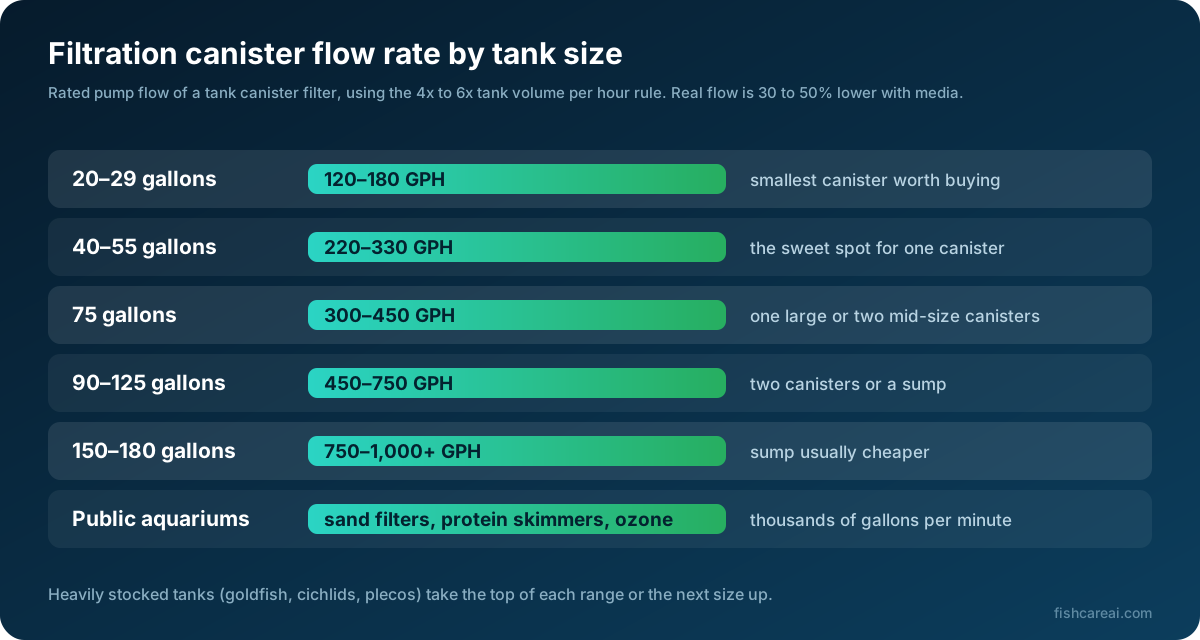
Manufacturers rate a filtration canister by pump flow with no media and no hoses. Real flow with a full media stack, two metres of hose and a spray bar is 30 to 50% lower and falls further as the sponges load. Buy by the box figure using the 4 to 6× rule, and buy the larger of two sizes when the tank is heavily stocked or planted:
| Tank size | Rated flow to buy | Typical canister class | Notes |
|---|---|---|---|
| 20–29 gallons | 120–180 GPH | Smallest models | A hang-on-back does this job cheaper unless the tank is planted |
| 40–55 gallons | 220–330 GPH | Mid-size, 4–6 L media | The size most people buy; the sweet spot |
| 75 gallons | 300–450 GPH | Large, 8–12 L media | Or two mid-size canisters, one each end |
| 90–125 gallons | 450–750 GPH | Large × 2 | Two canisters give redundancy and even flow |
| 150–180 gallons | 750–1,000+ GPH | Large × 2–3 or a sump | A sump is usually cheaper at this size |
| Goldfish, cichlids, plecos, any size | Top of the range or next size up | Bioload, not gallons, sets the media you need |
Bettas, fry and slow fish need the same media volume with less current: choose the right size and point the spray bar at the back glass or fit a wider outlet rather than buying a smaller canister. Check the tank's bioload with the fish tank stocking calculator before deciding between the two sizes.
Loading the Filtration Canister
Water enters the bottom basket and leaves the top on most designs (check the arrows on yours). Load in the direction of flow:
| Basket | Media | Purpose | Maintenance |
|---|---|---|---|
| 1 (first) | Coarse sponge, 20–30 ppi | Catches leaves, food, mulm | Rinse every clean |
| 2 | Fine sponge or filter floss | Polishes the water | Floss replaced, sponge rinsed |
| 3 (most of the volume) | Ceramic rings, sintered glass, lava rock, pot scrubbers | Bacteria; the tank's nitrogen cycle lives here | Swish in tank water, never tap water, never all at once |
| 4 (optional) | Carbon, purigen, phosphate remover | Clarity, medication removal, algae nutrient control | Replace every 4–6 weeks or omit |
Fill at least half the canister with biological media. The branded bio-balls and ceramic noodles that come in the box are fine; so is a bag of lava rock from a garden centre at a tenth of the price. Skip the carbon unless you are removing medication or tannins: in a tank fighting algae, a phosphate-removing resin in basket 4 does more.
Filtration Canister vs Hang-On-Back vs Sump
| Tank canister filter | Hang-on-back | Sump | |
|---|---|---|---|
| Best for | 30–180 gal, planted, messy fish | 5–40 gal, budget, simple | 125 gal+, saltwater, reef |
| Media volume | 4–12 L | 0.5–1.5 L | 20 L+ |
| Noise | Near silent | Trickle, hum | Overflow noise unless tuned |
| In-tank hardware | Intake and outlet only | Box on the rim | Overflow box or drilled tank |
| Cleaning | Every 4–8 weeks, 20 min | Every 2–4 weeks, 5 min | Monthly, plus socks weekly |
| Cost | $$–$$$ | $ | $$$ plus plumbing |
| Failure mode | Leak at the seal; flood risk | Pump stops; harmless | Overflow or return failure; flood risk |
The honest summary: under 30 gallons a canister is more filter than the tank needs; from 30 to 125 gallons it is the best choice for most freshwater tanks; above that a sump wins on media, cost and the option to hide heaters and dosing in it. The fish tank water guide covers what the filter cannot do, which is the weekly water change.
Cleaning a Tank Canister Filter
- Close both tap valves, unplug, and lift the head off over a bucket; the canister holds 1 to 3 gallons of dirty water, which is the water you rinse the media in.
- Rinse the sponges in that bucket until the water runs brown, not clear. Replace floss. Swish the ceramic media once; do not scrub it.
- Wipe the impeller and its well with a cotton bud; a rattling canister is a dirty impeller nine times out of ten.
- Check the O-ring, smear it with silicone grease, reassemble, refill by opening the tap valves and priming, and plug in only when the canister is full of water.
- Every three months brush the hoses and intake strainer; hose slime halves the flow of a filtration canister before the media does.
Never clean the canister and change more than 25% of the water on the same day, and never rinse the biological media under the tap; chlorine kills the bacteria and the tank re-cycles. A canister that is opened every four weeks and rinsed in tank water lasts ten years and never crashes a cycle.
What Type of Fish Tanks Do Aquariums Use?
Public aquariums use cast acrylic tanks, from a few thousand gallons up to the 6-million-gallon exhibits at Atlanta and the 2.7-million-gallon tank at Okinawa, with acrylic panels up to 2 feet thick because glass cannot be made that large or that safe. The life-support systems behind them do the same three jobs as a filtration canister at a different scale: pressurized sand filters for mechanical filtration, fluidized beds or trickle towers of plastic media for biological filtration, and protein skimmers, ozone and UV for the chemical and disinfection stage that a home tank leaves to water changes. Turnover is once every one to two hours, so a million-gallon exhibit moves 10,000 gallons a minute through pipes you can walk inside.
The principle to take home is the ratio: a lot of biological media, high flow through it, and mechanical filtration that is cleaned constantly, which is what a correctly sized tank canister filter gives a 75-gallon living room tank. For choosing the home tank itself, the aquarium size calculator covers volume, weight and stand requirements.
Filtration Canister FAQ
What is a filtration canister?
An external pressurized filter that sits below the tank: water is drawn down an intake tube, pushed through trays of sponge, ceramic and chemical media inside a sealed canister and pumped back through a spray bar. It holds 5 to 10 times the media of a hang-on-back filter.
What size canister filter do I need for my tank?
Pick a rated flow of 4 to 6 times the tank volume per hour: 220 to 330 GPH for a 55 gallon, 300 to 450 GPH for a 75. Real flow with media is 30 to 50% lower than the box figure, so round up.
How often should I clean a tank canister filter?
Every 4 to 8 weeks, or when the output visibly slows. Rinse the sponges in old tank water, never tap water, replace only the floss, and leave the ceramic media alone except for a quick swish.
Is a canister filter better than a hang-on-back?
For tanks over 40 gallons, planted tanks and messy fish, yes: more media, more flow, quieter and no hardware in the tank. Under 30 gallons a hang-on-back or sponge filter does the job for a third of the price.
Can a canister filter be too strong?
Yes for bettas, fry and slow fish. Point the spray bar at the glass, add a wider outlet or turn the tap valve down a quarter. Do not throttle below half or debris settles inside the canister.
What type of fish tanks do aquariums use?
Public aquariums use acrylic tanks from a few thousand to millions of gallons with life-support systems built around sand filters, protein skimmers, ozone and UV, turning the whole volume over every one to two hours. A home filtration canister is the same idea in a bucket.