Black beard algae (BBA, or black brush algae) is a red alga that grows as dark tufts on leaf edges, driftwood and filter outlets, and its cause is unstable CO2 and low flow, not light.
The tufts are 0.2 to 0.5 inches long, black, dark green or deep red, and anchored so firmly that a fingernail does not shift them. Nitrate and light matter less than in any other algae, which is why the usual advice fails on this one.
It is the genus Audouinella, and it is the hardest common aquarium algae to remove because nothing eats mature tufts and scrubbing leaves the holdfast behind. The fix is a 3% hydrogen peroxide or liquid carbon spot treatment to kill what is there, steady CO2 and better flow to stop it returning, and siamese algae eaters or amano shrimp to graze the new growth.
This page identifies BBA against the brown, blue-green, hair and spot algae it is confused with, gives the treatment doses, and names the animals that actually eat it. For the general clean-up plan that applies to every algae, see how to get rid of algae in a fish tank; for the animals, the algae eater fish guide.
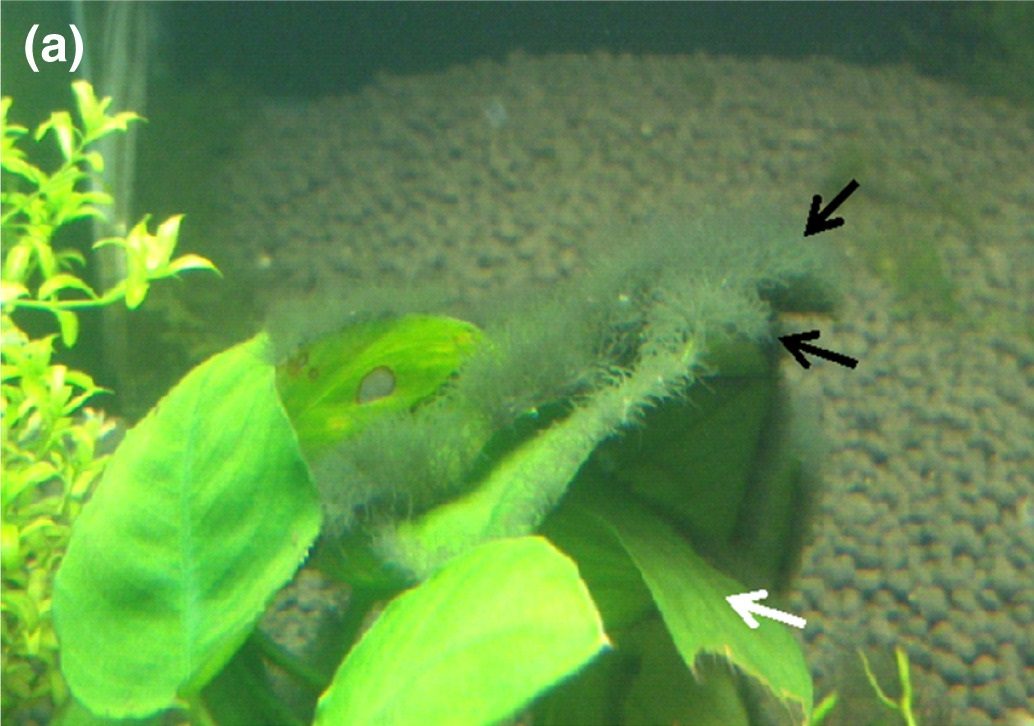
What Black Beard Algae Looks Like
BBA grows as dense, short tufts, black, dark green or deep red depending on the light, with the texture of a wet paintbrush. Each tuft is anchored by a holdfast that does not come off with a fingernail. It starts on the edges of slow-growing leaves (anubias, java fern, crypts), on driftwood, on the lip of the filter outlet and on the substrate line of the glass, always where water moves least. Under a hand lens the strands are branched and stiff; hair algae by contrast is a single soft green thread. Two other tells: BBA turns pink or red within a day of a hydrogen peroxide or liquid carbon dose, and it feels rough when the fish brush past it, so otocinclus and plecos avoid it.
Staghorn algae is the same family (Rhodophyta) grown differently: grey-black, branching, antler-shaped strands up to an inch long on leaf tips, and a sign of ammonia spikes and a dirty filter rather than CO2. Both are red algae, which is why the Audouinella entry on Wikipedia lists them with the seaweeds. Treat staghorn exactly like BBA.
What Causes Black Beard Algae
- Fluctuating CO2. The main cause in planted tanks: a CO2 system that runs out, a regulator that drifts, a lights-on schedule that starts before CO2 does. In unplanted tanks the same effect comes from large pH swings between water changes.
- Low or uneven flow. BBA colonises the dead corners first. A clogged canister filter running at half its rated flow is the usual reason a tank that was clean for a year suddenly grows it.
- Organic waste. Overfeeding, a deep dirty substrate and rotting leaves feed it. It is not driven by nitrate or phosphate directly, which is why cutting nutrients alone does not clear it.
- Old bulbs and long photoperiods. A secondary factor: a light over 10 hours or a fluorescent tube past 12 months gives BBA an edge over plants.
- Hitch-hiking. It arrives on plants and driftwood from tanks that have it. Quarantine or dip new plants (see prevention below).
How to Kill Black Beard Algae
| Method | Dose | Time to work | Safe for | Not safe for |
|---|---|---|---|---|
| 3% hydrogen peroxide, spot | 1 ml per gallon of tank volume per day, filter off 10 min, syringe onto tufts | Red in 1–2 days, white in 3–4, gone in a week | Fish, most plants, shrimp at this dose | Mosses, riccia, sensitive stem plants if sprayed directly |
| 3% hydrogen peroxide, dip | 1 part H2O2 to 3 parts water, 3–5 min, rinse, replant | 2–3 days | Anubias, java fern, crypts, wood, rock | Fine-leaved plants, moss |
| Liquid carbon (glutaraldehyde), spot | Normal plant dose × 2, filter off, syringe onto tufts | Red in 2–3 days | Fish, shrimp at 2× | Vallisneria, hornwort, anubias at 3×+ |
| Bleach dip (hardscape only) | 1:20 bleach to water, 2–3 min, rinse, dechlorinate | Immediate | Wood, rock, equipment | Anything alive |
| Remove and trim | Cut affected leaves at the stem; scrub wood and rock out of the tank | Immediate | Everything | Nothing, but the holdfasts remain on what you cannot remove |
Do the spot treatment every other day for a week, one area at a time, and a 30% water change at the end of it. Dead BBA turns white and is then eaten by shrimp and fish that ignored it alive. At the same time fix the cause: check CO2 comes on an hour before the lights and stays steady through the day, clean the filter, and aim the outlet so every leaf moves. Tanks that get the peroxide without the flow fix are clean for three weeks and then back where they started.
What Eats Black Beard Algae
Only a short list, and all of them prefer fresh growth to established tufts:
- Siamese algae eaters under 3 inches, in a group of three or more, fed lightly. The only fish that reliably eats it. Make sure they are true SAE and not flying foxes.
- Amano shrimp, 5 to 10 per 20 gallons, pick at tufts that have been weakened by peroxide.
- Florida flag fish and young bristlenose plecos graze it occasionally; do not buy them for it.
- Nerite snails keep the glass line clear but leave the tufts on leaves alone.
Black Beard Algae vs Brown and Blue-Green Algae
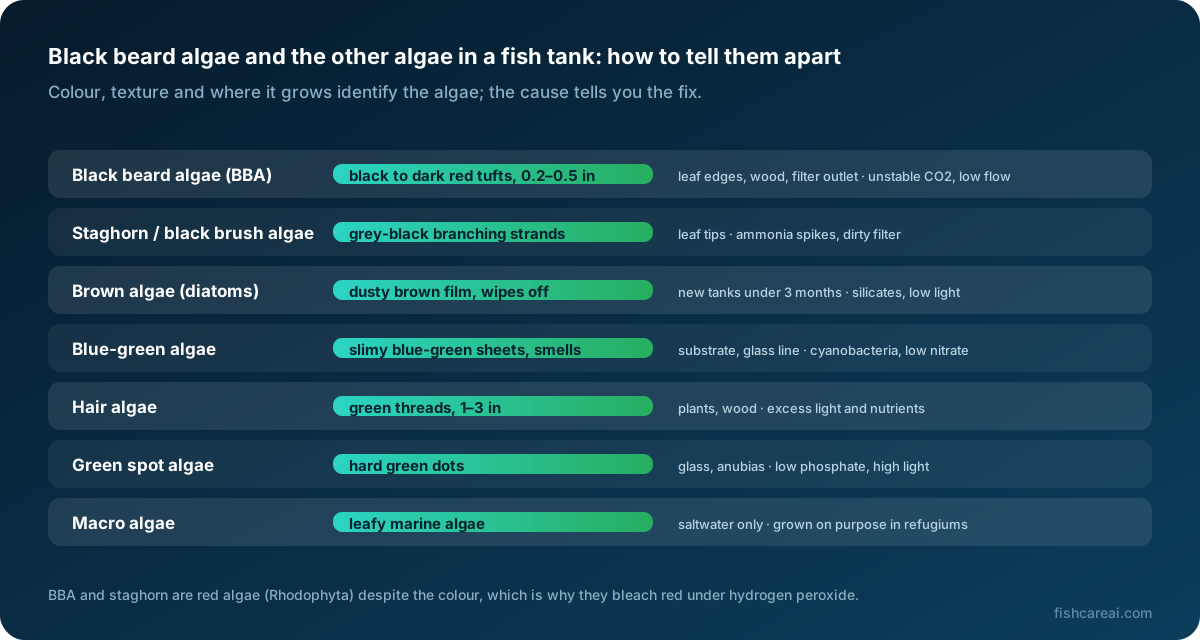
Most black algae in a fish tank is beard algae, but not all dark algae is, and the other types need different fixes:
| Algae | Looks like | Cause | Fix |
|---|---|---|---|
| BBA / black brush algae | Dark tufts on leaf edges, wood, outlet | Unstable CO2, low flow, organics | H2O2 spot, steady CO2, flow, SAE |
| Brown algae in a fish tank (diatoms) | Dusty brown film that wipes off; tanks under 3 months | Silicates in new substrate and tap water; low light | Wait 6–8 weeks, otocinclus, nerites; a silicate-removing pad if it persists |
| Green blue algae in an aquarium (cyanobacteria) | Slimy blue-green sheets on substrate and glass, earthy smell, peel off whole | Zero nitrate plus dirty substrate and low flow | Siphon, 3-day blackout, dose nitrate to 10 ppm, erythromycin as last resort |
| Hair algae (hairline algae) | Soft green threads 1–3 in on plants and wood | Excess light and nutrients | Cut light, amano shrimp, twirl out; full guide at hair algae |
| Green spot | Hard green dots on glass and anubias | High light, low phosphate | Razor, nerites, raise phosphate |
| Green dust / film | Even green haze on glass | New tank, high light | Leave 3 weeks then wipe; nerites |
| Macro algae | Leafy or grape-like marine algae (chaeto, caulerpa) | Grown deliberately in saltwater refugiums | Not a problem; it is the saltwater version of a fast plant |
Brown algae in a fish tank is the one most often mistaken for early BBA on driftwood. The test is a finger: diatoms smear off, BBA does not move. Green blue algae in an aquarium is not an alga at all but a bacterium, and the blackout that kills it does nothing to BBA. Macro algae belongs in a saltwater refugium and never appears in freshwater; if a shop offers "macro algae" for a freshwater tank it is selling a marine plant that will die in a week.
Keeping Black Beard Algae Away
Steady CO2 or none at all, flow that reaches every leaf, a filter cleaned monthly, and a light on a timer for 7 to 8 hours. In planted tanks a drop checker that stays lime-green from lights-on to lights-off is the single best insurance. Dip every new plant in 1:3 hydrogen peroxide for 3 minutes or 1:20 bleach for 2 minutes before it goes in, and keep three siamese algae eaters or a colony of amano shrimp to take the first tufts before they anchor.
BBA that returns within a month of treatment means the CO2 or flow problem is still there; treat the water, not the tufts. If the tank is unplanted and has no CO2, the swing is coming from big water changes on a tank with low KH; smaller, more frequent changes and a KH of 3 to 4 dKH stop it. The aquarium plant care guide covers the CO2 and fertilizer balance that keeps plants ahead of the algae, and the water parameter checker flags a pH swing between readings.
Black Beard Algae FAQ
What causes black beard algae in a fish tank?
Fluctuating CO2 is the main trigger, in planted tanks with an unstable CO2 supply and in unplanted tanks after big pH swings, combined with low flow and organic waste. Old light bulbs and dirty filters make it worse.
How do I get rid of black beard algae fast?
Turn off the filter, spot-treat the tufts with 3% hydrogen peroxide from a syringe (1 ml per gallon of tank volume per day), wait 10 minutes, restart the filter. BBA turns red then white in 2 to 4 days. Repeat every other day for a week and fix flow and CO2.
What fish eats black beard algae?
True siamese algae eaters, amano shrimp and, less reliably, florida flag fish and young bristlenose plecos. Adult fish fed well ignore it, so feed lightly while they work.
Is black beard algae harmful to fish?
No. It is ugly and it smothers slow-growing plant leaves, but it does not hurt fish or shrimp. The hydrogen peroxide and liquid carbon used to kill it can, so dose carefully.
Is black beard algae the same as black brush algae?
Yes, black brush algae, BBA and beard algae are the same red alga (Audouinella). Staghorn algae is a related red alga that grows in branching grey strands rather than tufts.
Why is there brown algae in my fish tank?
Brown algae in a new fish tank is diatoms feeding on silicates in fresh substrate and tap water. It wipes off with a finger and usually disappears on its own after 2 to 3 months; otocinclus and nerite snails eat it.
What is the green blue algae in my aquarium?
Blue-green algae is cyanobacteria, not a true alga: slimy sheets that peel off in one piece and smell earthy. It grows when nitrate hits zero in a dirty tank. Siphon it out, do a 3-day blackout and dose nitrate to 10 ppm.