The fairy cichlid (Neolamprologus brichardi) is a small rock-dwelling fairy cichlid from Lake Tanganyika that breeds in cooperative family groups.
In the hobby it is better known as the Princess of Burundi, the trade name it got when the first exports left Burundi in 1971, or as the lyretail cichlid after its streamer-tipped tail.[2] Wild fish live along the rocky northern shores of the lake, mostly between 5 and 25 m deep, in loose aggregations made up largely of breeding pairs.[2] They hover above the rock picking plankton from the open water.[1][2]
Tank size is the question most keepers ask first, and the answer depends on what you want to keep. A single pair is easy to house. A colony, in which juveniles from earlier spawns stay and help their parents, is the reason many people keep the species, and it needs considerably more room. This page covers both setups, along with water chemistry, diet, compatible Tanganyikans and breeding.

Fairy Cichlid Tank Size: Pair vs Colony
| Setup | Minimum length | Typical tank |
|---|---|---|
| One bonded pair | 80 cm (≈32 in) | About 30 US gal[1][2] |
| Family colony with helpers | 120 cm (48 in), 30 cm deep base | 40-gal long or larger[2] |
| Mixed Tanganyikan community | 150 cm (≈60 in) or more | Enough rockwork for separate territories[2] |
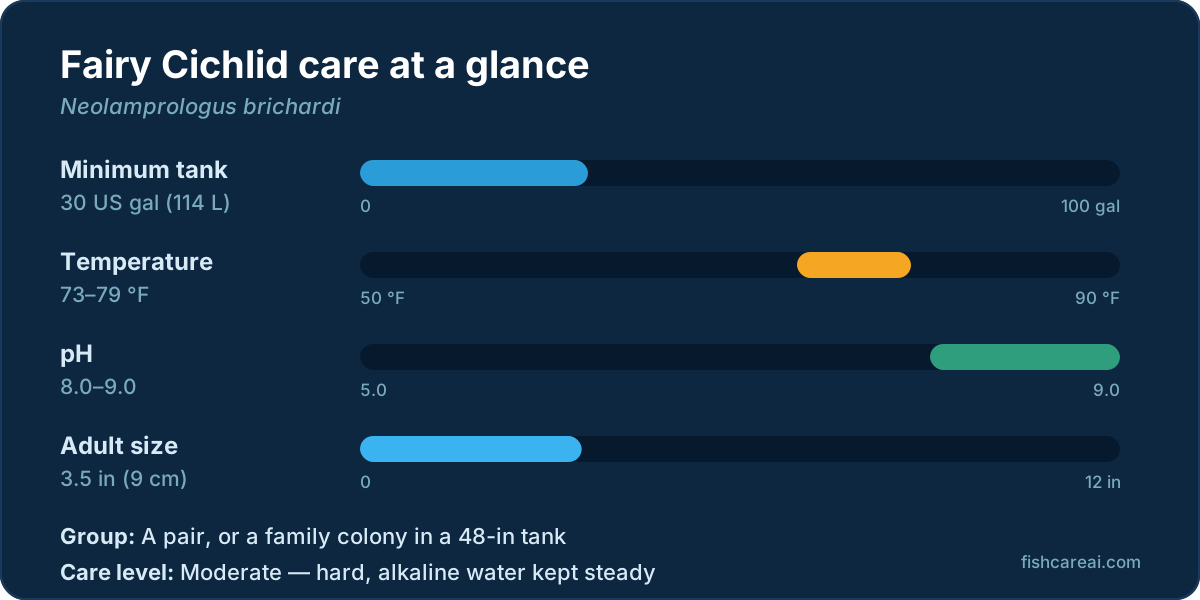
FishBase and Seriously Fish agree on 80 cm as the minimum length for a pair.[1][2] That figure assumes the pair has the tank to themselves. Once a pair spawns, the young stay on, and within a year a 32-inch tank can hold three generations competing for the same caves. Seriously Fish notes that when space runs out, the adults lay fewer eggs or start eating the smallest fry.[2] That is the clearest sign the tank has become too small.
Floor area matters more than height. These fish claim rock, not water volume, so a long, shallow tank with rock piles running end to end gives more territories than a tall tank with the same gallonage. Plan for growth if you intend to let the colony expand: a 48 × 12 in footprint is the practical starting point, and 55 to 75 gallons gives a family room to stay peaceful for longer.
Setting Up a Fairy Cichlid Tank
Recreate a stretch of Tanganyika shoreline: a sand bottom and stacked rocks forming caves across most of the tank.[2] Stable stacks matter, because pairs often dig out under a stone to enlarge their spawning cave. Set the bottom rocks on the glass or on egg-crate before adding sand, so digging cannot topple a pile.
- Caves: at least two or three more than the number of adult pairs, with entrances facing different ways.
- Sight lines: break up long views with rock so a subordinate fish can get out of sight.
- Plants: optional. Hardy species such as Anubias or Java fern tolerate hard water and are usually left alone.
- Buffering: crushed coral or aragonite sand helps hold pH above 8 in soft-tap areas.
Fairy Cichlid Water Parameters
Lake Tanganyika is hard and strongly alkaline, and the fairy cichlid does best when the tank copies that. Seriously Fish gives pH 8.0–9.0, hardness 9–19 dGH and 23–26 °C (73–79 °F). FishBase lists the same pH and hardness with a slightly cooler 22–25 °C.[1][2] Keep the chemistry steady, because swinging between soft and hard water is harder on the fish than any single value in that range.
What Fairy Cichlids Eat
In the wild this species is a plankton picker, feeding on tiny animals in the water column above its rock.[1][2] In the aquarium it takes almost anything, but live and frozen foods should make up a large share of the diet, with dry food fed less often.[2] Good options include frozen Cyclops, Daphnia, brine shrimp and mysis, plus small sinking pellets. Add some plant matter as well, for example a spirulina-based flake.[2]
Feed small amounts in several places at once. In a colony the breeding pair takes the best spot, and if all the food lands in one place the helpers and fry go hungry. Scattering food also stops one dominant fish from defending the feeding area.
Fairy Cichlid Tank Mates
This is a territorial cichlid that keeps defending its patch, and it gets fiercer once there are fry.[2] A species tank is the simplest choice. In a large aquarium it can share space with other small to medium Tanganyikans that use a different part of the tank:
- Open-water fish: Cyprichromis species, which stay in midwater above the rocks.[2]
- Shell dwellers: small Lamprologus and Neolamprologus that live in snail shells on open sand.[2]
- Other rock dwellers, only with plenty of space: Julidochromis or Altolamprologus, if every fish can hold its own territory.[2]
- Never: other members of the brichardi complex, such as N. pulcher or the daffodil cichlid, because they hybridise freely.[2]
Avoid soft-water community fish entirely. Tetras, rams and most gouramis cannot stay healthy at pH 8.5, however peaceful the cichlids are.
Breeding Fairy Cichlids and the Helper System
This is one of the easier Tanganyikan cichlids to breed. Pairs form inside a group, so unless you can buy a proven pair, start with six or more juveniles and rehome the extras once two fish pair off.[2] The pair spawns out of sight in a cave and attaches the eggs to the wall or roof. Usually the female tends the clutch while the male patrols the area around the entrance.[2]
What follows is unusual among fishes. Juveniles from earlier broods stay in their parents' territory and help: they clean eggs, remove sand from the breeding cave and defend the newest fry. Taborsky and Limberger described this "helpers at the nest" system in aquarium groups of this species in 1981, and it has since been confirmed in the lake, where many breeding pairs share one stretch of rock.[4][2] Later research on the closely related N. pulcher made the brichardi group a model for studying cooperative breeding in vertebrates.[5]
- The fry are large enough to eat newly hatched brine shrimp from the first day of free swimming.[2]
- Growth is slow, so the young stay small and vulnerable for months. That long stretch of slow growth is one reason they stay with their parents as helpers.
- To raise a large number, siphon fry to a rearing tank before space becomes tight in the main tank.[2]
Sexing adults is difficult. Males are usually slightly larger and grow longer streamers on the dorsal and tail fins, but the differences are small.[2]
Fairy Cichlid or Neolamprologus pulcher?
Fish sold as fairy cichlids are often confused with N. pulcher, which was described in the same 1952 paper. Check the gill cover. In N. brichardi, a dark bar running back from the eye meets a vertical bar at the rear edge of the gill cover, forming a sideways T. In N. pulcher the two bars run parallel and do not meet.[2]
Whether the two are really separate species is still debated. Duftner and colleagues found that mitochondrial DNA from populations around the lake does not group by facial pattern, and argued that the brichardi stripe evolved more than once.[6] FishBase still lists both species.[1] For a hobbyist the practical rule is the same either way: keep one form per tank, or you will end up with hybrids that cannot be traced back to either.
Fairy Cichlid FAQ
What size tank does a fairy cichlid need?
How big do fairy cichlids get?
Are fairy cichlids aggressive?
Is the fairy cichlid endangered?
Species Related to the Fairy Cichlid
References
- Froese, R. & Pauly, D. (eds.). Neolamprologus brichardi (Poll, 1974). FishBase, version 2025. fishbase.se
- Seriously Fish. Neolamprologus brichardi (Princess of Burundi). Species profile. seriouslyfish.com
- Francis-Floyd, R., Watson, C., Petty, D. & Pouder, D. B. Ammonia in Aquatic Systems (FA16). University of Florida IFAS Extension. edis.ifas.ufl.edu
- Taborsky, M. & Limberger, D. (1981). Helpers in fish. Behavioral Ecology and Sociobiology 8: 143–145. doi.org/10.1007/BF00300826
- Wong, M. & Balshine, S. (2011). The evolution of cooperative breeding in the African cichlid fish, Neolamprologus pulcher. Biological Reviews 86: 511–530. doi.org/10.1111/j.1469-185X.2010.00158.x
- Duftner, N., Sefc, K. M., Koblmüller, S., Salzburger, W., Taborsky, M. & Sturmbauer, C. (2007). Parallel evolution of facial stripe patterns in the Neolamprologus brichardi/pulcher species complex endemic to Lake Tanganyika. Molecular Phylogenetics and Evolution 45: 706–715. doi.org/10.1016/j.ympev.2007.08.001