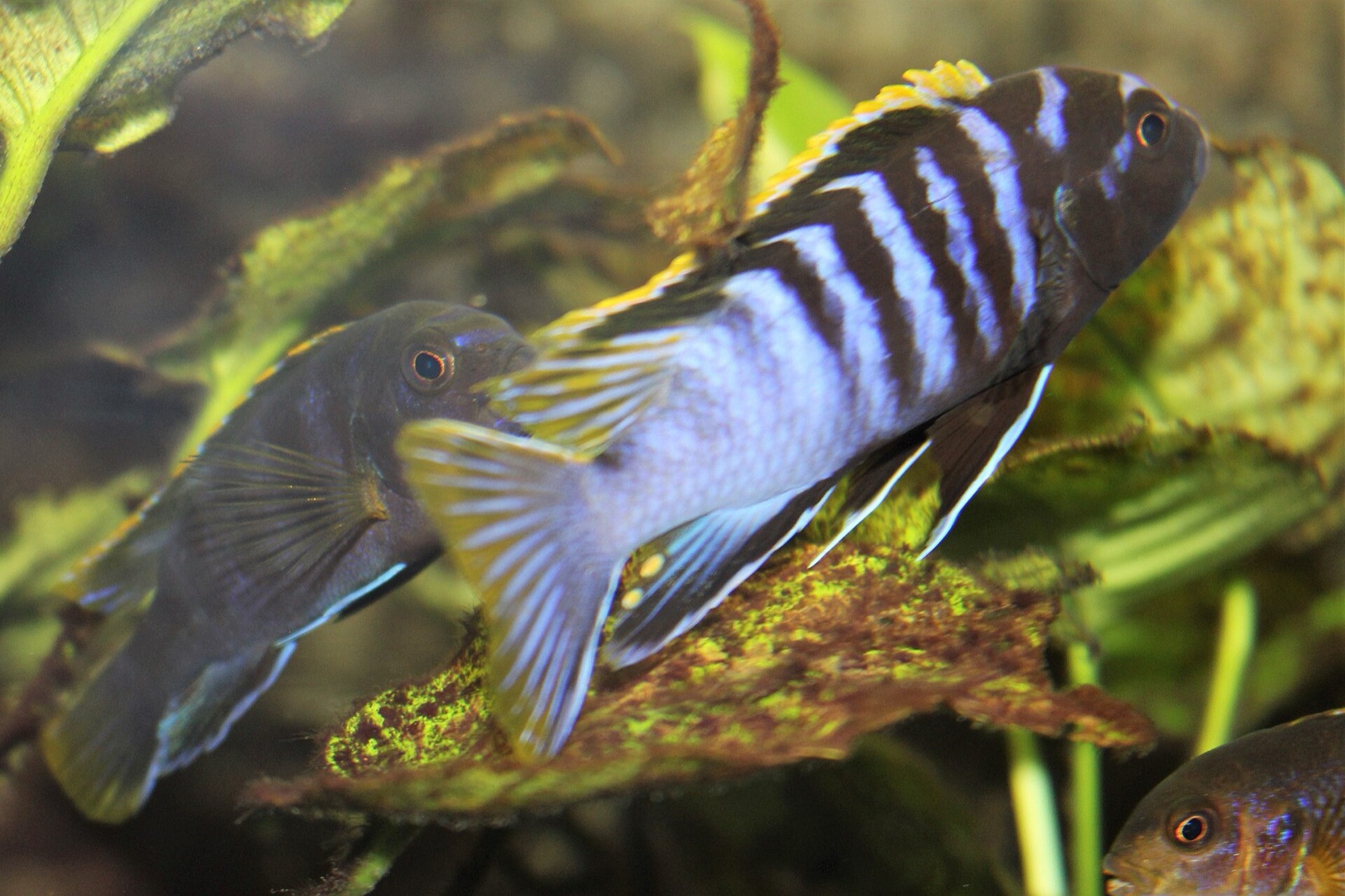
The demasoni cichlid (Chindongo demasoni) is a dwarf rock-dwelling cichlid from Lake Malawi, popular for its electric blue and black bars and notorious for picking fights far above its size.
In the wild it is known only from Pombo Rocks, off the Tanzanian coast of Lake Malawi, where it lives on a single rocky area, often in shallow water near the tops of the rocks.[1][3] Ad Konings described it in 1994 and named it after Laif DeMason, a Florida fish importer.[3] Because its range is so small, the IUCN lists it as Vulnerable.[2]
Many demasonis in home tanks do badly because they are kept the wrong way: in too small a group, with the wrong tank mates, or fed too much protein. This profile covers the stocking method that works, the water and food it needs, and how breeding happens in the tank.
Demasoni Tank Size and Rockwork
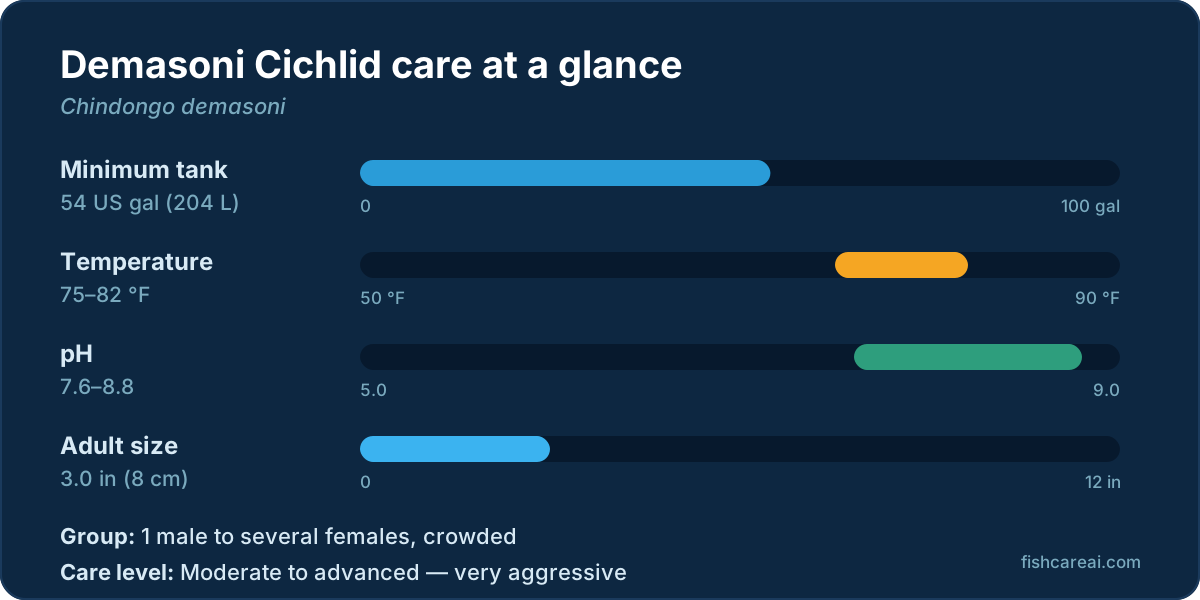
Seriously Fish gives 120 × 45 × 38 cm (48 × 18 × 15 in), about 205 litres or 54 US gallons, as the absolute minimum because of the species' aggression.[1] Practical Fishkeeping and Fishkeeper also call for a tank at least 90–120 cm long, and Practical Fishkeeping suggests a tall, wide tank to increase volume.[3][4]
Build extensive rock piles with plenty of caves over a sand substrate. Demasonis hug the rock surfaces, and caves give subordinate fish a way to break line of sight.[1] Stack rocks on the tank floor before adding sand, so digging fish cannot undermine them.
How to Stock Demasoni Without Losses
Aggression is the main problem with this species. Seriously Fish calls it one of the most aggressive and territorial mbuna, able to attack fish several times its size.[1] Fishkeeper describes it as extremely belligerent.[4] The usual answer is controlled crowding, which spreads attacks across many fish.
- Sex ratio: one male with several females. Unusually for mbuna, females also fight each other, so do not keep a single female with a male.[1][4] Fishkeeper suggests at least five females per male for breeding.[4]
- Group size: Practical Fishkeeping suggests about half a dozen demasoni, with females outnumbering males at least two to one, inside a crowded community of around 20 similar-sized mbuna in a 90 cm tank.[3]
- Add them last: they are very territorial towards newcomers, so introduce demasoni after the other fish.[4]
- Expect losses: subordinate males may still be killed, so watch closely and be ready to rehome extra males.[1]
Crowding only works with strong filtration and frequent water changes, because more fish means more waste.
Hard, Alkaline Water
Seriously Fish gives 24–28 °C (75–82 °F), pH 7.6–8.8 and 10–25 dGH.[1] Fishkeeper gives 24–26 °C, pH 7.5–8.5 and up to 25 dH.[4] Practical Fishkeeping adds that the water should be well oxygenated and low in nitrate, and suggests a buffer or calcareous rock and substrate where tap water is soft.[3]
Feeding a Demasoni Cichlid
Plant matter should make up a large share of the diet: Spirulina flake, blanched spinach and nori, plus some live and frozen foods.[1] Fishkeeper also says the diet should be primarily vegetarian, with Spirulina flake, mbuna granules and the occasional Mysis.[4] Practical Fishkeeping notes that high-Spirulina foods help digestion and colour.[3]
Demasoni Cichlid Tank Mates
Keep demasonis only with other robust mbuna. Practical Fishkeeping suggests Labidochromis, Iodotropheus and smaller Pseudotropheus, with Synodontis petricola as a catfish option.[3] On this site, the electric yellow cichlid is a Labidochromis often used for this.
- Avoid look-alikes: fish with a similar blue-barred pattern, such as Pseudotropheus saulosi and most Cynotilapia, must be avoided.[3][4]
- Avoid peaceful cichlids: Seriously Fish says demasonis are unsuitable with peacocks or utaka, so do not mix them with peacock cichlids.[1]
- Avoid large bullies: big, aggressive mbuna such as most Melanochromis and Labeotropheus are a poor match.[3]
Common Problems in Demasoni Tanks
Most demasoni problems come back to aggression and diet.
- One fish hiding or torn fins: a dominant male is targeting it. Add rockwork, raise the number of fish, or remove the target.[1][4]
- Fights with look-alikes: blue-barred fish such as P. saulosi and most Cynotilapia are attacked constantly.[3][4]
- Digestive problems: red meat such as beef heart disrupts their digestion, so keep the diet plant-based.[1]
- Lost broods: stressed females spit out or swallow their eggs, so keep holding females calm or move them to a quiet tank.[1]
- Rising nitrate in a crowded tank: Practical Fishkeeping wants low nitrate and high oxygen, so match crowding with strong filtration and frequent water changes.[3]
Rearrange the rockwork when you add new fish. It resets territories and gives newcomers a chance before the residents claim the tank again.
Sexing and Breeding
Males and females look alike. Males are slightly larger and more territorial, so behaviour is the easiest guide; venting is possible but best left to experts.[1] Demasonis can breed at under 5 cm.[3]
This is a maternal mouthbrooder. The male defends a flat rock or a pit, the female lays her eggs there and then picks them up in her mouth after the male fertilises them.[1] She carries them for about three weeks without eating, and Fishkeeper says incubation can last up to 25 days.[1][4] Stress can make her spit out or swallow the brood. The fry can eat brine shrimp nauplii from release, and they are aggressive towards each other from an early age, so separate them as they grow.[1]
Demasoni Cichlid FAQ
What size tank does a demasoni need?
How many demasoni should I keep together?
Can demasoni live with peacock cichlids?
What do demasoni cichlids eat?
Related Species
References
- Seriously Fish. Chindongo demasoni. Species profile. seriouslyfish.com
- Froese, R. & Pauly, D. (eds.). Chindongo demasoni (Konings, 1994). FishBase, version 2025. fishbase.se
- Gay, J. Malawi must-have: Pseudotropheus demasoni. Practical Fishkeeping. practicalfishkeeping.co.uk
- Fishkeeper. Demasoni. Species guide. fishkeeper.co.uk