Reef Fish Identification Chart: 24 Species with Pictures
Coral reefs hold about a quarter of all marine fish species, and most of them are small, colourful and fast. This reef fish identification chart puts a photo of each common species next to the traits that hold up underwater: silhouette, fin shape, bars and masks, and the scalpel spines, cheek spines and cleaning behaviour that separate look-alike families. Use the family key below for anything not on the chart, and the AI identifier when two rows still fit.
📷 Identify a reef fish from a photoReef fish identification chart with pictures
Species are ordered roughly by family: clownfish and damsels, tangs and surgeonfish, angelfish and butterflyfish, wrasses and parrotfish, triggerfish and puffers, then reef groupers, grunts and snappers. Indo-Pacific and Caribbean reefs share almost no species, so the Distribution column is often the fastest tie-breaker. Open-water and inshore species are on the saltwater fish identification chart.
| Photo | Species | Size Range | Key ID Traits | Distribution |
|---|---|---|---|---|
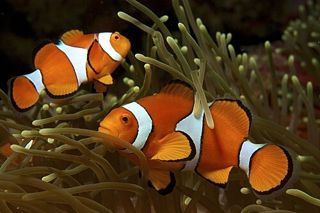 | Clownfish Amphiprioninae | 7–15 cm | Orange with white bars edged in black; lives in anemones | Indo-Pacific |
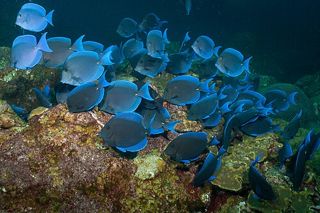 | Blue Tang Acanthurus coeruleus | 20–30 cm | Bright blue; yellow spine at tail base; juveniles are yellow | Atlantic / Caribbean |
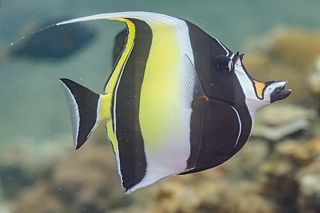 | Moorish Idol Zanclus cornutus | 15–20 cm | Black, white & yellow bands; extremely long dorsal filament | Indo-Pacific, Hawaii |
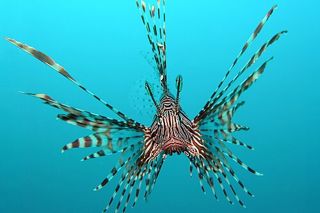 | Lionfish Pterois volitans | 25–38 cm | Red-white stripes; feathery pectoral fins; venomous spines | Indo-Pacific (invasive Atlantic) |
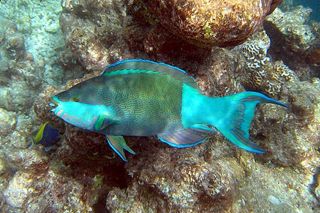 | Parrotfish Scarus spp. | 30–120 cm | Beak-like fused teeth; vivid blues, greens, pinks | Tropical worldwide |
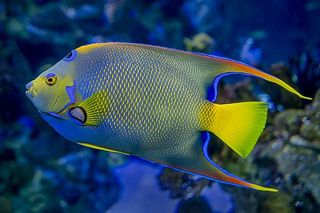 | Queen Angelfish Holacanthus ciliaris | 30–45 cm | Electric blue-yellow; blue crown spot on forehead | Caribbean |
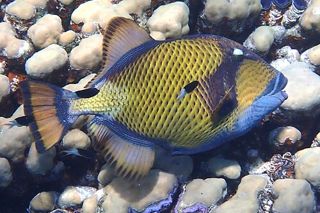 | Titan Triggerfish Balistoides viridescens | 50–75 cm | Mottled brown-green; large; will defend nest aggressively | Indo-Pacific |
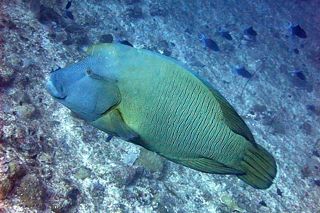 | Napoleon Wrasse Cheilinus undulatus | 60–230 cm | Distinctive forehead hump in adults; blue-green; endangered | Indo-Pacific |
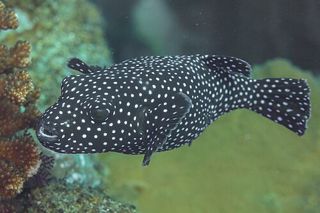 | Spotted Pufferfish Arothron meleagris | 30–50 cm | Dark brown covered in white spots; inflates when threatened | Indo-Pacific |
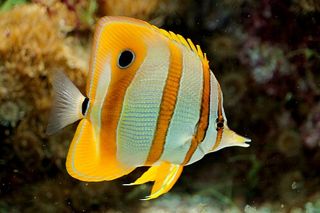 | Copperband Butterflyfish Chelmon rostratus | 15–20 cm | White with copper vertical bands; long pointed snout | Indo-Pacific |
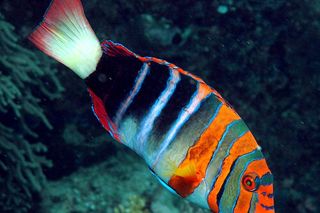 | Harlequin Tuskfish Choerodon fasciatus | 20–30 cm | Vivid blue, orange, and black banding; protruding blue tusk-like canines | W. Pacific, GBR |
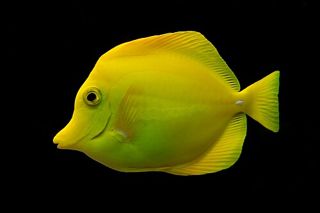 | Yellow Tang Zebrasoma flavescens | 10–20 cm | Solid lemon-yellow oval body; white scalpel spine at the tail base; tall dorsal and anal fins | Hawaii and Central Pacific |
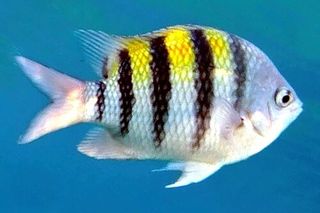 | Sergeant Major Abudefduf saxatilis | 10–20 cm | Silver-yellow with five bold black vertical bars; deep oval body; forked tail | Atlantic and Caribbean reefs; Indo-Pacific look-alike is A. vaigiensis |
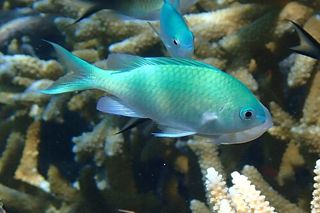 | Blue-green Chromis Chromis viridis | 5–8 cm | Small, uniform pale blue-green; forked tail; hovers in dense schools over branching coral | Indo-Pacific lagoons |
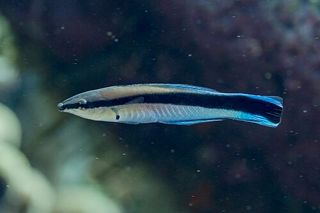 | Bluestreak Cleaner Wrasse Labroides dimidiatus | 8–12 cm | Slender; black stripe widening toward the tail on a blue-white body; runs cleaning stations | Indo-Pacific reefs |
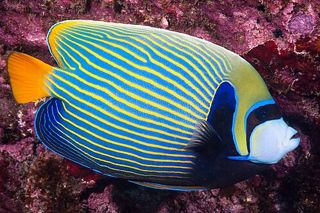 | Emperor Angelfish Pomacanthus imperator | 30–40 cm | Adults: yellow and blue diagonal stripes with a black eye mask; juveniles: dark blue with white concentric rings | Indo-Pacific and Red Sea |
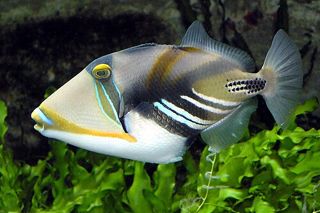 | Picasso Triggerfish Rhinecanthus aculeatus | 20–30 cm | Angular body; blue and black bands over the eye; black belly patch; yellow lip stripe | Indo-Pacific; Hawaii's humuhumunukunukuāpuaʻa |
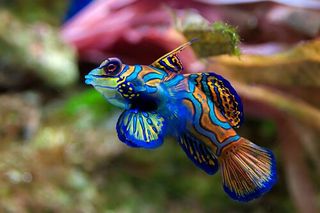 | Mandarinfish Synchiropus splendidus | 5–7 cm | Tiny; psychedelic orange and blue wavy stripes; broad fan-like pelvic fins; no scales | W. Pacific lagoons, rubble at dusk |
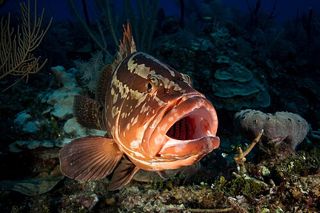 | Nassau Grouper Epinephelus striatus | 40–90 cm | Five dark bars on a tan body; black saddle on the tail base; dark tuning-fork mark on the forehead | Caribbean and W. Atlantic; endangered |
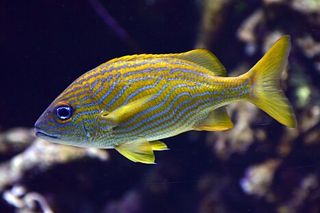 | French Grunt Haemulon flavolineatum | 15–30 cm | Yellow diagonal stripes on a silver-white body below the lateral line; yellow fins; schools under ledges by day | Caribbean and W. Atlantic |
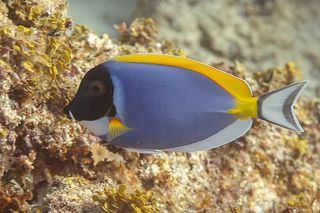 | Powder Blue Tang Acanthurus leucosternon | 15–23 cm | Powder-blue body, black face, yellow dorsal fin, white chest and pectoral base | Indian Ocean reefs |
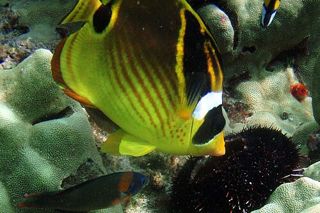 | Raccoon Butterflyfish Chaetodon lunula | 15–20 cm | Yellow-orange with a black "raccoon mask" across the eyes and a white band behind it; diagonal dark lines on the flank | Indo-Pacific |
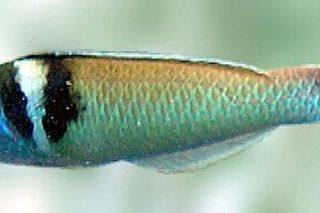 | Bluehead Wrasse Thalassoma bifasciatum | 8–15 cm | Terminal males: blue head, two black bars, green body; juveniles and females: yellow with a dark side stripe | Caribbean and W. Atlantic |
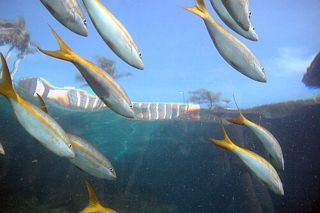 | Yellowtail Snapper Ocyurus chrysurus | 30–50 cm | Bright yellow stripe from snout to a deeply forked yellow tail; silver-blue body above the stripe | Caribbean and W. Atlantic; hovers above the reef |
Species photos are CC-licensed or public-domain images from Wikimedia Commons; see the full image credits for each file and its licence. All habitats are combined on the master fish identification chart.
Reef fish identification by family
Small (5–15 cm), territorial, often vivid. Sergeant majors show bars, chromis school over coral, clownfish live in anemones.
The most diverse reef family. Swim with the pectoral fins; terminal-phase males look nothing like females; cleaner wrasse run cleaning stations.
Oval body with a sharp scalpel spine at the tail base. Blue, yellow and powder blue tangs are the iconic species.
Like butterflyfish but with a prominent cheek spine. Juveniles often carry a completely different pattern from adults.
Thin, disc-shaped, pointed snout; many carry an eye-mask or false eye-spot. Most live in pairs and pick at coral polyps.
Triggerfish lock their first dorsal spine upright and can bite; puffers inflate and carry beak-like teeth.
Reef fish identification at depth
- Red disappears first. Below about 10 m a red fish looks grey or brown. Carry a light or shoot with a strobe to restore true colour.
- Yellow and blue survive longest. Tangs, angelfish and chromis are the easiest families to name without a light.
- Silhouette before colour. Disc = butterflyfish or angelfish; oval with a tail-base spine = tang; angular with a locking dorsal = triggerfish; cigar-shaped swimming with pectoral fins = wrasse.
- Behaviour is a trait. Cleaning stations mean cleaner wrasse; hovering schools over branching coral mean chromis; a fish defending a patch of algae is a damselfish.
Reef regions and their signature species
| Region | Signature Species | Why Distinctive |
|---|---|---|
| Great Barrier Reef | Napoleon (Maori) wrasse, potato grouper, clownfish | Strict no-take zones; fish are often less wary of divers |
| Red Sea | Masked pufferfish, Napoleon wrasse, Arabian Picasso triggerfish | High endemism — about 20% of species are found nowhere else |
| Caribbean | Queen angelfish, French grunt, Nassau grouper, bluehead wrasse | Atlantic fauna: no clownfish or tangs of the Indo-Pacific kind. See Caribbean fish identification |
| Coral Triangle | Mandarinfish, pygmy seahorse, wobbegong | Highest reef fish species richness on Earth |
| Hawaii | Picasso triggerfish (humuhumu), yellow tang, Moorish idol | About 25% endemism — many species occur only in Hawaiian waters |
Reef fish identification FAQ
Angelfish or butterflyfish?
Check the cheek. Angelfish carry a strong backward-pointing spine on the preopercle (the bone in front of the gill cover); butterflyfish do not. Butterflyfish are also smaller and thinner-bodied with a more pointed snout.
Why do reef fish look grey or brown at depth?
Water absorbs red light first, so below about 10 metres red and orange fish look grey or brown. Identify by silhouette and fin shape at depth and confirm colour with a dive light or a photo taken with a strobe.
Are juvenile reef fish on this chart?
Only where the juvenile is the form most people meet. Many reef species change completely with age — a blue tang starts yellow and an emperor angelfish juvenile wears white rings — so a juvenile that matches nothing is worth uploading to the identifier.
What if my fish is not on this chart?
Upload a clear photo to the AI fish identifier. It covers 866 species including most common Indo-Pacific and Caribbean reef fish and returns the top matches with a confidence score.