Caribbean Fish Identification Chart: 21 Species with Pictures
The Caribbean holds about 1,400 marine fish species, and its reefs belong to the Atlantic province, so almost nothing here overlaps with the Indo-Pacific. This Caribbean fish identification chart pairs a photo of each species you are most likely to meet snorkelling, diving or fishing from the Bahamas to Bonaire with the traits that separate it from its neighbours. Use the ID tips below when a fish is not on the chart, and the AI identifier when two rows still fit.
📷 Identify a Caribbean fish from a photoCaribbean fish identification chart with pictures
The chart runs from reef fish (angelfish, butterflyfish, tangs, parrotfish, wrasses, grunts, groupers, snappers) to the flats and offshore species that anglers target (tarpon, bonefish, permit, snook, mahi-mahi). Sizes are typical adult ranges.
| Photo | Species | Size Range | Key ID Traits | Where Found |
|---|---|---|---|---|
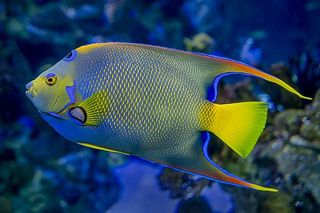 | Queen Angelfish Holacanthus ciliaris | 30–45 cm | Electric blue and yellow; blue-ringed black "crown" spot on the forehead; yellow tail | Reefs 5–40 m; usually in pairs |
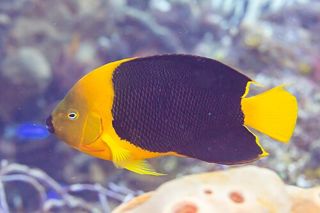 | Rock Beauty Holacanthus tricolor | 15–30 cm | Yellow head and tail, solid black body; juveniles yellow with a blue-ringed black spot | Reef ledges and sponges |
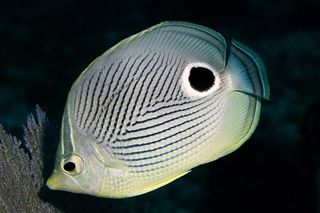 | Foureye Butterflyfish Chaetodon capistratus | 8–15 cm | Silver-grey with fine diagonal lines; large black eye-spot ringed in white near the tail | Shallow reefs; almost always in pairs |
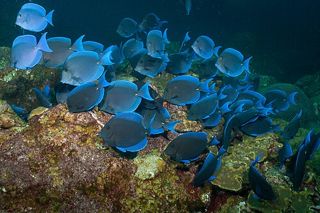 | Blue Tang Acanthurus coeruleus | 20–30 cm | Adults deep blue with a yellow tail-base spine; juveniles bright yellow | Reef tops in loose schools |
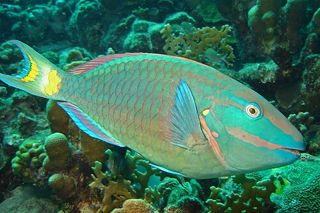 | Stoplight Parrotfish Sparisoma viride | 30–55 cm | Terminal males green with pink-orange face lines and a yellow tail spot; initial phase red-brown with white scale rows | Reefs and seagrass; sand producer |
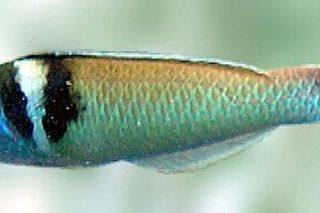 | Bluehead Wrasse Thalassoma bifasciatum | 8–15 cm | Terminal males: blue head, two black bars, green body; most fish are yellow with a dark side stripe | Every shallow Caribbean reef |
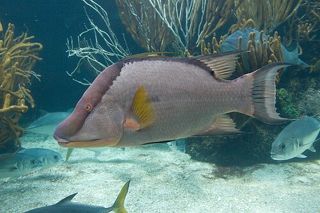 | Hogfish Lachnolaimus maximus | 40–90 cm | Long pig-like snout; first three dorsal spines drawn out into filaments; pink-white, dark patch on the tail base | Reef and hard bottom; Keys and Bahamas |
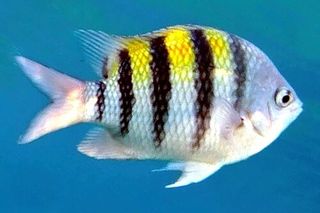 | Sergeant Major Abudefduf saxatilis | 10–20 cm | Silver-yellow with five bold black bars; nesting males turn dark blue | Reef crests, pilings, shallow water |
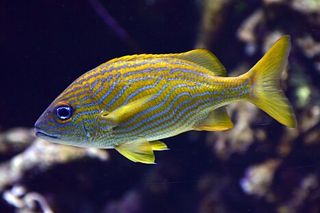 | French Grunt Haemulon flavolineatum | 15–30 cm | Yellow diagonal stripes on a silver body; yellow fins; schools under ledges by day | Shallow reefs and mangroves |
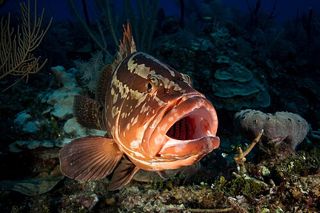 | Nassau Grouper Epinephelus striatus | 40–90 cm | Five dark bars, black saddle on the tail base, tuning-fork mark on the forehead; can pale or darken in seconds | Reef ledges; endangered, protected in most of the region |
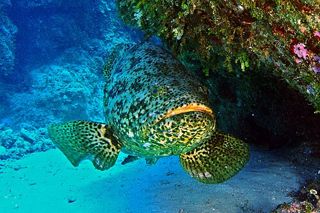 | Grouper (Goliath) Epinephelus itajara | 100–250 cm | Huge, brown-olive with small dark spots and faint bars; rounded fins | Wrecks, ledges, mangroves; Florida and Caribbean |
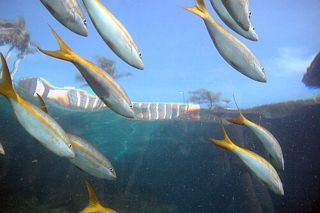 | Yellowtail Snapper Ocyurus chrysurus | 30–50 cm | Yellow mid-line stripe running into a deeply forked yellow tail; blue-silver back | Hovers above the reef; common in the Keys |
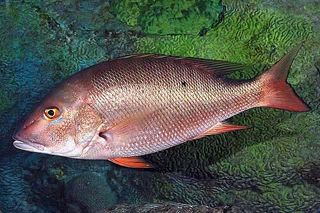 | Mutton Snapper Lutjanus analis | 40–80 cm | Olive-pink with a small black spot below the rear dorsal; blue lines on the cheek; pointed anal fin | Reefs, flats and sand; Bahamas and Florida |
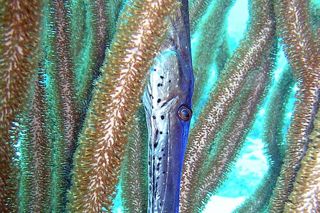 | Trumpetfish Aulostomus maculatus | 40–80 cm | Very long, thin body with a tube snout; brown, yellow or blue-grey; hangs vertically among sea rods | Reefs and gorgonian fields |
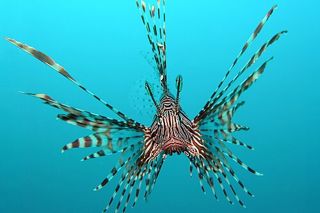 | Lionfish Pterois volitans | 25–38 cm | Red-white stripes, feathery pectoral fins, venomous spines; Indo-Pacific invader | Now on every Caribbean reef |
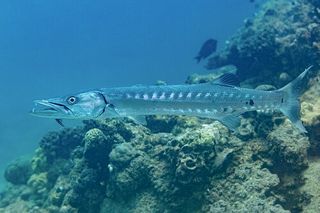 | Barracuda Sphyraena barracuda | 60–200 cm | Long cylindrical silver body with dark blotches on the flank; fang-like teeth | Reef edges, flats, under boats |
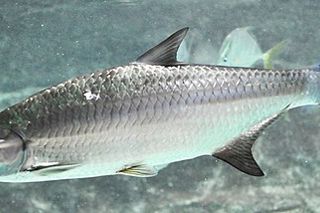 | Tarpon Megalops atlanticus | 100–250 cm | Huge silver scales, upturned mouth, long last dorsal ray | Flats, channels, harbours |
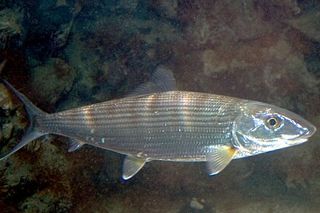 | Bonefish Albula vulpes | 40–90 cm | Slender silver with faint dark bars; inferior (downward) mouth; deeply forked tail | Shallow sand and grass flats |
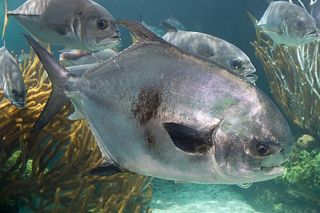 | Permit Trachinotus falcatus | 45–110 cm | Deep body, sickle-shaped dorsal and anal lobes, black-edged tail; orange belly tint | Flats and wrecks |
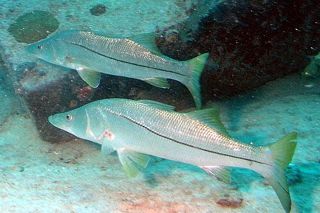 | Snook Centropomus undecimalis | 40–140 cm | Bold black lateral line, protruding lower jaw, silver-green | Mangroves, river mouths, beaches |
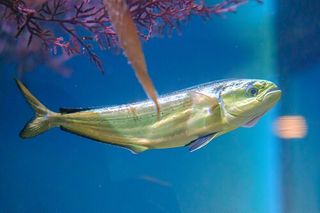 | Mahi-Mahi Coryphaena hippurus | 60–150 cm | Blue-green and gold with blue spots; males have a blunt forehead; long dorsal fin | Offshore, weed lines |
Species photos are CC-licensed or public-domain images from Wikimedia Commons; see the full image credits for each file and its licence. Indo-Pacific reef species are on the reef fish identification chart; Florida-specific species on Florida fish identification.
What makes Caribbean fish identification different
- No clownfish, one tang. Anemonefish are absent from the Atlantic. The blue tang is the only common Caribbean surgeonfish, and its juveniles are yellow.
- Atlantic-only groupers and snappers. Nassau grouper, goliath grouper, coney, graysby, yellowtail, mutton and schoolmaster snapper occur nowhere else.
- Wrasse and parrotfish change with age and sex. Bluehead wrasse and stoplight parrotfish have an initial phase and a terminal (male) phase that look like different species; the chart shows both where they are commonly seen.
- Invasive lionfish. Red lionfish from the Indo-Pacific have spread across the whole region since the 1980s and are now one of the most frequently seen reef fish.
Caribbean fish ID tips for snorkellers and divers
| Look At | What It Tells You | Example |
|---|---|---|
| Tail shape | Deeply forked = snapper, jack, bonefish; rounded = grouper, hogfish; truncate = angelfish, butterflyfish | Yellowtail snapper vs. Nassau grouper |
| Schooling or solitary | Grunts, snappers and sergeant majors school; groupers, trumpetfish and hogfish are solitary | French grunt vs. Nassau grouper |
| Reef zone | Parrotfish and tangs on shallow coral heads; angelfish mid-water near sponges; groupers under ledges | Blue tang vs. queen angelfish |
| Eye-spot or mask | A ringed spot near the tail = foureye butterflyfish; crown spot on the forehead = queen angelfish | Foureye vs. banded butterflyfish |
| Snout | Pig-like snout with dorsal filaments = hogfish; tube snout = trumpetfish; upturned mouth = tarpon | Hogfish vs. grouper |
Caribbean regions and what you will see
Shallow flats for bonefish, permit and tarpon; patch reefs with hogfish, mutton and yellowtail snapper. See Florida fish identification.
Wall diving: queen and French angelfish, rock beauty, Nassau grouper on ledges, eagle rays and schools of grunts.
Shore-diving reefs with dense sergeant majors, bluehead wrasse, stoplight parrotfish, trumpetfish and many lionfish.
Mangrove and reef mix: snook, mangrove snapper, tarpon in channels, plus the standard reef community.
Caribbean fish identification FAQ
What fish will I see snorkelling in the Caribbean?
On almost any shallow Caribbean reef you will meet sergeant majors, bluehead wrasse, French grunts, blue tangs, stoplight parrotfish and foureye butterflyfish within the first few minutes, with yellowtail snapper hovering above the coral and a barracuda watching from the edge.
Are there clownfish or tangs in the Caribbean?
No clownfish: anemonefish are Indo-Pacific only. The Caribbean has one common tang, the blue tang (Acanthurus coeruleus), which is a different species from the Pacific blue tang seen in films.
Is the lionfish native to the Caribbean?
No. The red lionfish is an Indo-Pacific species released in Florida in the 1980s and now found on every Caribbean reef. It is edible and many islands run culling programmes.
What if my fish is not on this chart?
Upload a clear photo to the AI fish identifier. It covers 866 species including the common Atlantic reef fauna and returns the top matches with a confidence score.