Fish Identification Chart with Pictures: 40 Species by Habitat
A visual fish identification chart you can scan in seconds: a photo of each species next to its size range, the two or three traits that separate it from look-alikes, and where it lives. Filter the chart by saltwater, freshwater or reef, or jump to the deeper habitat charts below. If you already have a photo, the AI identifier on our home page can match it against 866 species.
📷 Identify a fish from a photo insteadHow to use this fish identification chart
1. Pick the habitat first. Use the All / Saltwater / Freshwater / Reef buttons above the chart. Habitat rules out more species than any single body feature, so it is the fastest first cut.
2. Compare the picture, then the traits. Colour photos are the quickest match, but colour changes with age, sex, water and death (a mahi-mahi fades in minutes). The Key ID Traits column lists shape, fin and marking features that do not change.
3. Check size and range. A fish outside its normal size range or thousands of miles from its distribution is usually a different species that looks similar.
4. Still torn between two rows? Upload the photo to the AI fish identifier and it returns the top matches with a confidence score.
Deeper charts by habitat
Interactive fish identification chart: 40 species with pictures
| Photo | Species | Habitat | Size Range | Key ID Traits | Distribution |
|---|---|---|---|---|---|
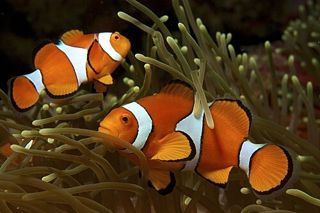 | Clownfish Amphiprioninae | 🐠 Reef | 7–15 cm | Orange with white bars edged in black; lives in anemones | Indo-Pacific |
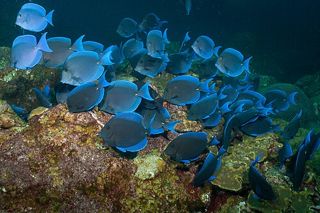 | Blue Tang Acanthurus coeruleus | 🐠 Reef | 20–30 cm | Bright blue; yellow spine at tail base; juveniles are yellow | Atlantic / Caribbean |
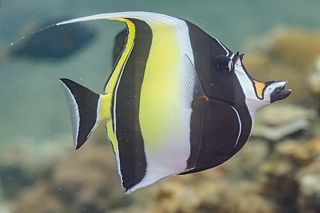 | Moorish Idol Zanclus cornutus | 🐠 Reef | 15–20 cm | Black, white & yellow bands; extremely long dorsal filament | Indo-Pacific, Hawaii |
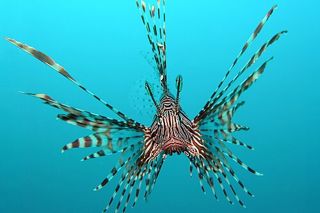 | Lionfish Pterois volitans | 🐠 Reef | 25–38 cm | Red-white stripes; feathery pectoral fins; venomous spines | Indo-Pacific (invasive Atlantic) |
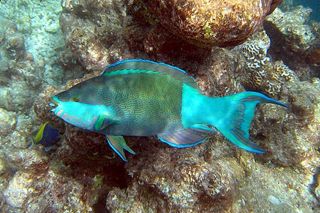 | Parrotfish Scarus spp. | 🐠 Reef | 30–120 cm | Beak-like fused teeth; vivid blues, greens, pinks | Tropical worldwide |
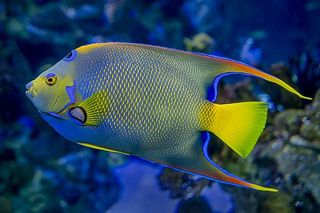 | Queen Angelfish Holacanthus ciliaris | 🐠 Reef | 30–45 cm | Electric blue-yellow; blue crown spot on forehead | Caribbean |
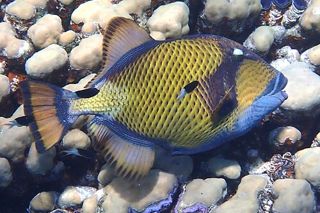 | Titan Triggerfish Balistoides viridescens | 🐠 Reef | 50–75 cm | Mottled brown-green; large; will defend nest aggressively | Indo-Pacific |
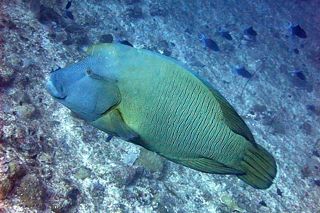 | Napoleon Wrasse Cheilinus undulatus | 🐠 Reef | 60–230 cm | Distinctive forehead hump in adults; blue-green; endangered | Indo-Pacific |
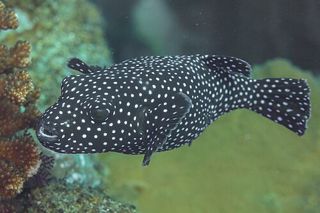 | Spotted Pufferfish Arothron meleagris | 🐠 Reef | 30–50 cm | Dark brown covered in white spots; inflates when threatened | Indo-Pacific |
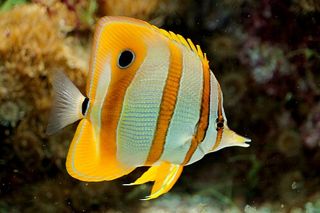 | Copperband Butterflyfish Chelmon rostratus | 🐠 Reef | 15–20 cm | White with copper vertical bands; long pointed snout | Indo-Pacific |
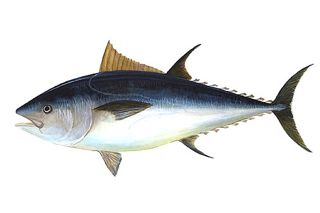 | Atlantic Bluefin Tuna Thunnus thynnus | 🌊 Saltwater | 100–300 cm | Steel-blue back; silver belly; short pectoral fins; crescent tail | N. Atlantic, Mediterranean |
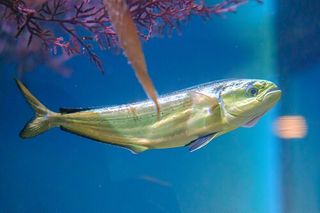 | Mahi-Mahi Coryphaena hippurus | 🌊 Saltwater | 60–150 cm | Vivid blue-green-gold; blunt forehead in males; rapidly fades after death | Tropical worldwide |
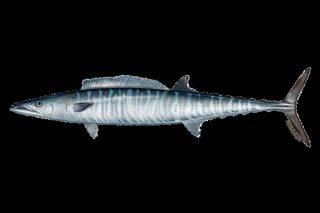 | Wahoo Acanthocybium solandri | 🌊 Saltwater | 100–210 cm | Elongated; blue-grey with faint vertical bars; knife-like teeth | Tropical worldwide |
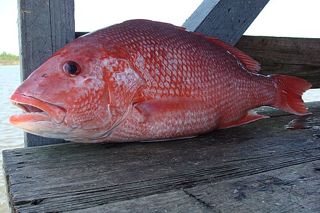 | Red Snapper Lutjanus campechanus | 🌊 Saltwater | 40–100 cm | Rose-red; pointed anal fin; large eye with red iris | W. Atlantic, Gulf of Mexico |
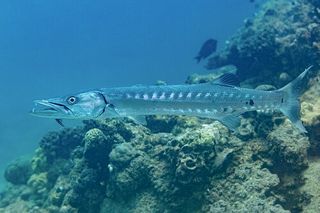 | Barracuda Sphyraena barracuda | 🌊 Saltwater | 60–200 cm | Long cylindrical; silver with dark blotches; fang-like teeth | Tropical worldwide |
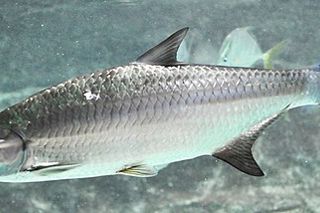 | Tarpon Megalops atlanticus | 🌊 Saltwater | 100–250 cm | Very large silver scales; upturned mouth; bony gular plate | Atlantic, Caribbean |
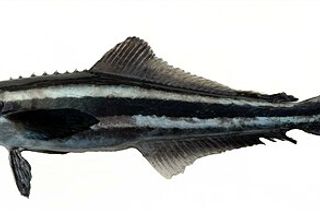 | Cobia Rachycentron canadum | 🌊 Saltwater | 60–200 cm | Dark brown; white belly; distinct lateral stripe; flat head | Atlantic, Indo-Pacific |
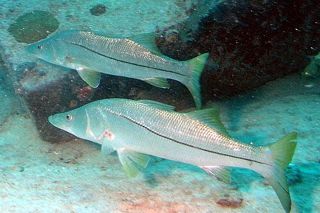 | Snook Centropomus undecimalis | 🌊 Saltwater | 40–140 cm | Prominent black lateral line; protruding lower jaw; silver | Tropical Atlantic |
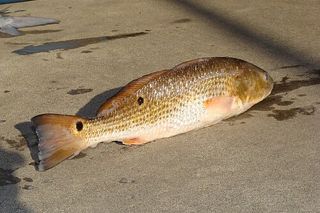 | Redfish (Red Drum) Sciaenops ocellatus | 🌊 Saltwater | 40–160 cm | Copper-bronze; one or more black spots at tail base | W. Atlantic, Gulf of Mexico |
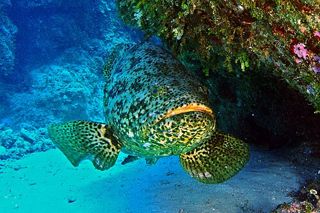 | Grouper (Goliath) Epinephelus itajara | 🌊 Saltwater | 100–250 cm | Brownish with dark spots; massive; can exceed 400 kg | Atlantic, E. Pacific |
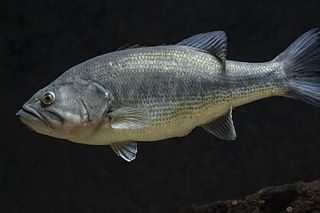 | Largemouth Bass Micropterus salmoides | 🏞 Freshwater | 25–75 cm | Dark lateral stripe; jaw extends past rear of eye | N. America (introduced worldwide) |
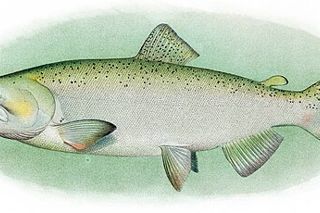 | Chinook Salmon Oncorhynchus tshawytscha | 🏞 Freshwater | 60–150 cm | Black spots on back and both tail lobes; black gum line | N. Pacific, introduced elsewhere |
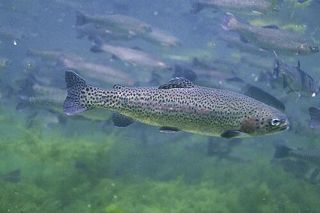 | Rainbow Trout Oncorhynchus mykiss | 🏞 Freshwater | 20–120 cm | Pink lateral stripe; black spots on body and fins | N. America, introduced worldwide |
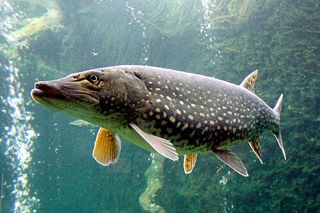 | Northern Pike Esox lucius | 🏞 Freshwater | 40–150 cm | Long body; duck-like snout; light bean-shaped spots on dark green | N. America, Europe, Asia |
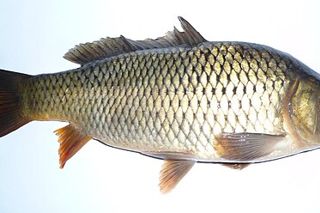 | Common Carp Cyprinus carpio | 🏞 Freshwater | 30–120 cm | Bronzy-gold; two pairs of barbels; large scales; dorsal spine | Worldwide (introduced) |
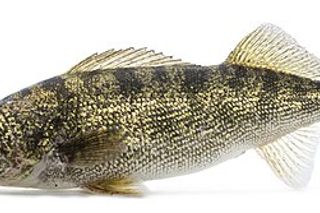 | Walleye Sander vitreus | 🏞 Freshwater | 35–90 cm | Glassy opaque eyes (tapetum lucidum); olive-gold; white tail tip | N. America |
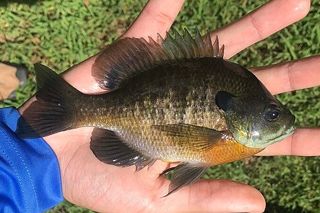 | Bluegill Lepomis macrochirus | 🏞 Freshwater | 10–30 cm | Deep blue-black ear flap; vertical bars; orange breast in males | N. America (introduced elsewhere) |
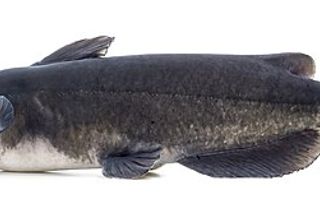 | Channel Catfish Ictalurus punctatus | 🏞 Freshwater | 30–100 cm | Deeply forked tail; scattered dark spots; long barbels | N. America |
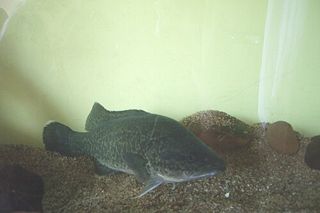 | Murray Cod Maccullochella peelii | 🏞 Freshwater | 50–180 cm | Green with dark blotches; large mouth; Australia's largest freshwater fish | SE Australia |
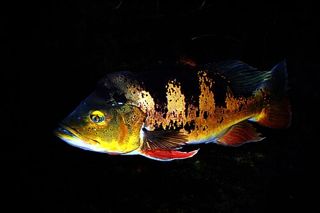 | Peacock Bass Cichla ocellaris | 🏞 Freshwater | 30–75 cm | Gold-green with three dark vertical bars; distinctive ocellus (eye-spot) at tail | S. America (introduced Florida) |
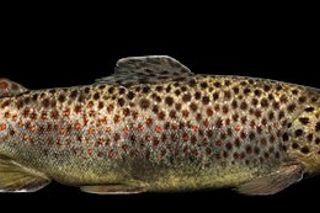 | Brown Trout Salmo trutta | 🏞 Freshwater | 25–100 cm | Brown with black and red spots; red spots often with pale halos | Europe (introduced worldwide) |
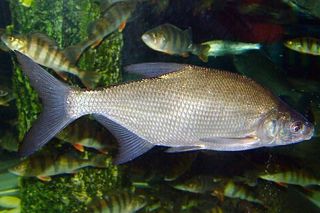 | Bream (Abramis) Abramis brama | 🏞 Freshwater | 20–60 cm | Deep, laterally compressed; bronze-silver; long anal fin | Europe |
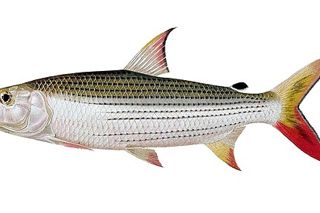 | Tigerfish Hydrocynus vittatus | 🏞 Freshwater | 40–100 cm | Silver with dark horizontal stripes; large, interlocking fang-like teeth | Sub-Saharan Africa |
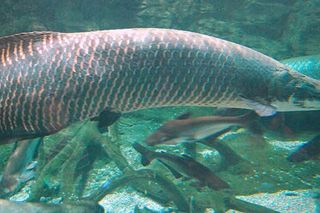 | Arapaima Arapaima gigas | 🏞 Freshwater | 100–300 cm | Massive; dark grey-green with red-orange accents near tail; must breathe air | Amazon basin |
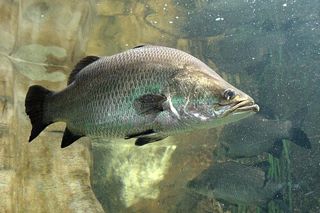 | Barramundi Lates calcarifer | 🏞 Freshwater | 40–180 cm | Silver-white; large concave tail; steep head profile; red eye | Australia, SE Asia |
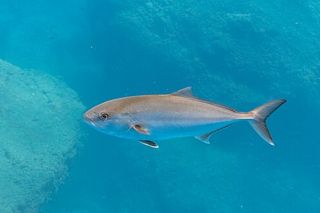 | Amberjack Seriola dumerili | 🌊 Saltwater | 60–200 cm | Amber lateral stripe from eye to tail; dark dorsal, silver sides | Tropical/subtropical worldwide |
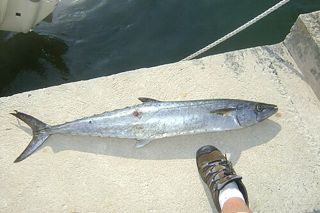 | King Mackerel Scomberomorus cavalla | 🌊 Saltwater | 50–185 cm | Silver; lateral line dips sharply at mid-body; iridescent green back | W. Atlantic, Gulf of Mexico |
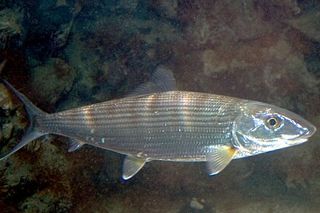 | Bonefish Albula vulpes | 🌊 Saltwater | 40–90 cm | Extremely silvery; almost transparent; pointed snout; tails in shallow flats | Tropical worldwide |
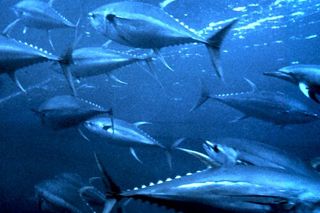 | Yellowfin Tuna Thunnus albacares | 🌊 Saltwater | 80–200 cm | Bright yellow fins and finlets; streamlined; deeply forked tail | Tropical worldwide |
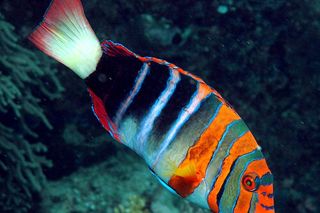 | Harlequin Tuskfish Choerodon fasciatus | 🐠 Reef | 20–30 cm | Vivid blue, orange, and black banding; protruding blue tusk-like canines | W. Pacific, GBR |
Species photos are CC-licensed or public-domain images from Wikimedia Commons; see the full image credits for each file and its licence.
Reading the chart when a fish does not match
Most misidentifications on a chart come from three things. Juveniles often wear different colours from adults (a blue tang starts life bright yellow). Regional forms of the same species vary, so treat the picture as a typical example, not a template. And dead fish lose colour: if you are identifying a catch on the dock, lean on body shape, fin shape, tooth pattern and lateral-line markings rather than hue. When two rows still fit, the AI identifier compares hundreds of features at once and is the quicker tie-breaker.
Fish identification chart FAQ
Does this chart cover aquarium fish?
This master chart is built around commonly caught and commonly seen wild species. For tank fish, the FishCare AI species database covers 250+ aquarium species with care parameters, and the photo identifier recognises both wild and aquarium fish.
Can I print the fish identification chart?
Yes. Pick a habitat filter, then print the page; the table keeps its photo, species, size and traits columns on paper. For a pocket reference on a boat, the freshwater and saltwater charts are shorter and print on fewer pages.
Which is more reliable, a chart or an AI identifier?
They answer different questions. A chart teaches you what to look at and works with no signal. The AI identifier is faster and better at separating close look-alikes, but it needs a clear side-on photo. Use the chart to narrow, the identifier to confirm.