Salmon Identification Chart: 7 Species with Pictures
Seven salmon and steelhead share the same body plan, and in the ocean they are all silver. This salmon identification chart pairs a photo of each species with the features that hold up in hand: gum colour, where the spots sit, tail shape, anal-fin ray count and the colour each species turns at spawning. Use the comparison table below when two rows still fit, and the AI identifier when you only have a photo.
📷 Identify a salmon from a photoSalmon identification chart with pictures
The five Pacific salmon (Chinook, Coho, Sockeye, Pink, Chum), the one Atlantic salmon and steelhead. Max sizes are record-class; a typical adult is a third to a half of that.
| Photo | Species | Max Size | Key ID Traits | Range |
|---|---|---|---|---|
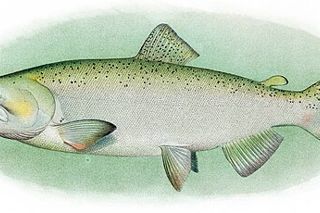 | Chinook Salmon Oncorhynchus tshawytscha | up to 58 kg / 150 cm | Black gums at the base of the teeth; large black spots on the back and on both tail lobes; silver-blue; 13–19 anal fin rays | N. Pacific; Alaska to California, Great Lakes |
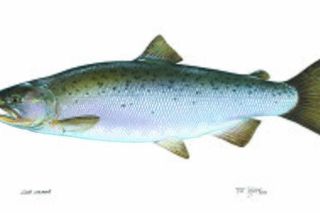 | Coho Salmon Oncorhynchus kisutch | up to 15 kg / 90 cm | White gums with a black tongue; small spots on the back and upper tail lobe only; silver tail wrist; spawning males turn red with a hooked jaw | N. Pacific; British Columbia to California |
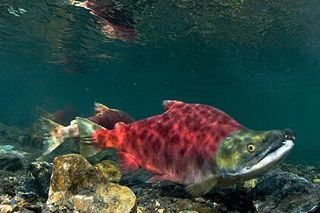 | Sockeye Salmon Oncorhynchus nerka | up to 7 kg / 80 cm | No distinct black spots; slender; large gold-flecked eye; spawning fish turn brilliant red with a green head | N. Pacific; Alaska, BC, Fraser and Columbia systems |
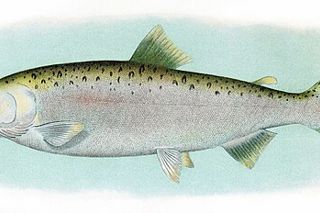 | Pink Salmon Oncorhynchus gorbuscha | up to 5 kg / 60 cm | Large oval black spots on the back and both tail lobes; very small scales; spawning males grow a pronounced hump | N. Pacific; odd-year runs in the south, every year in Alaska |
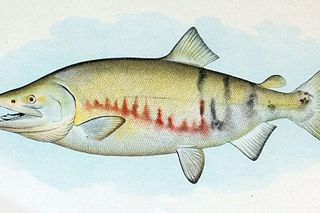 | Chum Salmon Oncorhynchus keta | up to 16 kg / 100 cm | No spots; faint grid pattern; white-tipped anal and pelvic fins; spawning fish show purple-red vertical "tiger stripes" | N. Pacific; Alaska to Oregon, Japan, Korea |
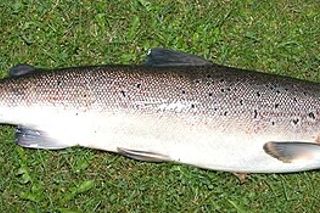 | Atlantic Salmon Salmo salar | up to 47 kg / 150 cm | X-shaped black spots above the lateral line, few below; slender tail wrist; no spots on the tail; survives spawning | N. Atlantic rivers; also farmed worldwide |
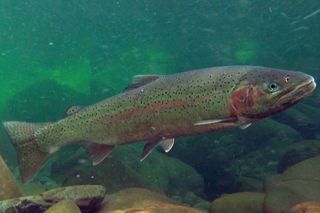 | Steelhead Oncorhynchus mykiss | up to 20 kg / 110 cm | Small black spots across the whole body, dorsal and tail; square tail; pink lateral band in spawning fish; sea-run rainbow trout | Pacific coast and Great Lakes tributaries |
Species photos are CC-licensed or public-domain images from Wikimedia Commons; see the full image credits for each file and its licence. Trout and other freshwater species are on the freshwater fish identification chart.
Salmon identification by gums, spots and tail
| Species | Gum Line | Spots | Tail | Anal Fin Rays | Spawning Colour |
|---|---|---|---|---|---|
| Chinook | Black | Back, dorsal, both tail lobes | Slightly forked, silver at base | 13–19 | Olive-brown to dark red |
| Coho | White (black tongue) | Back and upper tail lobe only | Slightly forked, silver wrist | 12–17 | Red sides, dark head, hooked jaw |
| Sockeye | White | None | Forked | 13–18 | Brilliant red body, green head |
| Pink | White | Large ovals on back and both lobes | Forked | 13–19 | Grey-green, humped back in males |
| Chum | White | None; faint grid | Forked, no spots | 13–17 | Purple and red vertical stripes |
| Atlantic | White | X-shaped above lateral line | Slightly forked, no spots | 8–11 | Bronze with red spots, kype in males |
| Steelhead | White | Small, all over body and tail | Square | 8–12 | Pink-red lateral band |
Anal fin rays are the most reliable check on a fish in hand: Pacific salmon have 13 or more, Atlantic salmon and steelhead 12 or fewer. The adipose fin, the small fleshy fin between the dorsal and the tail, is present on all of them and separates salmon from shad, herring and most other silver fish.
Salmon identification: Atlantic vs Pacific
Atlantic salmon (Salmo salar) is the only salmon in the genus Salmo. It can survive spawning and return to the sea several times, which is why a bright fish in a river may carry healed scars. It is the salmon farmed worldwide, so a fish sold as "salmon" with no species name is almost always Atlantic.
Pacific salmon (genus Oncorhynchus) all die after their first spawn. Chinook and Coho are the two anglers most often confuse; Sockeye and Chum are the two with no spots; Pink is the smallest and runs on a two-year cycle. Steelhead belongs to the same genus and, like Atlantic salmon, can spawn more than once.
Salmon identification FAQ
How do I tell a Chinook from a Coho?
Open the mouth. A Chinook has a black gum line at the base of its teeth; a Coho has white gums (only the tongue is dark). Chinook also carry spots on both tail lobes, Coho on the upper lobe only.
Which salmon has no spots?
Sockeye and chum. Sockeye are slender with a large eye and turn red with a green head at spawning; chum show a faint grid pattern and white-tipped anal and pelvic fins, and develop purple tiger stripes.
Is steelhead a salmon?
Biologically it is a sea-run rainbow trout, but it is managed and fished like a salmon and is usually included on salmon identification charts. Unlike Pacific salmon it can survive spawning and return to the sea.
What if my fish is not on this chart?
Upload a clear side-on photo to the AI fish identifier. It recognises all seven salmon and steelhead as well as the trout and char they are confused with, and returns the top matches with a confidence score.