Freshwater Fish Identification Chart: 33 Common Species with Pictures
This freshwater fish identification chart puts a photo of each species next to the traits that actually separate it from its look-alikes: jaw length on the two black basses, spot pattern on pike versus muskie, barbels on carp versus goldfish. Scan the chart first, then use the body-shape and fin key below when a fish does not match cleanly. If you have a photo, the AI identifier can check it against 866 species in seconds.
📷 Identify a freshwater fish from a photoFreshwater fish identification chart with pictures
Species are grouped roughly by family: black bass and sunfish, salmon and trout, pike, carp and minnows, catfish, perch and pike-perch, then the "living fossils" (sturgeon, gar, bowfin) that anglers most often cannot name. Sizes are typical adult ranges; record fish run larger.
| Photo | Species | Size Range | Key ID Traits | Where Found |
|---|---|---|---|---|
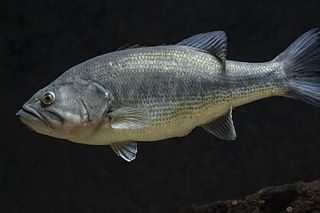 | Largemouth Bass Micropterus salmoides | 25–75 cm | Dark lateral stripe; jaw extends past rear of eye | N. America (introduced worldwide) |
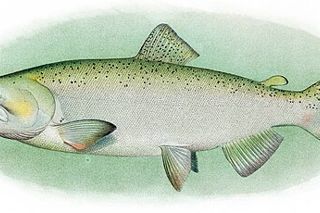 | Chinook Salmon Oncorhynchus tshawytscha | 60–150 cm | Black spots on back and both tail lobes; black gum line | N. Pacific, introduced elsewhere |
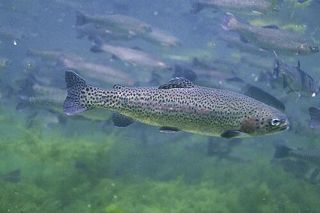 | Rainbow Trout Oncorhynchus mykiss | 20–120 cm | Pink lateral stripe; black spots on body and fins | N. America, introduced worldwide |
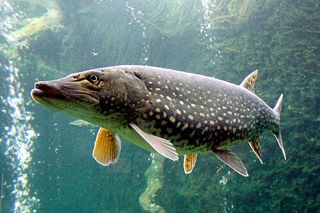 | Northern Pike Esox lucius | 40–150 cm | Long body; duck-like snout; light bean-shaped spots on dark green | N. America, Europe, Asia |
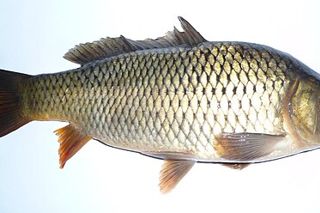 | Common Carp Cyprinus carpio | 30–120 cm | Bronzy-gold; two pairs of barbels; large scales; dorsal spine | Worldwide (introduced) |
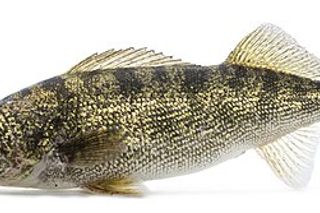 | Walleye Sander vitreus | 35–90 cm | Glassy opaque eyes (tapetum lucidum); olive-gold; white tail tip | N. America |
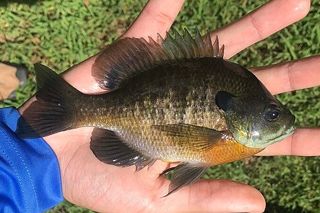 | Bluegill Lepomis macrochirus | 10–30 cm | Deep blue-black ear flap; vertical bars; orange breast in males | N. America (introduced elsewhere) |
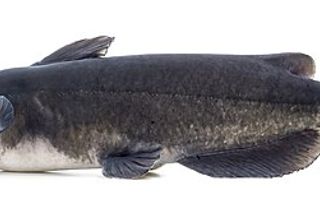 | Channel Catfish Ictalurus punctatus | 30–100 cm | Deeply forked tail; scattered dark spots; long barbels | N. America |
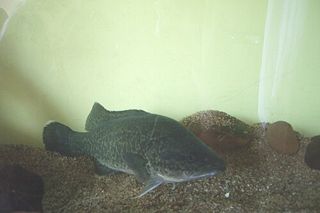 | Murray Cod Maccullochella peelii | 50–180 cm | Green with dark blotches; large mouth; Australia's largest freshwater fish | SE Australia |
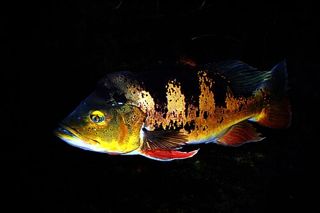 | Peacock Bass Cichla ocellaris | 30–75 cm | Gold-green with three dark vertical bars; distinctive ocellus (eye-spot) at tail | S. America (introduced Florida) |
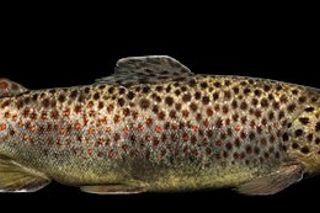 | Brown Trout Salmo trutta | 25–100 cm | Brown with black and red spots; red spots often with pale halos | Europe (introduced worldwide) |
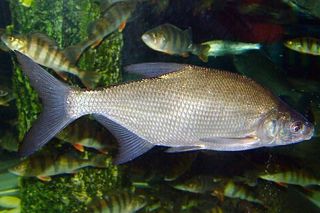 | Bream (Abramis) Abramis brama | 20–60 cm | Deep, laterally compressed; bronze-silver; long anal fin | Europe |
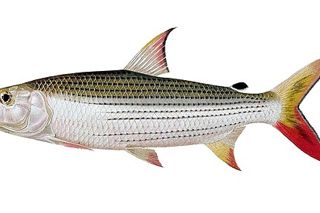 | Tigerfish Hydrocynus vittatus | 40–100 cm | Silver with dark horizontal stripes; large, interlocking fang-like teeth | Sub-Saharan Africa |
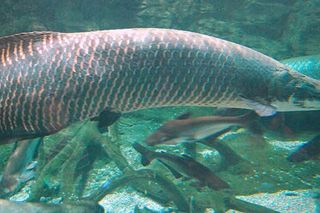 | Arapaima Arapaima gigas | 100–300 cm | Massive; dark grey-green with red-orange accents near tail; must breathe air | Amazon basin |
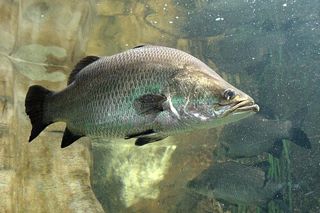 | Barramundi Lates calcarifer | 40–180 cm | Silver-white; large concave tail; steep head profile; red eye | Australia, SE Asia |
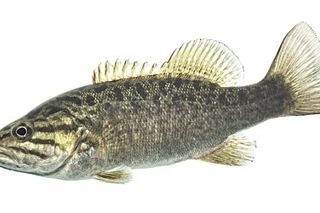 | Smallmouth Bass Micropterus dolomieu | 20–60 cm | Bronze-brown with vertical bars; jaw does not extend past the eye (largemouth's does); red-tinged eye | E. North America, rocky rivers and lakes |
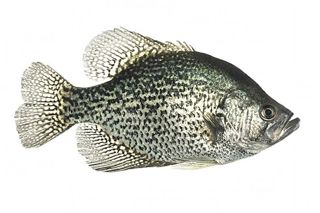 | Black Crappie Pomoxis nigromaculatus | 15–35 cm | Deep, laterally compressed; silver with irregular black speckles; 7–8 dorsal spines | North America, still water and weed beds |
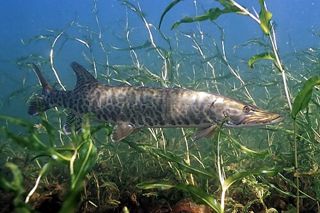 | Muskellunge Esox masquinongy | 70–150 cm | Pike-shaped but with dark bars or spots on a light body (pike is light spots on dark); pointed tail lobes | Great Lakes and St Lawrence region |
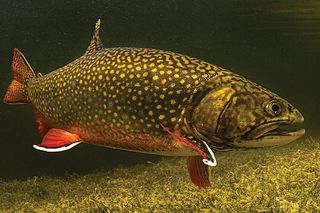 | Brook Trout Salvelinus fontinalis | 20–60 cm | Worm-like (vermiculate) markings on the back; red spots with blue halos; white leading edge on lower fins | E. North America, cold clear streams |
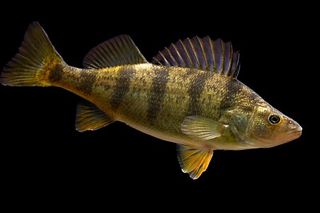 | Yellow Perch Perca flavescens | 15–35 cm | Golden-yellow with 6–8 dark vertical bars; two separate dorsal fins; orange lower fins | North America, lakes and slow rivers |
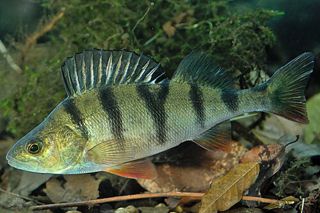 | European Perch Perca fluviatilis | 20–50 cm | Green-olive with 5–9 dark bars; spiny first dorsal with a black spot at the rear; bright red-orange pelvic and anal fins | Europe and N. Asia |
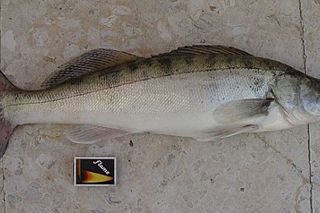 | Zander Sander lucioperca | 40–100 cm | Elongated pike-perch; faint bars; large glassy eye; canine teeth; two dorsal fins | Europe and W. Asia, turbid lakes and rivers |
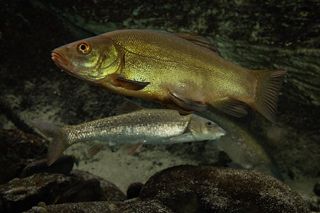 | Tench Tinca tinca | 30–70 cm | Olive-green, thick-set; very small scales; red-orange eye; two small barbels; rounded fins | Europe and W. Asia, still weedy water |
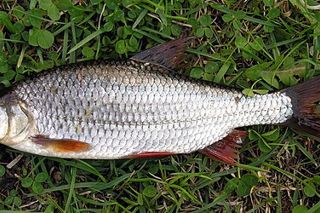 | Roach Rutilus rutilus | 15–40 cm | Silver with red-orange fins and a red iris; dorsal fin starts above the pelvic fins (rudd's starts behind) | Europe and W. Asia |
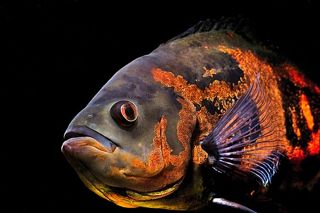 | Oscar Astronotus ocellatus | 25–45 cm | Oval, thick-lipped cichlid; dark body with orange blotches; black eye-spot ringed in orange at the tail base | Amazon and Orinoco basins; popular aquarium fish |
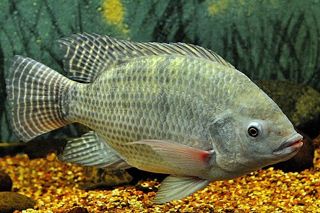 | Nile Tilapia Oreochromis niloticus | 30–60 cm | Deep-bodied, grey-silver; regular vertical bars on the tail fin; long continuous dorsal fin | Africa; farmed and introduced worldwide |
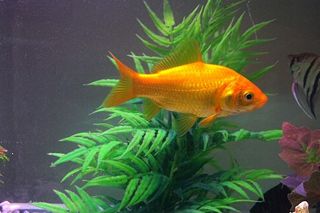 | Goldfish Carassius auratus | 10–40 cm | Orange, red, white or wild olive; no barbels (a carp has two pairs); deep body and forked tail | E. Asia; introduced globally, ponds and lakes |
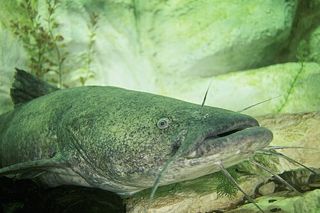 | Flathead Catfish Pylodictis olivaris | 40–120 cm | Flat, wide head; protruding lower jaw; mottled yellow-brown; tail only slightly notched, not forked | Mississippi and Gulf drainages |
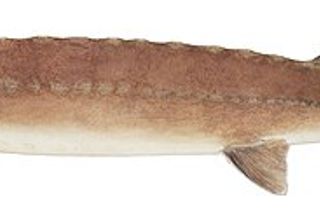 | Lake Sturgeon Acipenser fulvescens | 90–200 cm | Rows of bony plates (scutes) instead of scales; shark-like (heterocercal) tail; four barbels before a sucker mouth | Great Lakes, Mississippi and Hudson Bay drainages |
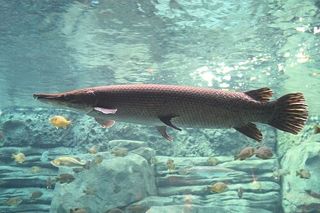 | Alligator Gar Atractosteus spatula | 150–250 cm | Broad alligator-like snout with two rows of upper teeth; armour of diamond-shaped ganoid scales; dorsal and anal fins set far back | S. United States, Gulf coast rivers |
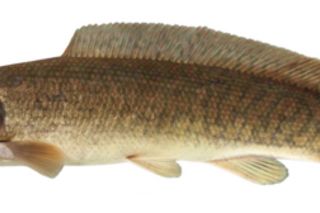 | Bowfin Amia calva | 40–80 cm | Long dorsal fin running most of the back; rounded tail; bony gular plate under the chin; males have a black tail spot | E. North America, swamps and backwaters |
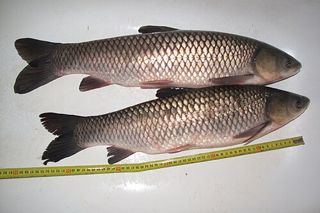 | Grass Carp Ctenopharyngodon idella | 60–130 cm | Torpedo-shaped, olive-silver; large scales with dark edges; no barbels; terminal mouth | E. Asia; stocked worldwide for weed control |
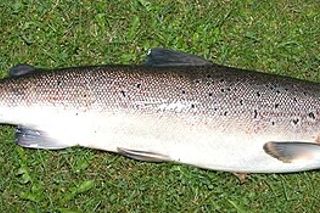 | Atlantic Salmon Salmo salar | 60–120 cm | Silver at sea, bronze in rivers; X-shaped black spots above the lateral line, few below; slender tail wrist | N. Atlantic rivers of Europe and N. America |
Species photos are CC-licensed or public-domain images from Wikimedia Commons; see the full image credits for each file and its licence. For saltwater and reef species, see the master fish identification chart.
Freshwater fish identification by body shape
Body shape is the fastest first filter when the chart does not give an instant match, because it reflects how the fish feeds and where it lives:
- Fusiform (streamlined): trout, salmon, bass, pike. Built for speed in open water or current.
- Laterally compressed (deep-bodied): sunfish, crappie, bluegill, perch, bream. Manoeuvrable in weedy or structured habitat.
- Depressed (flattened top-to-bottom): catfish, sturgeon. Bottom-dwelling; mouth usually positioned below the snout.
- Elongated (eel-like or pike-like): gar, bowfin, pike, muskellunge. Ambush predators in slow or shallow water.
- Oval, thick-lipped (cichlid): oscar, tilapia, peacock bass. Long single dorsal fin, often with an eye-spot near the tail.
Freshwater fish identification by fins
| Feature | What It Tells You | Example |
|---|---|---|
| Adipose fin | Small fleshy fin between dorsal and tail = salmonid, catfish or characin family | Trout, salmon, catfish, tigerfish |
| Two dorsal fins | Separate spiny and soft dorsals = perch family | Yellow perch, European perch, walleye, zander |
| One long dorsal with spines in front | Sunfish and cichlid families | Bluegill, crappie, largemouth bass, oscar |
| Dorsal set far back, near the tail | Ambush predator | Pike, muskellunge, gar |
| Barbels around the mouth | Bottom feeder; count them | Carp (2 pairs), tench (1 pair), catfish (4 pairs), sturgeon (4) |
| Tail shape | Forked = fast swimmer; rounded = slow water; heterocercal (shark-like) = sturgeon | Trout vs. bowfin vs. sturgeon |
| Jaw length | Upper jaw past the rear of the eye = largemouth; stops below the eye = smallmouth | Largemouth vs. smallmouth bass |
Common freshwater species by region
Largemouth and smallmouth bass, bluegill, crappie, walleye, northern pike, muskellunge, channel and flathead catfish, rainbow, brook and brown trout, lake sturgeon, alligator gar, bowfin
Common carp, tench, bream, roach, pike, European perch, zander, brown trout, grayling, Atlantic salmon (river runs)
Arapaima, peacock bass, oscar, payara, red-bellied piranha, giant catfish species, discus
Giant snakehead, mahseer, goonch catfish, grass carp, goldfish (wild form), Asian arowana, Siamese fighting fish
Murray cod, golden perch, silver perch, barramundi (enters freshwater), Australian lungfish
Nile perch, tigerfish, Nile tilapia, vundu catfish, African lungfish
Freshwater fish identification FAQ
How do I tell a largemouth bass from a smallmouth bass?
Close the mouth and look at the upper jaw. On a largemouth it reaches past the rear edge of the eye; on a smallmouth it stops below the eye. Smallmouth also show vertical bars and a bronze tone, while largemouth carry a dark horizontal stripe.
How do I tell a northern pike from a muskellunge?
Pike have light spots on a dark body; muskie have dark bars or spots on a light body. Pike tails are rounded at the lobe tips, muskie tails are pointed, and the muskie has fewer than six pores under each side of the jaw versus more on a pike.
Carp or goldfish?
Common carp have two pairs of barbels at the mouth; goldfish have none. Large wild goldfish are olive-bronze and are regularly mistaken for carp on that basis alone.
What if my fish is not on this chart?
Upload a clear side-on photo to the AI fish identifier. It is trained on 866 freshwater and saltwater species and returns the top matches with a confidence score, which is the fastest way to name a species that is regional or rarely caught.