Butterfly Fish Identification Chart: 13 Species with Pictures
There are more than 120 species in the family, and most of them are a variation on the same theme: a yellow-and-white disc with a black bar through the eye. This butterfly fish identification chart pairs a photo of each species divers and aquarists meet most with the one or two marks that make it unique: the eye-spot, the saddle, the banner, the snout. The family key below separates them from angelfish, and the care notes say which species survive in a tank.
📷 Identify one from a photoButterfly fish identification chart with pictures
Indo-Pacific species first, then the three Caribbean species. Sizes are adult totals; most are 12–20 cm.
| Photo | Species | Size Range | Key ID Traits | Range |
|---|---|---|---|---|
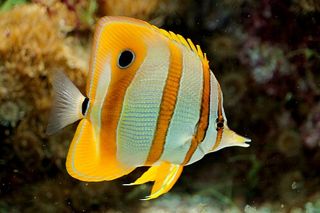 | Copperband Butterflyfish Chelmon rostratus | 15–20 cm | Long pointed snout; white body with copper-orange vertical bands; black eye-spot on the rear dorsal | Indo-Pacific; aquarium favourite |
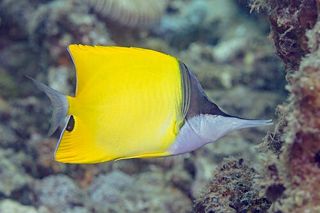 | Longnose Butterflyfish Forcipiger flavissimus | 15–22 cm | Extremely long tube snout; bright yellow body with a black cap over the eyes and a silver face | Indo-Pacific, Hawaii |
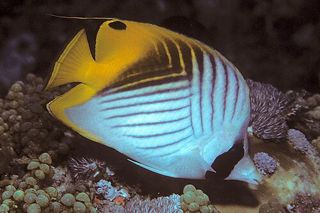 | Threadfin Butterflyfish Chaetodon auriga | 15–23 cm | White front, yellow rear with diagonal chevron lines; black eye bar; trailing filament on the dorsal fin | Indo-Pacific, Red Sea |
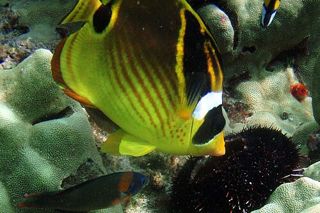 | Raccoon Butterflyfish Chaetodon lunula | 15–20 cm | Yellow-orange with a black eye mask and white band behind it; diagonal dark lines on the flank | Indo-Pacific |
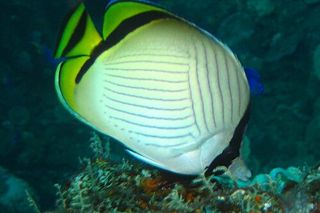 | Vagabond Butterflyfish Chaetodon vagabundus | 15–23 cm | White with two sets of diagonal lines meeting in a chevron; black eye bar and a black band across the rear body and tail | Indo-Pacific |
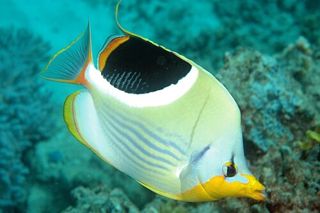 | Saddleback Butterflyfish Chaetodon ephippium | 20–30 cm | Large black saddle edged in white on the upper rear body; yellow snout and tail edge; blue lines on the belly | Indo-Pacific |
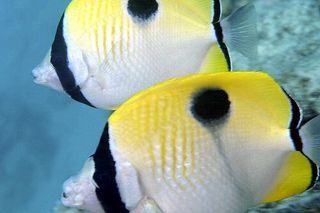 | Teardrop Butterflyfish Chaetodon unimaculatus | 15–20 cm | Yellow-white body with a large black teardrop spot on the upper flank; black eye bar | Indo-Pacific |
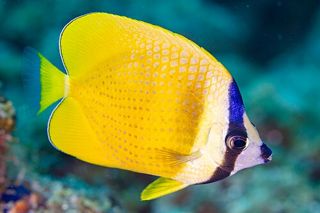 | Klein's Butterflyfish Chaetodon kleinii | 12–15 cm | Small; yellow-brown with two pale vertical bands and a dark eye bar; blue-grey snout | Indo-Pacific; hardy in aquariums |
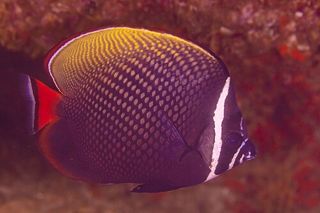 | Pakistani Butterflyfish Chaetodon collare | 15–18 cm | Dark brown with a white collar behind the head and a red-orange tail; scales edged in white | Indian Ocean and W. Pacific |
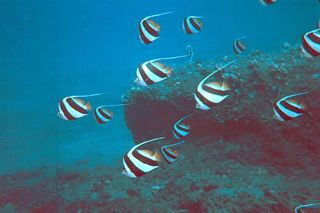 | Bannerfish Heniochus acuminatus | 20–25 cm | Two broad black bands on a white body; very long white dorsal banner; yellow rear fins | Indo-Pacific; often mistaken for the Moorish idol |
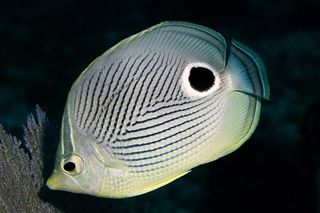 | Foureye Butterflyfish Chaetodon capistratus | 8–15 cm | Silver-grey with fine diagonal lines; large black eye-spot ringed in white near the tail; black eye bar | Caribbean and W. Atlantic |
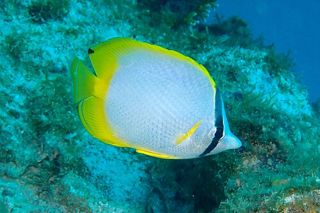 | Spotfin Butterflyfish Chaetodon ocellatus | 12–20 cm | White body with yellow fins; black eye bar; small black spot on the rear soft dorsal | Caribbean and W. Atlantic |
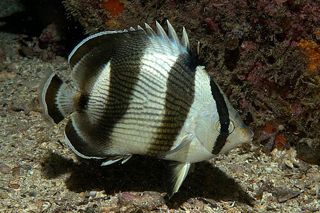 | Banded Butterflyfish Chaetodon striatus | 12–16 cm | White with three or four bold black vertical bands, one through the eye | Caribbean and W. Atlantic |
Species photos are CC-licensed or public-domain images from Wikimedia Commons; see the full image credits for each file and its licence. Other reef families: reef fish identification chart and parrot fish identification.
How to identify a butterfly fish
- Disc-shaped body. Strongly compressed sideways; nearly circular in profile, with a single continuous dorsal fin.
- Eye bar. Almost every species runs a dark vertical bar through the eye to hide it.
- Eye-spot (ocellus). Many carry a false eye near the tail or on the dorsal fin.
- Snout length. Short-snouted species graze polyps and algae; long-snouted species (copperband, longnose) pick invertebrates from crevices.
- No cheek spine. The single reliable difference from angelfish, which carry a spine on the preopercle. They also lack the angelfish's scale sheath at the base of the pelvic fins.
- Pairs. Most species live in monogamous pairs and are seen two at a time.
Butterfly fish aquarium care
| Species | Diet in Captivity | Verdict |
|---|---|---|
| Raccoon, Klein's, Pakistani, Vagabond, Threadfin | Accept frozen mysis, brine shrimp and pellets | Hardy; suitable for fish-only tanks of 55 gal+ (200 L) |
| Longnose, Copperband | Need live or frozen invertebrates; copperbands often refuse food | Demanding; experienced keepers only |
| Saddleback, Teardrop and most coral-feeding Chaetodon | Obligate coral polyp feeders | Rarely survive; leave on the reef |
| Bannerfish | Omnivore; takes most frozen foods | Hardy, but needs swimming room and a peaceful tank |
All of them need pristine water (nitrate under 20 ppm) and cannot be treated with copper-based medications. None are reef-safe with stony corals.
Butterfly fish identification FAQ
How do I tell one from an angelfish?
Check the cheek: angelfish have a strong backward-pointing spine on the preopercle (the bone in front of the gill cover); butterflyfish do not. They are smaller, thinner and more disc-shaped, usually with a black bar through the eye.
Why do so many species have an eye-spot near the tail?
The false eye-spot, combined with a black bar hiding the real eye, makes predators strike the wrong end. Foureye, teardrop and copperband butterflyfish all use it; it is also a useful ID feature.
Are they reef-safe in an aquarium?
Mostly no. Many Chaetodon species are obligate coral feeders and starve in captivity. Raccoon, Klein's, Pakistani and vagabond accept frozen mysis and brine shrimp and are the species to choose; copperbands are demanding; saddleback and most obligate coral feeders should be left on the reef. Give any of them at least 55 gallons (200 L) and pristine water.
What if my fish is not on this chart?
Upload a clear photo to the AI fish identifier. It covers the common Indo-Pacific and Atlantic species and returns the top matches with a confidence score.