Parrot Fish Identification Chart: 12 Species with Pictures
These beaked, technicolour grazers are found on every tropical reef, and they are also the reef fish most likely to be misnamed, because one species can wear two completely different colour phases. This parrot fish identification chart pairs a photo of each common species with the features that separate it: head shape, the pattern on the cheek and the tail-base spot. The family key below tells you how to recognise the family in the first place, and the AI identifier settles the rest.
📷 Identify one from a photoParrot fish identification chart with pictures
Caribbean species first, then the Indo-Pacific ones. Where a species has an initial (IP) and a terminal (TP) phase both are described; the photo shows the phase most often seen.
| Photo | Species | Size Range | Key ID Traits | Range |
|---|---|---|---|---|
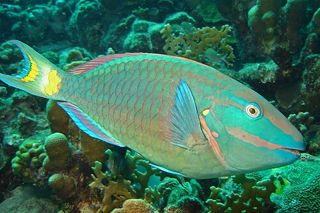 | Stoplight Parrotfish Sparisoma viride | 30–55 cm | Terminal males green with pink-orange lines on the face and a yellow spot on the tail base; initial phase red-brown with rows of white scale spots and a red belly | Caribbean, W. Atlantic |
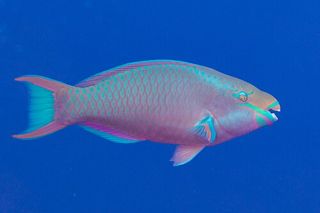 | Queen Parrotfish Scarus vetula | 30–60 cm | Terminal males blue-green with pink and yellow bands across the cheek; initial phase grey-brown with a broad white side stripe | Caribbean |
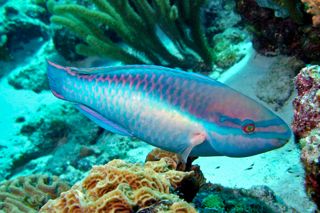 | Princess Parrotfish Scarus taeniopterus | 20–35 cm | Slender; terminal males blue-green with orange-yellow stripes on the head and a yellow patch on the flank; initial phase striped brown and white | Caribbean |
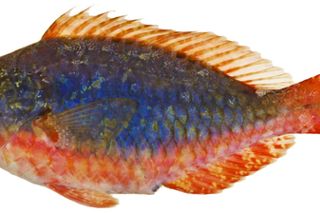 | Redband Parrotfish Sparisoma aurofrenatum | 15–28 cm | Small; orange-red band from mouth to gill cover; black-and-white saddle spot on the tail base in terminal males | Caribbean |
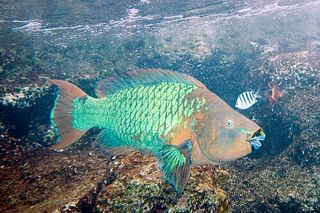 | Rainbow Parrotfish Scarus guacamaia | 60–120 cm | Largest Atlantic parrotfish; green body with orange-edged scales; orange-brown head; near threatened | Caribbean, mangroves as juveniles |
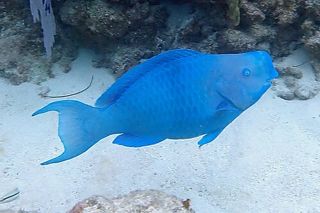 | Blue Parrotfish Scarus coeruleus | 30–120 cm | Uniform powder-blue at all sizes; adults develop a squared-off, humped snout | Caribbean, W. Atlantic |
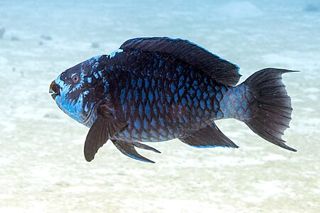 | Midnight Parrotfish Scarus coelestinus | 40–75 cm | Deep indigo-black with turquoise patches on the head and scale edges; blue beak | Caribbean, Bahamas |
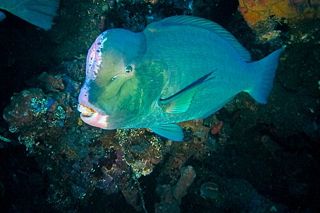 | Bumphead Parrotfish Bolbometopon muricatum | 70–130 cm | The largest parrotfish; huge bulbous forehead; grey-green body with a pink face; moves in herds and rams coral | Indo-Pacific and Red Sea |
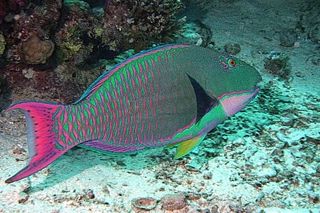 | Bicolor Parrotfish Cetoscarus bicolor | 50–90 cm | Juveniles white with an orange head band and a black eye-spot on the dorsal; terminal males green with pink scale edges and a pink-spotted head | Indo-Pacific, Red Sea |
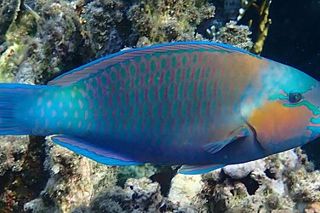 | Bullethead Parrotfish Chlorurus sordidus | 25–40 cm | Stocky bullet-shaped head; initial phase drab brown with a pale tail-base spot; terminal males green with a purple-blue cheek and orange face | Indo-Pacific, very common |
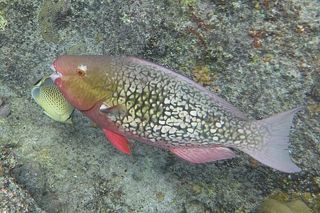 | Ember Parrotfish Scarus rubroviolaceus | 40–70 cm | Terminal males green with a deep purple-red rear half and a squared forehead; initial phase red-brown with fine dark lines | Indo-Pacific and E. Pacific |
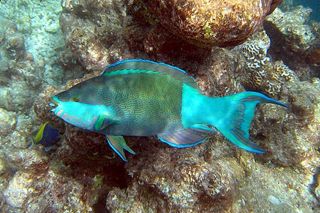 | Parrotfish Scarus frenatus | 30–45 cm | Bridled parrotfish: terminal males green with a blue-edged tail and a dark stripe behind the mouth; initial phase red-brown with faint stripes | Indo-Pacific |
Species photos are CC-licensed or public-domain images from Wikimedia Commons; see the full image credits for each file and its licence. Other reef species: reef fish identification chart and Caribbean fish identification.
How to identify a parrot fish
- Beak-like teeth. Fused dental plates that look like a parrot's beak: unique among reef fish. You can hear them scraping coral underwater.
- Large scales and a blunt head. Robust oval body, big cycloid scales, and in many species a steep or humped forehead.
- Two colour phases. Initial phase fish are red, brown or striped; terminal-phase males are green and blue with pink and orange face markings. Juveniles can be a third pattern.
- Pectoral-fin swimming. Like wrasses they row with the pectoral fins and use the tail only in bursts.
- Mucus cocoon at night. Many species sleep in a transparent bubble of mucus wedged in the reef, a behavioural clue divers see on night dives.
Parrot fish habitat and behaviour
They live on coral reefs, seagrass beds and rocky shallows throughout the tropics, with the highest diversity in the Indo-Pacific and about 15 species in the Caribbean. They are diurnal grazers that scrape algae and dead coral with the beak, grind it with pharyngeal teeth and excrete the coral as fine white sand; a single large fish can produce up to 90 kg of sand a year. Most are protogynous hermaphrodites: fish start life as females in the initial phase and the largest change sex into terminal-phase males that hold a territory and a harem. Bumphead parrotfish are the exception, moving in herds of dozens and ramming coral heads to break them.
Parrot fish identification FAQ
How do I know it is not a wrasse?
Look at the mouth: teeth fused into a solid beak, where wrasses have separate, often protruding teeth. They are also stockier with large scales and a blunt head, and they swim with the same pectoral-fin stroke as wrasses.
Why do fish of the same species look so different?
Most species have an initial phase (usually drab red-brown or striped, mostly females) and a terminal phase (bright green-blue males). One fish can pass through both; the chart lists both forms where they are commonly seen.
Can you eat them?
They are eaten in many regions but are increasingly protected, because their grazing keeps algae off coral. Large species like bumphead and rainbow parrotfish are threatened. Check local rules; some islands ban the take of the whole family.
What if my fish is not on this chart?
Upload a clear photo to the AI fish identifier. It covers the common Caribbean and Indo-Pacific species in both phases and returns the top matches with a confidence score.