The peacock spiny eel (Macrognathus siamensis), often shortened to peacock eel, is a burrowing peacock spiny eel from the river systems of mainland Southeast Asia.
FishBase records it from the Mekong, Chao Phraya and Maeklong basins and from river systems in peninsular and southeastern Thailand.[1] There it lives in heavily vegetated, slow stretches of river and swamp, spends most of the day buried in sand or silt with only its snout showing, and comes out at dusk to eat crustaceans, insect larvae and worms.[3] Despite the name it is not a true eel. Spiny eels are a separate family named for the row of short spines along the back.
This guide focuses on the three things buyers most often get wrong: how large the peacock eel grows, how it escapes, and what it will eat, including small tank mates.

Peacock Eel Size and Growth
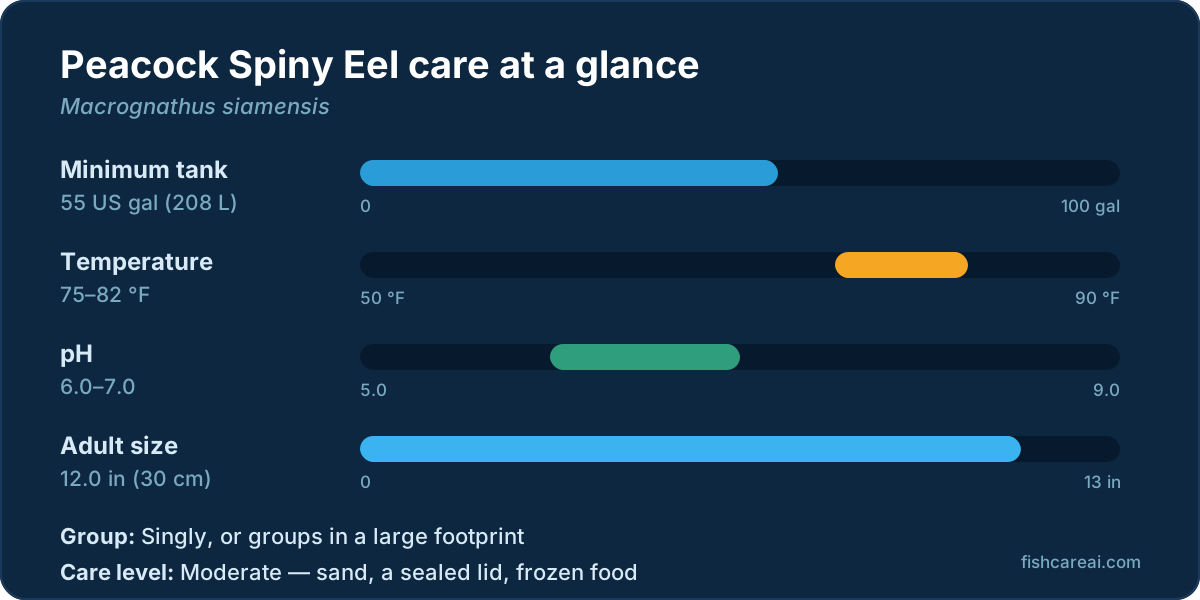
FishBase gives a maximum of 30 cm (about 12 in) standard length, measured without the tail fin. The Maidenhead Aquatics species file lists 32.5 cm (12.8 in).[1][3] Shops usually sell them at around 10 cm, so a new owner may see a fish one-third of its adult length. Growth is steady on a good frozen diet, and a well-kept eel lives for many years, so plan the tank around the adult.
Peacock Spiny Eel Tank Setup
Footprint matters much more than height for this bottom-dweller.[3] A 4-foot tank of about 55 gallons gives an adult enough length to move and burrow. Juveniles can start in something smaller, but they outgrow it quickly.
- Substrate: fine, soft sand deep enough to cover the whole body. Coarse or sharp gravel scrapes the skin when the eel burrows.[3]
- Décor: wood, smooth rock caves and PVC pipes. Large eels undermine décor, so set rocks on the bare glass before adding sand.[3]
- Lighting: dim, with floating plants. A blue night light lets you watch the eel when it is active.[3]
- Leaf litter: Indian almond leaves are appreciated, and should be replaced as they rot.[3]
- Lid: completely sealed, including cable and filter cut-outs. These are skilled escape artists.[3]
Water Parameters
Keep the water at 24–28 °C (75–82 °F), ideally soft and slightly acidic at pH 6.0–7.0 with hardness up to 15 dH.[3] Clean, well-filtered water is essential, but keep the flow gentle.[3] Spiny eels spend their lives in the substrate, where waste and uneaten food collect. Vacuum the sand surface regularly, and keep ammonia and nitrite at zero.[4]
What Peacock Spiny Eels Eat
This is a carnivore. Feed frozen bloodworm, white mosquito larvae, enriched brine shrimp and Daphnia, and offer larger eels mysis or finely chopped krill.[3] Dry foods are rarely accepted, although some individuals learn to take sinking pellets.[3]
Feed in the evening, when the eel is out of the sand. A feeding tube or a small dish on the bottom keeps food from being snatched by faster fish. In a busy community, a shy eel can slowly starve while its tank mates eat everything.
Tank Mates
These eels are not aggressive, but adults catch small fish at night. The Maidenhead Aquatics file specifically advises against neon-tetra-sized tank mates.[3] Suitable company includes large rasboras, large gouramis, rainbowfish, peaceful botiid loaches of decent size, Geophagus eartheaters and L-number plecos.[3] The same source describes the species as fairly sociable and suggests groups in large tanks. Make sure each eel has its own burrowing space.
Why You Should Never Release a Peacock Eel
Released aquarium peacock eels are now established in South Florida. A 2024 study in Biological Invasions used 15 years of electrofishing data from the Everglades' Shark River Estuary and found that their numbers had risen rapidly. In recent years, the catch of peacock eels exceeded the catch of all native sunfishes combined.[2] Abundance tracked warmer water and longer marsh flooding, and the authors warned that the eels' feeding could reduce the bottom-living prey that native food webs depend on.[2]
Sexing and Breeding
The sexes are difficult to tell apart, although mature females in breeding condition may look plumper. The species has not been bred in home aquaria.[3] Fish in the trade come from wild collection or from farms in Southeast Asia.
Peacock Spiny Eel FAQ
How big does a peacock eel get?
Is a peacock eel a real eel?
Will a peacock eel eat my fish?
Do peacock eels need sand?
Related Species
References
- Froese, R. & Pauly, D. (eds.). Macrognathus siamensis (Günther, 1861). FishBase, version 2025. fishbase.se
- Kahmann, G., Rehage, J. S., Massie, J. A., Nelson, J. A., Santos, R. O., Viadero, N. M., James, W. R., Boucek, R. E., Crane, D. P. & Rezek, R. J. (2024). Trophic niche of a nonnative invader and environmental drivers of its increasing populations in the coastal Everglades. Biological Invasions 26: 4245–4263. doi.org/10.1007/s10530-024-03444-w
- Maidenhead Aquatics. Peacock Spiny Eel — Macrognathus siamensis. FishKeeper species data bank. fishkeeper.co.uk
- Francis-Floyd, R., Watson, C., Petty, D. & Pouder, D. B. Ammonia in Aquatic Systems (FA16). University of Florida IFAS Extension. edis.ifas.ufl.edu