The badis (Badis badis), sold as the chameleon fish, is a small predator from the Ganges river system that can change colour within moments.
Its range runs from the Yamuna in Himachal Pradesh down the Ganges to its delta in Bangladesh, with records from Nepal, the Mahanadi system and parts of Assam.[2][1] It favours slow, often turbid water with submerged plants and is often found among water lilies.[2] The species was described by Hamilton only from notes and drawings, so in 2002 Kullander and Britz designated a neotype from West Bengal to fix its identity against similar-looking relatives.[2]
That 2002 revision split the family into many more species and created the genus Dario, which is why badid names in the trade are confusing.[2] This guide covers care for the chameleon fish and explains what you are actually buying when a shop sells a "black tiger badis".

Badis Tank Size and Setup
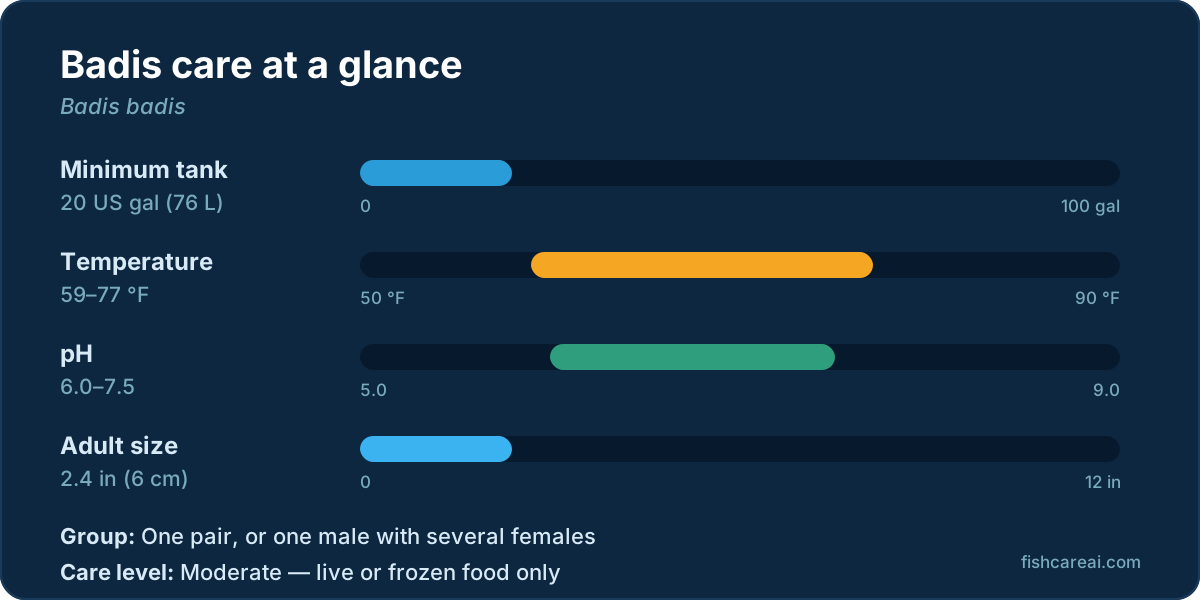
A pair or small group fits in a tank with a base of 80 × 30 cm (31 × 12 in) or more, about 70 litres.[2] Build a structured tank on a sand or fine gravel substrate with water-worn rocks and pebbles, driftwood twigs, floating plants and leaf litter. Filtration and lighting can be modest.[2]
Caves matter most. Males claim them as spawning sites, and breeders use half coconut shells or upturned clay pots with an entrance cut in.[2] Spread the caves across the tank rather than grouping them, so each male holds his own area and rivals rarely meet.[2]
Badis Water Parameters
Seriously Fish gives 15–25 °C (59–77 °F), pH 6.0–7.5 and 3–15 dGH. FishBase records a wider tolerance of 14–30 °C.[1][2] Many people keep this species warmer than it prefers by putting it in a standard 80 °F tropical community tank. A room-temperature tank in the low to mid 70s °F is closer to its natural conditions, and it may not need a heater at all.
What Badis Eat
Badids are micropredators that eat small crustaceans, worms, insect larvae and zooplankton. In aquaria they often refuse dried food entirely.[2] Offer small frozen or live foods such as brine shrimp, Daphnia and glassworm.[2] Seriously Fish gives one specific warning: all badids tend to become obese and more disease-prone when fed bloodworm (chironomid larvae) or Tubifex, so leave both out of the diet.[2]
They are shy, deliberate feeders. In a tank with fast eaters they lose out, which is the main reason they do best in a species tank or with very calm company.
Badis Tank Mates and Behaviour
This is a slow, retiring fish that larger or pushier species easily intimidate or outcompete for food.[2] Do not keep it with territorial bottom-dwellers unless the tank is very large, and never mix it with other Badis species, which may hybridise.[2] Cherry and other Neocaridina or Caridina shrimp may be eaten.[2]
It is not a schooling fish. Rival males can be aggressive towards each other in a small tank, so buy one pair or one male with several females. In larger tanks a group works, provided each male can hold a territory.[2] Small, peaceful midwater fish such as chili rasboras or celestial pearl danios can share the tank if feeding is managed.
What Is a Black Tiger Badis?
The fish sold as "black tiger badis" or "black tiger dario" is not a form of Badis badis. For years it was treated as a colour variant of the flame red dwarf species, Dario hysginon, from northern Myanmar.[4] Aquarists noticed that the two would not interbreed. In 2022 Britz, Kullander and Rüber described it as a separate species, Dario tigris, from mountain streams south of Mogaung in the Ayeyarwaddy basin.[3][4]
| <em>Badis badis</em> | Black tiger, <em>Dario tigris</em> | |
|---|---|---|
| Adult size | About 6 cm SL[2] | Miniature; Dario species usually under 25 mm[2] |
| Pattern | Changeable; dark cleithral spot above the pectoral fin[2] | Eight vertical bars (two ash-grey, six orange-red in males) plus rows of small black spots on the head and nape[3] |
| Females | Smaller, duller, no blue in fins[2] | Spotted nape like males, unlike striped D. hysginon females[4] |
| Origin | Ganges basin, India | Northern Myanmar, Kachin State[3] |
Dario tigris is far smaller than the chameleon fish and needs a small, densely planted tank, tiny live foods, and no competition from larger fish. It is a different care project. Importers note that frightened D. tigris and D. hysginon look alike, so mixed shipments do happen.[4] Buy coloured-up fish, and check that the females have the spotted nape.
Sexing and Breeding Badis
Females are smaller, rounder and duller, with no blue in the fins. Mature males develop longer dorsal, anal and tail fins.[2] Badis are cave spawners that form temporary pair bonds.[2]
- Breeding males darken almost to black, their fins turn bright blue, and they court females passing their caves. Males often lock jaws with a female and pull her towards the cave.[2]
- A willing female enters and lays a typical clutch of 30–100 eggs. The male then chases her out and guards and fans the brood alone.[2]
- Eggs hatch in two to three days, and the fry become free-swimming at six to eight days old.[2]
- About a week later the fry leave the cave, and the adults, including the father, may start to eat them. Move the fry to a rearing tank and feed microworms, then brine shrimp nauplii.[2]
Badis FAQ
Why is it called the chameleon fish?
Is the black tiger badis the same as the chameleon fish?
Will a chameleon fish eat flakes?
Can it live with shrimp?
Related Species
Care, breeding and identification details for the chameleon fish follow Seriously Fish's profile, which reflects Kullander and Britz's 2002 revision. Tolerance ranges are cross-checked with FishBase.[1][2] The black tiger section is based on the 2022 Zootaxa description of Dario tigris and an importer's notes on telling it apart in shipments.[3][4]
References
- Froese, R. & Pauly, D. (eds.). Badis badis (Hamilton, 1822). FishBase, version 2025. fishbase.se
- Seriously Fish. Badis badis (Badis). Species profile. seriouslyfish.com
- Britz, R., Kullander, S. O. & Rüber, L. (2022). Dario tigris and Dario melanogrammus, two new species of miniature chameleon fishes from northern Myanmar (Teleostei: Badidae). Zootaxa 5138: 1–16. doi.org/10.11646/zootaxa.5138.1.1
- Schäfer, F. (2022). Dario tigris – the "Black Tiger" was scientifically described. Aquarium Glaser fish archive. aquariumglaser.de